
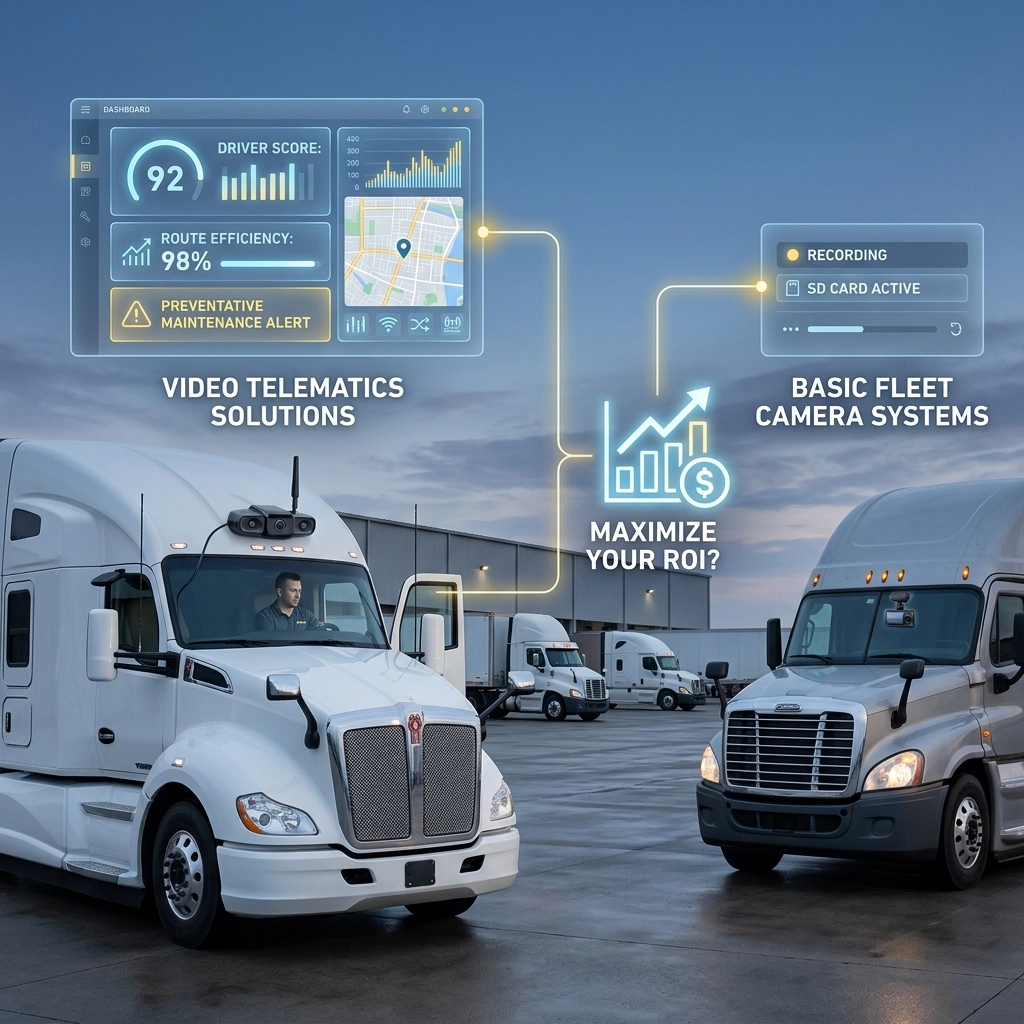
Video Telematics vs. Basic Fleet Cameras: Maximizing ROI
For fleet owners and operations managers, the decision to install cameras is no longer a question of “if,” but “which kind?” The market is flooded with options ranging from $50 retail dash cams to enterprise-grade video telematics solutions. At first glance, the price gap can be jarring. However, viewing this technology as a simple hardware purchase is a mistake that often leads to missed savings and increased liability.
The real debate isn’t about the upfront cost of the hardware; it’s about the total return on investment (ROI). While fleet camera systems provide a basic record of events, a truck camera system with GPS and integrated AI acts as a proactive business tool. Understanding the functional and financial differences between these two tiers is essential for protecting your bottom line in an era of rising insurance premiums and nuclear verdicts.
Defining the Two Tiers: Recording vs. Intelligence
To understand the ROI, you must first distinguish between a passive recording device and an active telematics platform.
Basic Fleet Camera Systems
A basic system typically consists of a standalone dash cam that records video to a local SD card. These units are often “reactive.” If an accident occurs, a manager must physically go to the truck, retrieve the SD card, and search through hours of footage to find the relevant clip. While these systems are better than having no video at all, they offer no real-time connectivity, no driver coaching tools, and no integration with vehicle data.
Video Telematics Solutions
In contrast, video telematics solutions represent the convergence of video, GPS tracking, and artificial intelligence. These systems do not just record; they analyze. An AI-enhanced dash camera monitors driver behavior, road conditions, and vehicle performance simultaneously. Key footage is automatically uploaded to the cloud, categorized, and linked to specific GPS data points.

1. Accident Prevention: The Proactive ROI
The most significant drain on a fleet’s ROI is the cost of accidents. Beyond the immediate repair bills, accidents lead to increased insurance premiums, vehicle downtime, and potential legal fees.
Basic fleet camera systems provide evidence after a crash, which can help with exoneration. However, they do nothing to prevent the crash from happening in the first place. Video telematics solutions utilize Edge AI to detect risky behaviors such as tailgating, distracted driving, and drowsiness.
When the system detects a driver looking at a phone or following too closely, it provides an immediate in-cab alert. This “virtual co-pilot” allows the driver to correct their behavior in seconds, potentially avoiding a multi-thousand-dollar collision. Statistics consistently show that fleets using AI-enabled video telematics see a 40% to 60% reduction in total accidents within the first year of implementation.
2. Exoneration and the “Nuclear Verdict” Shield
In the legal world, a “nuclear verdict” refers to a jury award that exceeds $10 million. These are becoming increasingly common in the trucking industry. When a commercial vehicle is involved in an accident, the assumption of guilt often falls on the professional driver unless proven otherwise.
A truck camera system with GPS and video telematics provides the “context” that basic cameras lack. It doesn’t just show the impact; it shows the vehicle’s exact speed, braking force, and location leading up to the event. This data is transmitted instantly to the cloud, ensuring that footage cannot be “lost” or “corrupted” on an SD card.
Having instant access to high-definition video allows fleet managers to exonerate their drivers on the spot. Faster claim resolution prevents small incidents from ballooning into massive legal battles. For many fleets, a single exoneration in a major accident provides enough ROI to pay for the entire system across the whole fleet for several years.
Learn more about how cameras defend against nuclear verdicts.

3. Operational Efficiency and Asset Tracking
A basic camera system is a siloed tool. It tells you about the “view,” but it doesn’t tell you about the “journey.” Modern video telematics solutions integrate the camera into the broader GPS infrastructure of the business.
When you invest in a truck camera system with GPS, you gain visibility into:
- Route Optimization: Identifying where drivers are getting stuck or taking inefficient detours.
- Idling Costs: Excessive idling burns fuel and wears out engines. Telematics can flag these events and link them to video to see if the driver is using the truck as a climate-controlled lounge.
- Maintenance Needs: Harsh driving behaviors like aggressive cornering or hard braking put immense stress on tires and brakes. By coaching these behaviors out of your fleet, you extend the life of your assets.
This holistic view ensures that your fleet is running at peak efficiency, turning a safety tool into an operational asset.

4. Reducing the Administrative Burden
One of the hidden costs of basic fleet camera systems is the labor required to manage them. If you have 50 trucks and a “manual” camera system, your safety officer could spend dozens of hours every week pulling SD cards, looking for “near-misses,” and trying to match video files with driver logs.
Video telematics automates this entire process. The system uses AI to “flag” only the most important clips. Instead of watching 40 hours of mundane driving, a manager receives a daily summary of the three most critical events. These clips are pre-sorted and ready for a coaching session. This efficiency allows a single safety manager to oversee a much larger fleet without losing oversight quality.
Discover how AI supports fleet managers rather than replacing them.
5. Insurance Premiums and Fleet Health
Insurance companies are increasingly moving toward “usage-based” or “safety-based” pricing models. A fleet that can provide documented evidence of a formal coaching program, declining “harsh event” scores, and 100% video coverage is a much lower risk to an underwriter.
While a basic camera might get you a small discount or help in a claim, a comprehensive video telematics platform helps you negotiate from a position of power. It shows that your company has a “culture of safety.” Over time, the reduction in claims and the improvement in driver scores lead to lower premiums that directly impact your ROI.

Comparing the Cost-Benefit: A 12-Month Outlook
To truly see which is better for your ROI, look at the projected costs and savings over a one-year period for a typical 20-truck fleet.
| Feature | Basic Fleet Camera Systems | Video Telematics Solutions |
|---|---|---|
| Upfront Hardware Cost | Low | Moderate to High |
| Monthly Subscription | None to Low | Required |
| Accident Reduction | Minimal | 40% – 60% |
| Exoneration Speed | Slow (Manual retrieval) | Instant (Cloud upload) |
| Driver Coaching | Reactive/Manual | Automated/Data-driven |
| Fuel & Maintenance | No Impact | 5% – 15% Savings |
| Typical Payback Period | 18 – 24 Months | 6 – 12 Months |
While the monthly subscription of a video telematics platform is an added expense, the savings generated from fuel, maintenance, and accident prevention far outweigh the cost. Most fleets find that the system pays for itself within the first year of operation.
Choosing the Right Path for Your Fleet
The decision ultimately depends on your fleet’s goals. If you are a small owner-operator with one or two trucks and you only care about having evidence after a fender-bender, a basic camera might suffice for the short term.
However, for any growing business, a truck camera system with GPS and full video telematics is the only way to scale safely. The ability to monitor your fleet in real-time, coach drivers based on objective data, and protect your company from catastrophic legal settlements makes video telematics the superior financial choice.
At Safety Track, we specialize in helping fleets move from reactive recording to proactive management. Our systems are designed to integrate seamlessly into your operations, providing the clarity you need to protect your drivers and your profits.

Conclusion: The Future is Connected
The era of “set it and forget it” dash cams is coming to an end. As road density increases and legal risks grow, the value of data-driven safety cannot be overstated. Investing in video telematics solutions is an investment in the long-term viability of your business. By focusing on prevention rather than just documentation, you ensure a higher ROI and a safer future for everyone on the road.
If you are ready to see how a custom-tailored telematics solution can transform your fleet’s performance, contact our team at Safety Track today for a personalized ROI analysis.

Tyler Schneider is the IT Director at Safety Track, overseeing the company’s technological infrastructure and innovations. With a strong background in information technology and systems management, Tyler ensures that Safety Track stays at the forefront of tech solutions in fleet management. His strategic expertise supports the seamless integration of technology across the company’s operations.