
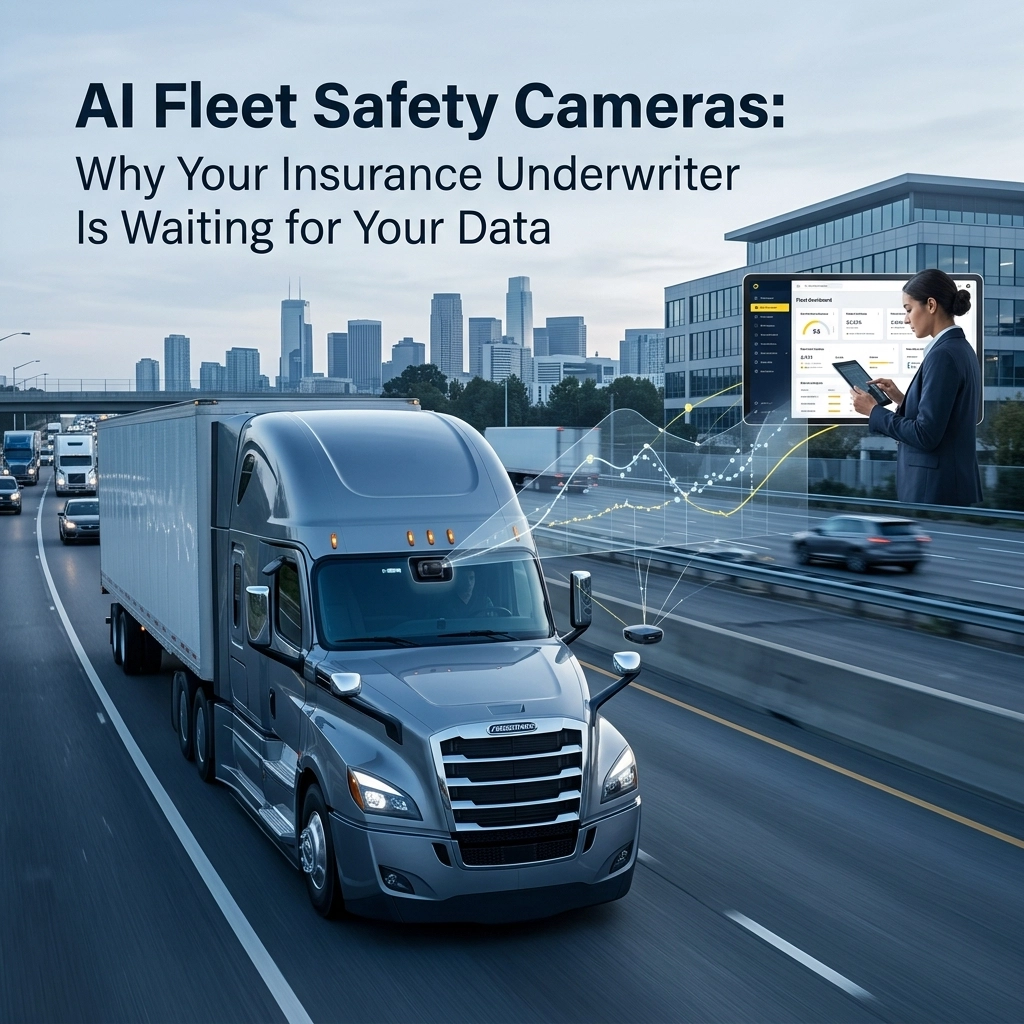
AI Fleet Safety Cameras: Why Your Insurance Underwriter Is Waiting for Your Data
For decades, commercial insurance underwriting was a “rear-view mirror” process. Underwriters looked at your past three to five years of loss runs, applied a few industry-wide actuarial tables, and handed you a premium. If you had a bad year, your rates went up. If you had a good year, they stayed relatively flat. But in the era of “nuclear verdicts” and rising litigation costs, that old model is breaking.
Today, insurance underwriters have quietly shifted how they evaluate fleet risk. They are no longer satisfied with knowing what happened yesterday; they want to know what is happening right now and how you are preventing what might happen tomorrow. Simply telling an underwriter that you have installed hardware is no longer enough to move the needle. What they are truly waiting for, and what can significantly impact your bottom line, is your data.
Specifically, they want clear, consistent evidence that your AI dash cameras for fleets are actively changing driver behavior and reducing the likelihood of a catastrophic claim.
The New Language of Risk: Video Telematics
In the current insurance climate, video telematics solutions have become the primary language of risk. Underwriters are facing a market where settlement costs are skyrocketing. A single major accident involving a US-model semi-truck can result in a payout that exceeds a fleet’s total premium contributions for a decade. To combat this, insurers are looking for “best-in-class” operators who utilize technology to de-risk their operations.
Why Underwriters Care About AI Camera Data
Underwriters price your policy based on expected future losses. They look at three specific pillars:
- Frequency: How often do you have accidents or “near-miss” incidents?
- Severity: When an accident happens, how much does it cost?
- Litigation Exposure: How easily can a plaintiff’s attorney turn a simple accident into a multi-million dollar judgment?
AI fleet safety cameras directly attack all three. When you share data showing a downward trend in harsh braking or distracted driving, you are proving that your frequency is dropping. When you provide video evidence that exonerates your driver in a side-swipe incident, you are reducing severity to zero. When you show a documented coaching log, you are demonstrating a “culture of safety” that makes your fleet a very difficult target for aggressive litigation.

What Your Underwriter Is Actually Looking For
When you sit down for a renewal meeting, your broker might mention that the underwriter is asking about your telematics. If you simply say, “Yes, we have cameras,” you are leaving money on the table. To secure the best rates and terms, you need to provide a structured data package.
1. Normalized Event Trends
Raw numbers don’t tell the whole story. Telling an underwriter you had 50 harsh braking events last month means nothing without context. Instead, underwriters look for “normalized” data: events per 10,000 miles or per driving hour.
A high-performing fleet can show a report like this: “In Q1, we averaged 4.2 distracted driving alerts per 10,000 miles. By Q3, following the implementation of our AI dash camera coaching program, that number dropped to 1.1.” This trend line is exactly what an underwriter needs to justify a lower risk rating.
2. Distracted Driving Mitigation
Distracted driving is the leading cause of modern fleet accidents. AI-enhanced cameras can detect if a driver is looking at a phone, eating, or showing signs of fatigue. Underwriters are particularly interested in these metrics because they are highly “preventable.” If your data shows that your drivers are consistently attentive, you are viewed as a much safer bet than a fleet without that visibility.
3. Proof of an Active Safety Program
Insurers no longer reward “passive” technology. If a camera is on the windshield but no one is looking at the alerts, the risk hasn’t actually decreased. Underwriters want to see:
- How often managers review safety events.
- The percentage of “critical” events that resulted in a documented coaching session.
- The improvement in a driver’s individual safety score after coaching.
Using fleet safety cameras as a training tool rather than just a recording device is what separates a “standard” risk from a “preferred” risk.
The Power of Exoneration and Claims Resolution
One of the biggest drivers of insurance costs is the “unknown.” When an accident occurs and there is no video, it becomes a “he-said, she-said” situation. In many jurisdictions, the larger vehicle: usually the Freightliner or Peterbilt: is unfairly blamed by default.
Faster Settlements, Lower Legal Spend
When you have video telematics solutions, you can often resolve claims in hours rather than months. If your driver was not at fault, you can send the footage to the adjuster immediately. This prevents the claimant from hiring an attorney and inflating the medical costs, which keeps your loss runs clean.
Underwriters love this because it reduces “unallocated loss adjustment expenses” (ULAE). Basically, it costs the insurance company less money to manage your account because the evidence is clear and indisputable. Over time, avoiding these inflated claims leads to significantly lower premiums.

Protecting Against the “Nuclear Verdict”
The term “nuclear verdict” refers to jury awards that exceed $10 million. These are becoming increasingly common in the US trucking industry. Plaintiff attorneys often use a strategy called the “Reptile Theory,” which attempts to show that a fleet has a systemic disregard for safety.
If you don’t have data, you can’t fight this narrative. However, if you can produce a log from your AI dash cameras for fleets showing that you have a 98% safety rating and that every single alert was addressed by management, you effectively disarm the attorney’s argument. You aren’t a “dangerous” fleet; you are a technologically advanced, safety-first organization. Your underwriter knows this, and they price your policy to reflect that lower level of legal volatility.
How to Package Your Data for Your Next Renewal
You shouldn’t wait for your insurance company to ask for data. Being proactive can put you in a much stronger negotiating position. Here is a step-by-step guide to preparing your data for an underwriter:
Step 1: Start 120 Days Out
Insurance renewals are won or lost three to four months before the expiration date. Pull your safety reports early so you have time to address any spikes in risky behavior before the underwriter sees them.
Step 2: Create a Safety Executive Summary
Don’t just hand over a 100-page spreadsheet. Create a one-page summary that highlights:
- Technology Stack: “We utilize Safety Track AI dash cameras and real-time GPS tracking.”
- KPI Improvements: “30% reduction in following-too-close events over the last 12 months.”
- Exoneration Wins: “Video footage allowed us to successfully deny liability in two major accidents this year, saving an estimated $150,000 in claims.”
- Coaching Engagement: “100% of high-risk alerts were reviewed and coached within 24 hours.”
Step 3: Highlight the “Human” Element
Mention how your drivers have embraced the technology. If you have a driver recognition program based on telematics safety scores, highlight it. Underwriters like to see that safety is part of the company culture, not just a mandate from the head office.
The ROI of Data Sharing
Some fleet owners are hesitant to share data with their insurance companies, fearing that a few bad events might be used against them. However, the reality is that the underwriter is already assuming the worst. Without data, they have to price for the “average” risk in your industry, which is often much higher than your actual risk.
By providing transparency through AI fleet safety cameras, you are removing the uncertainty. You are showing them exactly what you are doing to protect their capital. In many cases, fleets that proactively share their safety data and demonstrate a commitment to improvement can see:
- Premium Credits: 5% to 15% discounts on the base rate.
- Lower Deductibles: Access to better terms because the insurer trusts your claims process.
- Long-term Stability: Even in a “hard” insurance market, data-driven fleets are the last to see massive rate hikes.
Moving Toward a Connected Future
The relationship between fleets and insurers is changing from an adversarial one to a partnership. As video telematics solutions become the standard, the fleets that thrive will be the ones that master their data.
At Safety Track, we understand that choosing the right technology is only the first step. The real value lies in how you use that technology to protect your drivers, your reputation, and your bottom line. Whether you are running a few Kenworths for a local route or a massive fleet of Peterbilts across the country, your underwriter is waiting to see what your data says about you.

Conclusion: Don’t Leave Your Premium to Chance
Insurance is one of the largest fixed costs for any fleet. Letting an underwriter guess your risk level is a recipe for high premiums and restrictive terms. By leveraging the power of AI dash cameras for fleets, you gain the ability to tell your own story.
You can prove that your drivers are professionals, your safety program is rigorous, and your fleet is the safest one on the road. When you turn your telematics data into a strategic asset, you don’t just get a dash cam: you get a powerful tool for financial stability and long-term growth.
Is your fleet ready for its next renewal? Don’t go in empty-handed. Let the data from your AI fleet safety cameras do the talking for you.
To learn more about how Safety Track can help you capture the data your insurance underwriter is looking for, explore our AI-enhanced dash camera solutions or contact our team for a custom risk assessment.

Tyler Schneider is the IT Director at Safety Track, overseeing the company’s technological infrastructure and innovations. With a strong background in information technology and systems management, Tyler ensures that Safety Track stays at the forefront of tech solutions in fleet management. His strategic expertise supports the seamless integration of technology across the company’s operations.