
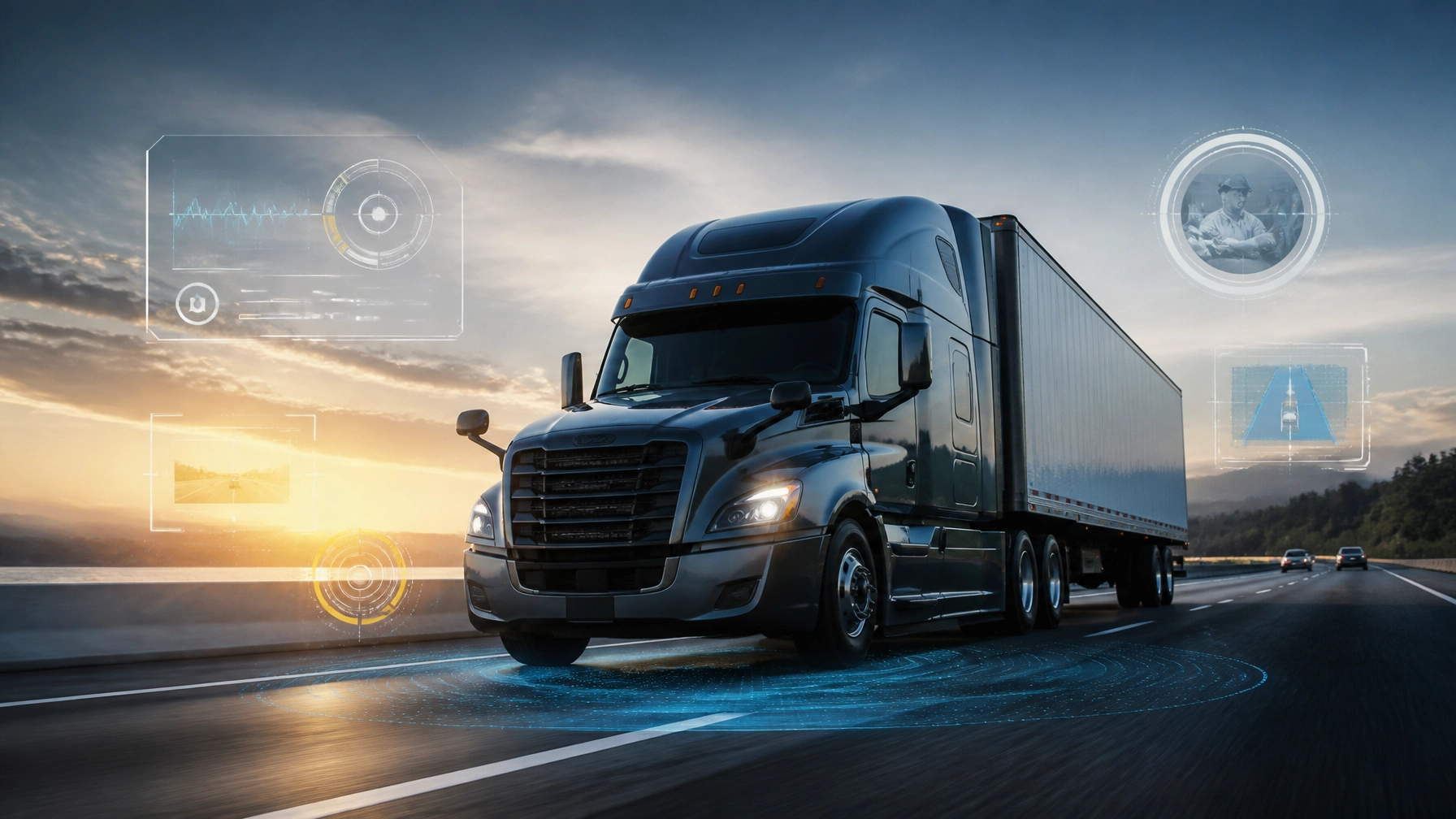
AI-Standardized Risk Assessment: The New Gold Standard for Fleets
For decades, fleet management was a game of intuition. A veteran fleet manager could walk into a breakroom, look at a driver, and “just know” who the risky ones were. Maybe it was a stack of paper logs that looked too perfect, or a certain attitude during a ride-along. This “gut feeling” was the primary tool for risk assessment.
But in 2026, the stakes are too high for guesswork. With nuclear verdicts on the rise and insurance premiums climbing, relying on subjective human observation isn’t just outdated: it’s a liability.
Today, the industry is shifting toward a more accurate, fair, and scalable method: AI-standardized risk assessment. By leveraging AI fleet safety cameras and sophisticated algorithms, companies are finally removing the bias from driver coaching and setting a new gold standard for safety.
The Hidden Problem with “Human” Risk Assessment
Every human has biases. In a fleet setting, these biases often manifest as favoritism or, conversely, unfair scrutiny. A manager might overlook a “good” driver’s habit of following too closely because they are always on time. Meanwhile, a newer driver might be penalized more harshly for a single hard-braking event that was actually a defensive move to avoid a collision.
When risk assessment is subjective:
- Coaching is inconsistent: Drivers at different terminals may be held to different standards depending on their supervisor.
- Legal defense is weak: In court, “I felt he was a safe driver” doesn’t hold up against a plaintiff attorney’s data.
- Morale suffers: Drivers who feel they are being “picked on” while others get a pass are more likely to leave.
AI changes the conversation by focusing strictly on observable, measurable data. It doesn’t care about a driver’s tenure or personality; it only cares about behavior and safety outcomes.

How AI Fleet Safety Cameras Standardize the Field
Standardization means that every driver in your fleet: whether you have 10 or 1,000: is evaluated against the exact same set of parameters. AI fleet safety cameras are the engine behind this shift. These aren’t just recording devices; they are intelligent sensors that can distinguish between a “harsh brake” caused by aggressive driving and one caused by a child running into the street.
1. Eliminating the “False Positive”
One of the biggest frustrations for drivers is getting “dinged” for an event they couldn’t control. Modern video telematics solutions use AI to analyze the context of an event. If a driver slams on the brakes because they were cut off, the AI identifies the external vehicle’s movement. Instead of a “violation,” the system marks it as a “defensive maneuver.”
2. Identifying “Invisible” Risks
Human managers can only coach what they see. AI, however, sees the “invisible” risks that lead to accidents:
- Distracted Driving: Detecting eyes off the road or phone usage before an accident happens.
- Fatigue: Identifying micro-sleeps or frequent yawning through cabin-facing sensors.
- Tailgating: Measuring precise following distances that the human eye can’t consistently judge from a grainy video.
By standardizing these metrics, the best dash cam for fleet vehicles ensures that risk is measured by the potential for an accident, not just the occurrence of one.
Moving from Reactive to Predictive Coaching
The old model of fleet safety was reactive: something bad happens, you watch the tape, you have a meeting. AI-standardized risk assessment moves the needle toward predictive management.
When you have a standardized safety score for every driver, patterns emerge. You might find that a specific group of drivers has a 20% higher risk of distracted driving during the last two hours of their shift. This data allows you to implement targeted coaching programs before a fender-bender turns into a multi-million dollar claim.
The Power of the Scorecard
Standardized risk assessment produces a “Safety Score”: a single, objective number that represents a driver’s performance.
| Feature | Manual Assessment | AI-Standardized Assessment |
|---|---|---|
| Data Source | Manager’s memory / paper logs | Real-time AI video & telematics |
| Consistency | Low (varies by manager) | High (universal algorithms) |
| Bias | Present (subjective) | Minimal (data-driven) |
| Proactivity | Reactive (post-incident) | Predictive (behavior-based) |
The Financial Impact: Slashing Costs with Data
At Safety Track, we see the results of this standardization every day. Our clients typically see up to 40% fewer accidents once they implement AI-enhanced security. But the benefits go beyond just avoiding crashes.
- Insurance Savings: Insurers love data. When you can prove your risk assessment is standardized and your drivers are coached based on objective AI metrics, you can negotiate up to 25% lower insurance costs.
- Legal Protection: If an accident does occur, having a standardized history of coaching and safety scores proves that your company has a “culture of safety,” which is the best defense against claims of negligence.
- Fuel Efficiency: Standardized risk assessment often rewards smooth driving. By reducing harsh acceleration and speeding, fleets can see up to 30% fuel savings.

Choosing the Best Dash Cam for Fleet Vehicles
Not all cameras are created equal. To achieve true standardized risk assessment, you need more than just a lens on the windshield. You need a platform that integrates GPS tracking, vehicle diagnostics, and AI processing.
When evaluating video telematics solutions, look for:
- Edge Processing: Does the camera process AI on the device for instant driver feedback?
- Contextual Logic: Can the system tell the difference between a pothole and a collision?
- Customization: Can you tailor the risk thresholds to your specific industry, whether it’s construction or long-haul logistics?
At Safety Track, we specialize in custom-tailored solutions. We understand that a waste management fleet has different risk profiles than a cold-chain logistics provider. Our AI systems are tuned to your specific operations, ensuring that your “gold standard” is actually relevant to your business.
Conclusion: Fairer for Drivers, Safer for Everyone
The shift to AI-standardized risk assessment isn’t about “Big Brother” watching over drivers. It’s about creating a fair, transparent environment where drivers are judged on their actual skill and safety, not on a manager’s “gut feeling.”
By removing bias from the equation, you don’t just protect your bottom line: you build a culture where safety is a shared, measurable goal. In the high-speed world of 2026 fleet management, data is the only thing that should be in the driver’s seat when it comes to risk.
Ready to see how AI can transform your fleet’s safety culture? Contact Safety Track today for a custom demo of our AI-enhanced dash cameras and telematics solutions.

Tyler Schneider is the IT Director at Safety Track, overseeing the company’s technological infrastructure and innovations. With a strong background in information technology and systems management, Tyler ensures that Safety Track stays at the forefront of tech solutions in fleet management. His strategic expertise supports the seamless integration of technology across the company’s operations.