
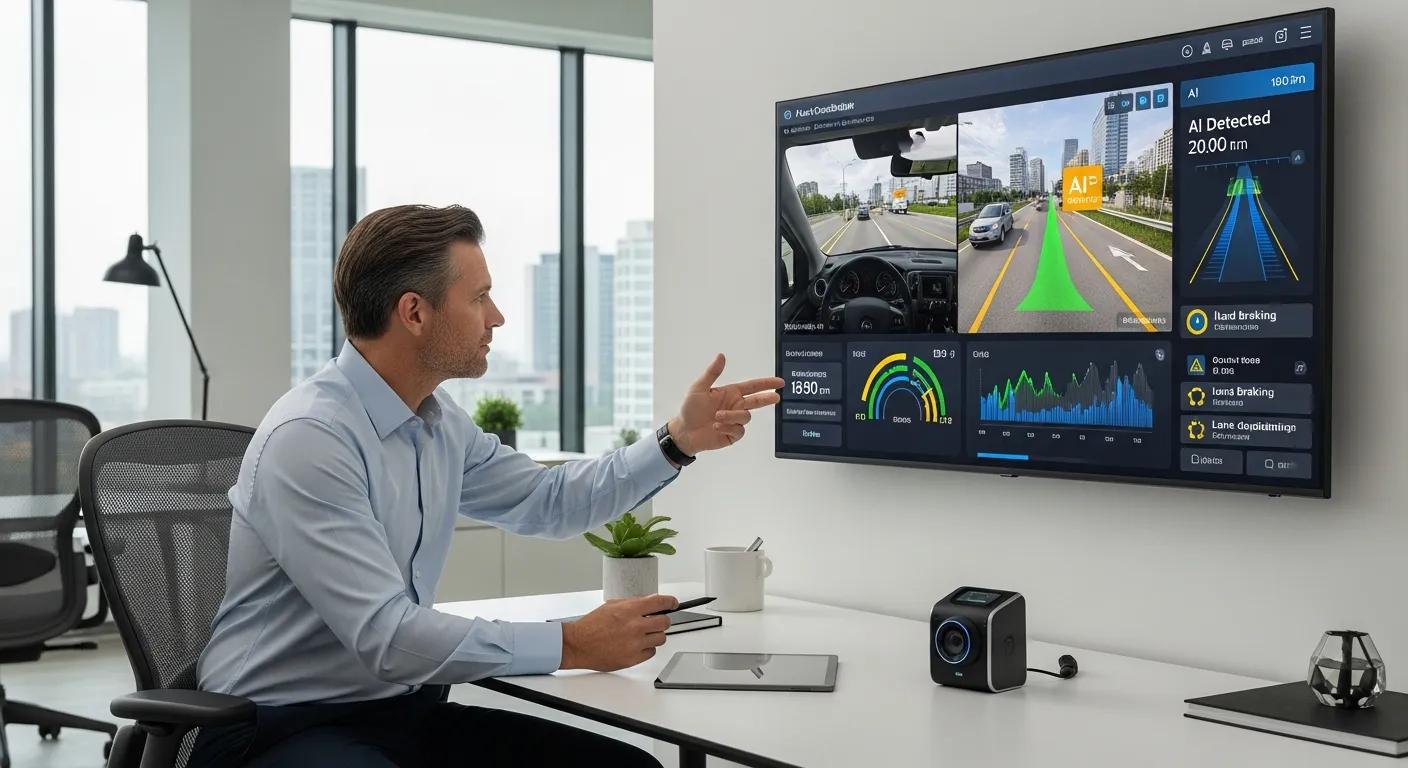
Enhance Safety and Efficiency in Commercial Fleets Today
AI Fleet Dash Cameras: Boost Safety, Cut Costs & Improve Efficiency
AI fleet dash cameras combine onboard video capture with real-time artificial intelligence to detect risky driving behaviors, record verified events, and feed synchronized telemetry into fleet management workflows. This article explains how ai fleet dash cameras benefits translate into measurable safety improvements, cost reductions, and operational efficiency gains so fleet leaders can evaluate solutions strategically. Fleet managers will learn how computer vision and predictive analytics detect distraction and fatigue, how video telematics influences insurance and claims outcomes, and which operational KPIs improve when cameras integrate with telematics and diagnostics. Many fleets struggle with high accident rates, rising claims, unpredictable maintenance costs, and inefficient routing; AI dash cams address these problems by providing event-level evidence, behavior coaching, and data-driven alerts that reduce risk and waste. The article first outlines core benefits, then dives into driver behavior mechanisms, insurance impacts, efficiency gains, enabling AI technologies, buying guidance, security and compliance, and practical ROI scenarios. Throughout, readers will find checklists, EAV tables, and concrete examples to guide procurement and deployment of ai dash cams for fleets.
What Are the Core Benefits of AI Fleet Dash Cameras for Commercial Fleets?
AI fleet dash cameras deliver five core business outcomes—improved safety, lower operating costs, better operational efficiency, enhanced security, and compliance support—by combining video telematics with real-time analytics to detect events and trigger workflows. These systems convert camera sensor data and GPS telemetry into actionable insights by classifying incidents (harsh braking, lane departure, phone use), timestamping video evidence, and scoring driver risk, which in turn reduces incident frequency and shortens investigation cycles. The mechanism is straightforward: edge AI filters and flags high-risk events, cloud analytics aggregate patterns across vehicles, and managers use dashboards to coach drivers and adjust routes or maintenance schedules. The result is measurable: fewer accidents, faster claims resolution, lower fuel and maintenance spend, and stronger asset protection through geofencing and remote alerts. The next sections unpack how these mechanisms operate in practice, starting with safety improvements and then mapping cost savings and other benefits.
AI fleet dash camera benefits summarized:
- Safety Improvements: Real-time detection and coaching reduce collisions and risky behaviors.
- Cost Reductions: Video evidence and analytics lower insurance costs and claims expenses.
- Operational Efficiency: Route optimization and automated reporting reduce fuel use and idle time.
- Security & Theft Protection: Geofencing and motion alerts support asset recovery and prevention.
- Compliance Support: Timestamped footage and audit-ready logs assist regulatory reporting.
These five benefits create a virtuous cycle where improved safety reduces costs, which frees resources to invest in further efficiency improvements.
Intro to core benefits table and what it shows: the following table maps each primary benefit area to specific features and measurable outcomes so fleet leaders can quickly scan expected impacts and decide which metrics to track.
How Do AI Dash Cams Enhance Fleet Safety and Reduce Accidents?
AI dash cams enhance fleet safety by detecting risky driving events in real time, alerting drivers or managers, and creating a persistent record for coaching and investigation. Computer vision models on the edge identify behaviors such as distracted driving, tailgating, or sudden lane departures while synchronized telemetry (speed, braking) provides context that classifies event severity. When an alert triggers, systems can issue in-cab warnings to the driver and log the event with a video clip and metadata so managers can review and coach drivers later. This closed-loop process—detect, alert, record, coach—reduces repeat offenses because drivers receive timely feedback and managers can target coaching where it matters most. Understanding this safety feedback loop sets up evaluation metrics like reduction in harsh events per 100k miles and time-to-coaching for drivers.
What Cost Savings Can Businesses Expect from AI Fleet Cameras?
AI fleet cameras reduce costs through several linked mechanisms: fewer accidents lower direct repair and liability spends, reliable video evidence reduces contested claims and legal fees, and operational insights decrease fuel and maintenance costs. Video evidence shortens claims cycles by providing clear event reconstruction with time-synced GPS and speed data, which insurers interpret as lower risk and may reward with premium discounts. Additionally, behavior-driven fuel savings occur when analytics identify inefficient driving and route patterns that fleet managers correct, leading to improved MPG and reduced idle time. Cost-savings modeling typically aggregates insurance savings, fuel and maintenance reductions, and avoided downtime to show multi-year ROI; using conservative estimates helps set realistic expectations for payback periods and budget planning.
How Do AI Dash Cameras Improve Driver Behavior and Fleet Safety?
AI dash cameras influence driver behavior by detecting specific risky actions, providing immediate feedback, and enabling systematic coaching that changes long-term habits. The fundamental mechanism is the detection-to-coaching loop: sensors capture an event, AI classifies its nature, in-cab alerts or post-trip reviews prompt corrective actions, and managers use trend data to reinforce positive behaviors. Driver behavior monitoring includes detection of distracted driving, fatigue indicators, harsh braking, and speeding, which are translated into risk scores and training priorities. Over time, fleets see measurable reductions in repeat incidents because drivers internalize feedback and organizations implement incentivized safety programs. The subsequent sections explain the AI technologies that make this monitoring possible and how real-time coaching is delivered operationally.
What AI Technologies Detect Distracted Driving and Fatigue?
Detecting distraction and fatigue rests on computer vision and signal-processing techniques such as facial landmarking, head-pose estimation, gaze tracking, and blink-rate analysis, often combined with cabin and road-facing camera data. These methods work by mapping facial and eye positions to probabilistic models that indicate eyes-off-road or prolonged eyelid closure; correlation with steering patterns and lane deviation strengthens confidence in classification. Edge AI runs lightweight inference models near the camera to preserve latency and privacy, while periodic cloud retraining refines accuracy using aggregated anonymized data. False-positive mitigation uses multi-sensor thresholds and temporal smoothing to avoid unnecessary alerts, which improves driver trust and reduces alert fatigue. This technology overview sets expectations for detection accuracy and operational tradeoffs between edge responsiveness and cloud model refinement.
The application of AI and machine learning is crucial for developing sophisticated systems that can accurately detect driver fatigue and drowsiness, thereby preventing accidents.
AI and Machine Learning for Driver Fatigue and Drowsiness Detection
There are several factors for vehicle accidents during driving such as drivers’ negligence, drowsiness, and fatigue. These accidents can be avoided, if drivers are warned in time. Moreover, recent developments in computer vision and artificial intelligence (AI) have helped to monitor drivers and alert them in case they are not concentrating on driving. The AI techniques can extract relevant features from expressions of driver’s face, such as eye closure, yawning, and head movements to infer the level of sleepiness. In addition, they can acquire biological signals from the driver’s body, and indications from the vehicle behavior. This paper provides a comprehensive review of the detection techniques of drowsiness and fatigue of drivers using machine learning (ML) and deep learning (DL). The current techniques for this application are classified into four categories: image- or video-based analysis during the driving, biological signal analysis for drivers, vehicle movement analysis, and hybrid techniques. A review of supervised techniques is presented for detecting fatigue and drowsiness on different datasets, with a comparison of the various techniques in terms of pros and cons. Results are presented in terms of accuracy of detection for each technique. The results are discussed according to the recent problems and challenges in this field. The paper also highlights the applicability and reliability of the different techniques. Furthermore, some suggestions are presented for the future work in the field of driver drowsiness detection (DDD).
Machine learning and deep learning techniques for driver fatigue and drowsiness detection: a review, SA El-Nabi, 2024
How Does Real-Time Driver Coaching Work with AI Dash Cams?
Real-time driver coaching typically combines immediate in-cab cues (audio chimes, spoken prompts) with automated event logging and manager-facing dashboards for follow-up coaching. When an AI model flags a risky behavior, an in-cab alert nudges the driver to correct the action, while the system simultaneously captures a short video clip and telemetry snapshot that populate a review queue. Managers access these clips through a safety platform to conduct structured coaching sessions, create corrective action plans, and track improvement over time using risk trend reports. Integration with rewards or demerit systems helps sustain behavior change by tying coaching outcomes to performance evaluations or incentive programs. Understanding this workflow clarifies why fleets should plan both technical deployment and human processes before scaling coaching programs.
In What Ways Do AI Fleet Dash Cameras Lower Insurance Costs for Businesses?
AI dash cams influence insurance costs by improving risk profiles through demonstrated behavior improvements and by providing unambiguous event evidence that accelerates claim resolution and reduces fraud payouts. Insurers value datasets that show reduced accident frequency and severity, and video-verified evidence lowers uncertainty during claim adjudication, which can translate into premium negotiations for fleets. The combination of proactive risk reduction (fewer high-risk events) and reactive certainty (clear event footage) gives underwriters the confidence to offer better terms or credits for robust safety programs. The next subsections spell out how to present telematics evidence to insurers and how synchronized telemetry protects against false claims and liability exposure.
AI-influenced insurance savings typically arise from three mechanisms:
- Video evidence shortens investigations and reduces contested payouts.
- Demonstrated behavior improvements lower claim frequency and severity.
- Aggregate telematics metrics create leverage during renewal negotiations.
How Does Video Evidence from AI Dash Cams Reduce Insurance Premiums?
Video evidence reduces insurance premiums by making incidents easier to adjudicate, lowering uncertainty about fault, and reducing the administrative burden of lengthy disputes. Time-synced clips paired with GPS, speed, and braking data create a rich event record that insurers can use to resolve liability quickly, which decreases average claim handling time and legal exposure. To leverage footage effectively, fleets should maintain consistent retention policies, index events with standardized metadata, and be prepared to share anonymized trend reports with underwriters to demonstrate program effectiveness. Insurers typically respond to documented reductions in accident frequency and severity with premium adjustments or safety credits, especially when fleets can show multi-month or multi-year improvement trends.
Can AI Dash Cameras Help Protect Against False Claims and Liability?
Yes—AI dash cameras help disprove false claims and reduce liability by providing timestamped, synchronized video and telemetry that reconstruct events precisely. A complete event package includes cabin and road-facing video, GPS coordinates, speed, braking force, and event markers that together create a chain-of-evidence narrative useful in disputes. Best practices for preserving this evidentiary value include strict chain-of-custody procedures, secure cloud storage with access logs, and clear retention and redaction policies to balance privacy and legal needs. Implementing these governance measures ensures that footage is admissible and defensible during investigations, which materially reduces exposure to fraudulent claims or inflated claims.
How Do AI Fleet Dash Cameras Boost Operational Efficiency and Productivity?

AI fleet dash cameras contribute to operational efficiency by supplying contextualized event data that refines routing, reduces idle and non-revenue time, and automates administrative tasks such as incident reporting and maintenance triggers. Video telematics combined with GPS and vehicle diagnostics highlights route inefficiencies, identifies idling hotspots, and correlates harsh driving events with maintenance flags that inform preventive scheduling. These insights reduce miles driven, improve on-time performance, and decrease unscheduled downtime by enabling predictive maintenance. The following subsections detail route optimization impacts and how diagnostics reporting integrates into maintenance workflows to produce concrete productivity gains.
Intro to the EAV table for operational efficiency: the table below links specific AI camera features to metrics they impact and provides example improvement ranges so fleet managers can prioritize initiatives and set targets.
What Role Does Route Optimization Play in Fuel and Time Savings?
Route optimization informed by camera and telematics data reduces fuel consumption and travel time by identifying recurring detours, traffic-prone segments, and inefficient stop sequences. Video telematics surfaces behavioral contributors—excessive idling, avoidable detours, or poor route adherence—that routing algorithms and dispatchers can remediate. When routing changes are implemented based on these insights, fleets commonly see improvements in fuel economy and reduced driver hours, which lowers operating costs and increases vehicle utilization. Integrating route optimization with live camera alerts and GPS data closes the feedback loop so dispatch can adapt in near real time, improving punctuality and decreasing overtime.
Leveraging AI and machine learning for predictive analytics is key to optimizing various aspects of fleet management, including route planning and maintenance.
AI Predictive Analytics for Fleet Management Optimization
The realm of logistics and transportation is undergoing a transformative shift due to advancements in artificial intelligence (AI) and machine learning (ML) technologies. This research paper investigates the application of AI-driven predictive analytics for optimizing fleet management, focusing on three critical aspects: route planning, vehicle allocation, and predictive maintenance. The study is driven by the imperative to reduce operational costs, enhance delivery efficiency, and improve vehicle utilization through sophisticated AI models.
AI-Driven Predictive Analytics for Fleet Management Optimization in Logistics and Transportation: Leveraging Machine Learning for Route Planning, Vehicle …, P Punukollu, 2022
How Do Vehicle Diagnostics and Reporting Improve Fleet Management?
Vehicle diagnostics tied to driving events enable proactive maintenance by correlating fault codes with event video, so managers understand whether driving behavior contributed to component wear. Automated reporting aggregates these signals into prioritized maintenance queues, enabling timely interventions that reduce downtime and extend vehicle life. Combined dashboards that present trends—such as increasing fault frequency after a driver’s specific event types—allow targeted retraining or mechanical inspection before failures occur. This integration reduces emergency repairs, improves fleet availability, and tightens spare-parts forecasting to lower inventory costs.
What AI Technologies Power Advanced Fleet Dash Cameras?
Advanced fleet dash cameras rely on a layered AI stack: computer vision models for detection, lightweight edge inference for low-latency alerts, cloud machine learning for model improvement and risk scoring, and predictive analytics for forecasting maintenance and incident risk. Computer vision handles object and action detection, while machine learning aggregates event histories into risk models that identify patterns and predict future incidents or component failures. Edge AI reduces bandwidth and preserves driver privacy by pre-filtering routine footage, sending only flagged events for cloud analysis and long-term storage. Understanding these components helps fleet leaders evaluate vendors on detection accuracy, update cadence, and data governance, which are critical when assessing long-term value.
Key technological building blocks include:
- Computer vision for object and action detection.
- Edge AI for on-device inference and privacy-preserving filtering.
- Cloud analytics for fleet-level pattern detection and retraining.
- Predictive analytics for maintenance and risk forecasting.
These building blocks combine to produce the ai-powered video telematics capabilities that drive business outcomes.
How Does Computer Vision Enable Smarter Driver Monitoring?
Computer vision enables smarter monitoring by converting pixel data into structured events: detecting phones, hands off wheel, lane position, and other visual cues that signify risk. Models use object detection (to spot phones or unsafe objects), pose estimation (to infer head and eye orientation), and temporal analysis (to detect prolonged distraction), which together yield high-confidence event classifications. Proper camera placement and illumination handling are critical technical considerations so models perform reliably across day/night and weather conditions. Continual model calibration using fleet-specific datasets reduces false positives and adapts to unique cabin geometries, improving trust and ensuring alerts remain meaningful to drivers and managers.
What Is the Role of Machine Learning and Predictive Analytics?
Machine learning and predictive analytics turn historical event and maintenance data into forward-looking insights such as risk scores and maintenance forecasts. ML models trained on aggregated fleet data learn to associate subtle patterns—repeated minor harsh events, incremental diagnostic codes, or route-specific risks—with higher probabilities of future incidents or component failures. Predictive alerts surface prioritized actions for managers, such as scheduling inspections or reassigning routes, enabling cost avoidance rather than merely reacting to failures. Continuous retraining with new labeled events improves model precision and helps personalize risk thresholds for different vehicle classes or operating environments.
How Can Businesses Choose the Right AI Fleet Dash Camera Solution?
Choosing the right ai dash cams for fleets requires evaluating features (detection accuracy, camera quality, storage and retention), integration capabilities (APIs, telematics compatibility), privacy and compliance controls, scalability, and vendor support. Decision-making should start with clear KPIs (accident reduction, claims cycle time, fuel savings) and a pilot scope that tests detection accuracy in representative operating conditions. Assess vendors on their AI model transparency, edge/cloud architecture, and ability to integrate with fleet management systems so event data can flow into dispatch, maintenance, and HR workflows. The following checklist and table help fleet managers compare candidates and form an acquisition roadmap.
Intro to product feature checklist: the list below prioritizes the features fleet managers should evaluate and explains why each matters when selecting an ai fleet camera provider.
- Detection accuracy and low false-positive rate: Ensures alerts are actionable and driver trust remains high.
- Edge vs. cloud processing balance: Determines latency, bandwidth needs, and privacy posture.
- Integration APIs and telematics compatibility: Enables automated workflows and data consolidation.
- Secure storage and retention controls: Supports evidence governance and compliance.
- Scalability and support model: Impacts total cost of ownership and rollout speed.
Summary: prioritize features that map directly to your KPIs and operational workflows so the chosen solution delivers measurable business value.
What Features Should Fleet Managers Look for in AI Dash Cameras?
Fleet managers should look for a prioritized set of features that directly map to expected outcomes: reliable detection models, synchronized telemetry, secure event storage, integration APIs, and administrative controls for privacy and retention. Minimum recommended specs include HD road-facing and cabin cameras, event-triggered clip lengths with metadata, and configurable alert thresholds to align with fleet policies. Nice-to-have capabilities include infrared/night vision, multi-camera arrays for large vehicles, and in-cab coaching interfaces that adapt to driver feedback. Evaluating features in the context of operational workflows—dispatch, maintenance, HR—ensures the selected solution accelerates the path from data to actionable decisions.
How Important Is Integration with Fleet Management Systems?
Integration with fleet management systems is crucial because camera events must feed into dispatch, maintenance, and HR processes to generate value beyond isolated clips. When systems are integrated, an event can automatically create a maintenance ticket, populate driver coaching records, or trigger a routing adjustment, reducing manual work and improving response times. Recommended integration points include event-to-ticketing for maintenance, driver-profile synchronization for coaching records, and daily or weekly KPI exports for safety teams. Robust APIs, bulk data export options, and single sign-on support simplify operational adoption and ensure cameras become part of the broader telematics ecosystem rather than a siloed tool.
Integration note about a solution provider: after evaluating core benefits and integration needs, some fleets choose to work with providers that offer tightly integrated stacks combining GPS tracking and AI cameras to simplify deployment. Safety Track provides AI Fleet Cameras and AI Dash Cameras that integrate with vehicle tracking devices and platform-level analytics to support real-time driver coaching, route optimization, and evidence-based claims support. Safety Track’s solutions are positioned to enhance safety and lower costs through combined telematics and video capabilities, and fleets can request demonstration deployments to validate detection accuracy and integration workflows before scaling.
How Do AI Fleet Dash Cameras Enhance Fleet Security and Compliance?
AI fleet dash cameras bolster security with features like geofencing, motion-triggered recording, and remote monitoring, while also supporting compliance through structured retention policies and audit-ready logs. Geofencing alerts notify managers of unauthorized vehicle movement, and event-triggered clips provide investigative leads for theft or misuse. For compliance, timestamped video paired with telematics assists with audits, hours-of-service reviews, and incident reporting by supplying verified records that regulators or insurers can examine. The next subsections describe theft-protection capabilities and how systems should be configured to support regulatory obligations while balancing driver privacy.
What Theft Protection and Asset Security Features Are Available?
Theft protection features include geofence breach alerts, motion detection during off-hours, and remote snapshot capabilities that provide immediate situational awareness. When a vehicle leaves an authorized zone or exhibits motion at an unusual time, the system sends alerts with short video clips and location data, enabling rapid response and law-enforcement coordination. Multi-sensor approaches that combine GPS, accelerometer, and camera data reduce false alarms and improve recovery chances. Practical workflows tie these alerts into dispatch center procedures so security teams receive prioritized notifications and have the evidence needed to act.
How Do AI Dash Cams Help Maintain Regulatory Compliance?
AI dash cams support compliance by producing tamper-evident records that can be used in audits and investigations, provided organizations implement clear retention and access controls. Compliance workflows combine automated retention schedules, immutable access logs, and redaction tools so sensitive information can be protected while necessary footage is available for regulators or insurers. For hours-of-service or driver-eligibility reviews, synchronized video and telemetry provide corroborative evidence that streamlines audits and reduces administrative overhead. Implementing governance policies that define who can access footage, under what conditions, and for how long ensures cameras enhance compliance without compromising privacy.
What Are the Real-World Results and ROI of Using AI Fleet Dash Cameras?
Real-world ROI from AI fleet dash cameras aggregates savings from fewer accidents, lower insurance costs, fuel and maintenance reductions, and productivity gains. Example outcomes typically combine percent reductions in accident frequency, shortened claims cycle times, and decreases in idle and fuel consumption to estimate payback periods. While specific results vary by industry and fleet size, a conservative modeling approach projects ROI by summing annualized savings across these categories and comparing them to total cost of ownership including hardware, installation, and recurring cloud/analytics fees. The subsections below present anonymized example scenarios and operational improvements fleets commonly achieve to help managers build their own ROI cases.
Intro to ROI examples table: the table below provides illustrative scenarios showing how different improvement areas combine to produce multi-year savings for typical fleets, helping managers translate analytics into budget requests.
How Have Businesses Reduced Accidents and Insurance Costs?
Businesses have reduced accidents and insurance costs by deploying AI dash cams as part of comprehensive safety programs that combine real-time alerts with structured coaching and performance tracking. The pathway to savings begins with accurate detection and rapid coaching to correct behaviors, followed by integration of evidence into insurer discussions to negotiate premium adjustments based on demonstrated improvements. Documenting month-over-month reductions in severe events and presenting these trend reports to underwriters creates negotiating leverage for premium credits or incentives. Fleets that embed cameras into safety culture—training drivers on alert purpose and using data for supportive coaching rather than punitive measures—tend to realize the most sustainable reductions in claims and associated insurance costs. how ai dash cameras enhances fleet safety
What Operational Improvements and Savings Have Fleets Achieved?
Operational improvements from AI dash cameras include reduced miles driven through route corrections, lower idle time via driver coaching, fewer emergency repairs from event-correlated diagnostics, and faster administrative processing of incidents thanks to automated reporting. These improvements increase vehicle availability and reduce total operating expenditure, while clearer incident records shorten dispute resolution and administrative labor. To track these gains, fleets should monitor KPIs such as miles per gallon, idle minutes per shift, mean time to repair, and claims cycle time. Regularly reviewing these KPIs and correlating them with camera-derived events ensures that the technology continues to deliver measurable value and informs where further process changes can amplify savings.
- Integration tip: for fleets aiming to quantify ROI, run a controlled pilot with baseline KPI measurement, deploy cameras with aligned coaching procedures, and measure changes over a 6–12 month window to account for behavior change timelines and seasonal variability.
- Define pilot scope: Select representative vehicles and routes.
- Measure baseline KPIs: Record incident rates, fuel use, and maintenance costs.
- Deploy cameras and coaching: Implement alerts and manager review processes.
- Analyze outcomes: Compare post-deployment KPIs and adjust program elements.

Hannah Lang is a Social Media Marketing Specialist at Safety Track. She has her bachelor’s degree in Advertising and Public Relations from Grand Valley State University. With her passion for research, Hannah possesses a wealth of knowledge expanding across multiple industries and disciplines. Her efforts won her a Scholastic Art and Writing regional Gold Key award.