
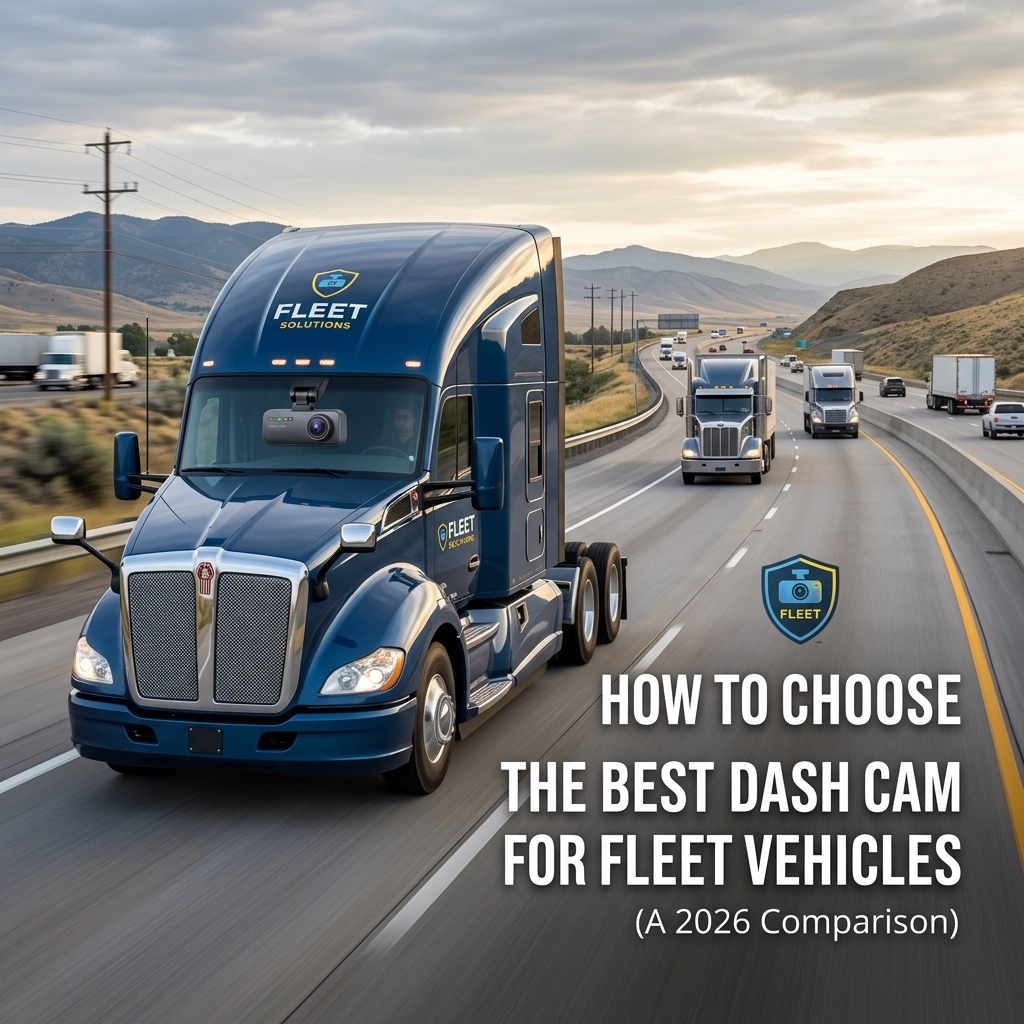
How to Choose the Best Dash Cam for Fleet Vehicles (A 2026 Comparison)
In 2026, the commercial trucking industry has moved far beyond the simple “set it and forget it” dash camera. The days of pulling SD cards after an accident are largely over. Today, a commercial dash cam system is an active participant in fleet safety, utilizing Edge AI to prevent accidents before they happen and cloud connectivity to provide instant exoneration.
Choosing the best dash cam for fleet vehicles is no longer just about resolution; it is about how that data integrates into your daily operations. With nuclear verdicts on the rise and insurance premiums reaching record highs, your choice of camera system is one of the most significant ROI decisions you will make this year.
This guide provides a comprehensive comparison of the top fleet dash cam solutions in 2026, helping you navigate the technical jargon of AI, LTE connectivity, and dual-facing lenses to find the right fit for your specific fleet profile.
1. Start with Your Fleet Profile and Goals
Before diving into hardware specs, you must define what you need the system to achieve. A 10-vehicle local landscaping fleet has vastly different requirements than a 500-unit long-haul carrier.
Fleet Size and Type
The complexity of your management software should scale with your fleet. Smaller fleets may prioritize a low-cost dual dash cam for fleets with basic cloud storage, while larger enterprises require advanced API integrations and automated coaching workflows. Whether you are managing heavy-duty semi-trucks in a construction yard or a fleet of delivery vans, the hardware must be rugged enough for the environment.
Primary Objectives
- Exoneration: You need high-definition footage to prove your driver wasn’t at fault in a “he-said, she-said” incident.
- Collision Reduction: You want AI that alerts drivers to tailgating or distraction in real-time.
- Insurance Discounts: Many insurers now mandate specific AI features to maintain coverage or offer premium credits.
- Compliance: Ensuring the system works alongside your ELD and FMCSA requirements is non-negotiable.
2. Key Buying Criteria for 2026
To find the best dash cam for fleet vehicles, you must evaluate four core pillars: hardware, AI intelligence, connectivity, and total cost of ownership (TCO).
A. Camera Configuration & Resolution
In 2026, 1080p is the bare minimum. Many premium systems, like the Samsara CM34 or high-end BlackVue models, now offer 2K or 4K resolution. Higher resolution allows you to read license plates from further away and provides clearer evidence in low-light conditions.
You must also decide between:
- Forward-Facing Only: Best for simple exoneration and budget-conscious fleets.
- Dual-Facing (Road + Cab): The industry standard for safety and driver coaching.
- Multi-Cam Systems: Adding side, rear, or cargo cameras for 360-degree visibility.
B. AI Safety and Real-Time Coaching
The “AI” in a commercial dash cam system refers to its ability to “see” and interpret behavior. Modern systems detect:
- Distracted Driving: Mobile phone use or looking away from the road.
- Drowsiness: Detecting frequent blinking or head drooping.
- Road Behaviors: Tailgating, rolling stops, and lane departures.
The most effective systems provide audible in-cab alerts, acting as a virtual co-pilot for the driver.

C. Cloud Storage and Data Retrieval
In the event of a crash, time is of the essence. You cannot wait for a truck to return to the yard to retrieve footage. The best systems offer “on-demand” cloud retrieval, allowing managers to request specific time segments over the LTE network.
3. Top Fleet Dash Cam Comparisons (2026)
Based on current market performance and fleet manager feedback, here is how the leading contenders stack up.
| Feature | Samsara CM34 | Motive AI Dashcam Plus | SmartWitness CP2-LTE | BlackVue DR970X |
|---|---|---|---|---|
| Best For | Enterprise/All-in-One | Integrated ELD/Safety | Mid-Market/Value | Owner-Operators |
| Resolution | 2K Road / 1080p Cab | 1080p Dual | 1080p Dual | 4K Road / 1080p Rear |
| AI Features | Advanced (Distraction, Tailgating) | Robust (30+ AI Models) | Basic/Essential | Minimal AI |
| Connectivity | 4G/5G LTE | 4G/5G LTE | 4G LTE | Wi-Fi/LTE (Optional) |
| Installation | Professional | Fast (Integrated) | Modular | DIY/Simple |
Samsara CM34: The Enterprise Gold Standard
Samsara continues to lead the pack for fleets that want a unified platform. The CM34 offers incredible 2K resolution and a wide field of view. Its AI is among the most mature in the industry, significantly reducing “false positives” that can lead to driver fatigue with alerts. It integrates seamlessly with GPS tracking and maintenance logs.
Motive AI Dashcam Plus: The Integration Leader
Motive has gained massive ground by tightly coupling their dash cam with their ELD. Their hardware runs over 30 AI models directly on the device, meaning alerts happen instantly without needing to send data to the cloud first. This is a top choice for carriers looking to streamline their tech stack.
SmartWitness CP2-LTE: The Value Choice
For fleets that need reliable video and LTE connectivity without the high monthly subscription fees of the “big two,” SmartWitness is an excellent alternative. It provides essential AI features and high-quality dual-facing video, making it a favorite for local service fleets like landscaping and tree services.
BlackVue DR970X: The Video Specialist
If your primary goal is the highest possible video quality: perhaps for an owner-operator who wants 4K evidence: BlackVue is the winner. While it lacks the deep fleet management and coaching workflows of Samsara or Motive, its image sensor is superior for capturing details in high-speed or low-light environments.
4. Why AI-Driven Coaching is Essential
A dual dash cam for fleets is only as good as the behavior change it creates. In 2026, fleet managers are moving away from “punitive” management and toward “proactive” coaching.
AI cameras allow you to identify “near-misses”: those moments where a driver braked hard or swerved to avoid a collision. By reviewing these clips, managers can coach drivers on following distances or scanning the road ahead before a minor mistake becomes a nuclear verdict.

Real-Time Accountability
When a driver knows the AI is monitoring for seatbelt compliance or phone usage, habits change instantly. This level of accountability is what insurance companies are looking for when they set your rates. Monitoring these behaviors in real-time ensures that your fleet remains a low-risk asset.
5. Implementation: Pilot and ROI
Before committing to a multi-year contract for hundreds of units, every fleet should conduct a pilot program.
The Pilot Checklist
- Test AI Accuracy: Does the camera alert for a “phone” when the driver is just scratching their ear? High false-alert rates will make drivers hate the system.
- Evaluate Low-Light Performance: Test the cameras during the 3:00 AM shift to ensure infrared sensors provide clear cab footage.
- Check Retrieval Speed: How long does it take to get a 10-minute clip from the cloud to your desktop?
Calculating TCO
Don’t just look at the hardware cost. Calculate the 3-year or 5-year total cost of ownership, including:
- Monthly subscription fees.
- Professional installation costs.
- Data overage charges for “live viewing.”
- The potential savings from one avoided accident or one successfully defended insurance claim.

6. Addressing Privacy and Driver Buy-In
One of the biggest hurdles to installing a commercial dash cam system is driver pushback. Drivers often feel that “Big Brother” is watching. In 2026, the most successful fleets overcome this by:
- Transparency: Showing drivers exactly what the camera sees and when it uploads footage (e.g., only during “events”).
- Incentives: Using safety scorecards to reward the best drivers with bonuses.
- Exoneration Stories: Sharing real-world examples where the dash cam saved a driver’s career by proving they weren’t at fault.
Safety Track has found that when drivers understand the camera is there to protect their CDL from predatory litigation, buy-in increases dramatically.
7. The Safety Track Advantage
Choosing the best dash cam for fleet vehicles can be overwhelming with so many tech giants competing for your business. At Safety Track, we specialize in helping fleets navigate these choices to find a solution that fits their specific operational needs.
Whether you need a simple forward-facing camera or a fully integrated AI safety suite, our team provides the expert guidance and support that only a family-owned business can offer. We understand that your fleet is your livelihood, and we are committed to providing the tools that keep your drivers safe and your business profitable.
Final Thoughts for 2026
The “best” camera is the one that your drivers will accept, your managers will use, and your insurance company will trust. By focusing on AI capabilities, cloud reliability, and professional-grade hardware, you can turn your fleet into a data-driven safety powerhouse.
If you are ready to compare systems or want to see a demo of the latest AI features, contact the experts at Safety Track today. Let’s build a safer future for your fleet, one mile at a time.

Tyler Schneider is the IT Director at Safety Track, overseeing the company’s technological infrastructure and innovations. With a strong background in information technology and systems management, Tyler ensures that Safety Track stays at the forefront of tech solutions in fleet management. His strategic expertise supports the seamless integration of technology across the company’s operations.