
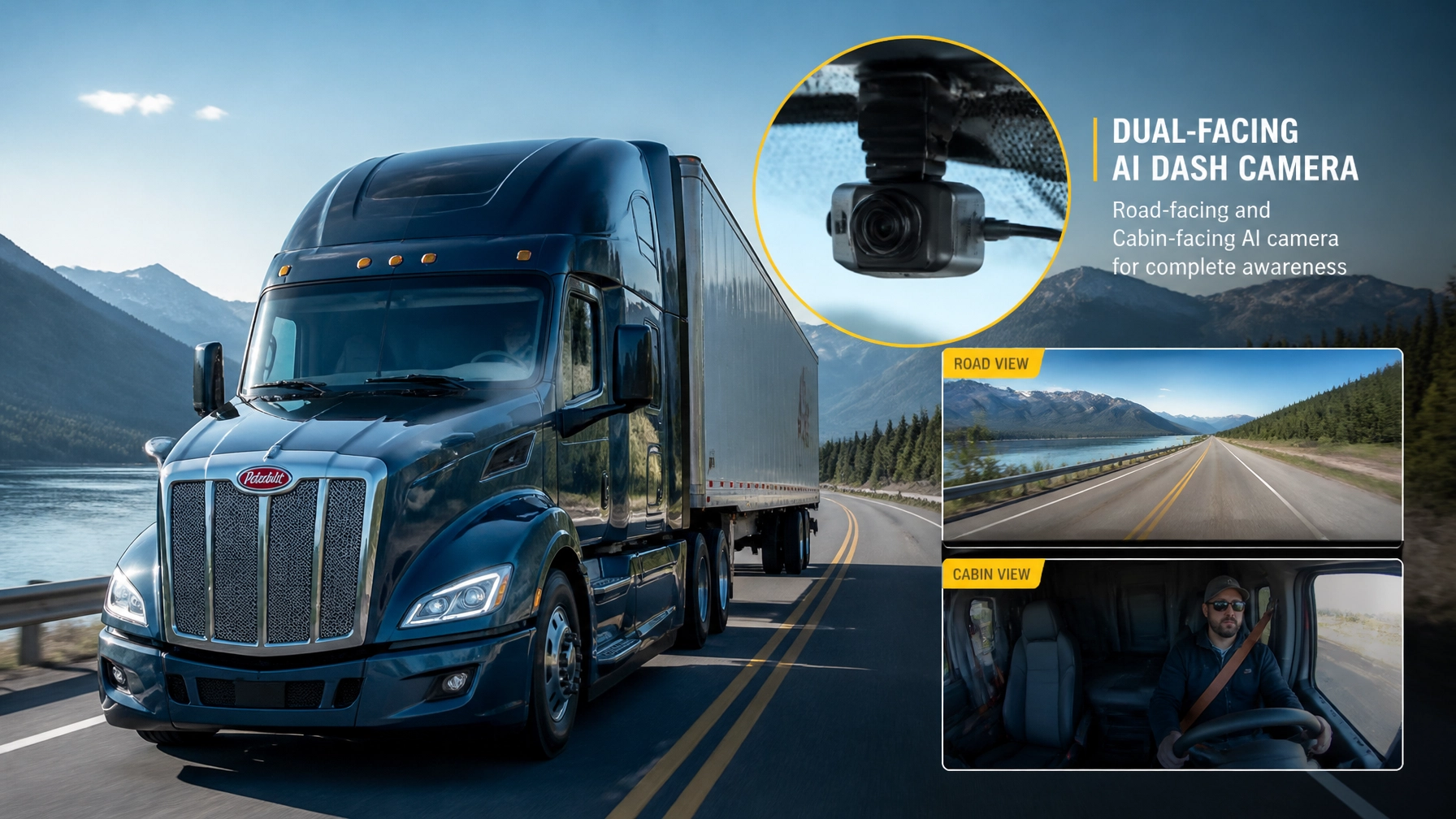
Dual Dash Cameras for Fleets: Preventing Fraud and Reducing Claims
For fleet managers in the logistics and delivery sectors, an accident is rarely just an accident. It is the beginning of a complex legal and financial process where the stakes are high and the facts are often disputed. In an era of “nuclear verdicts” and rising insurance premiums, a single false claim can cost a company hundreds of thousands of dollars in settlements and legal fees.
While front-facing cameras have become a standard safety tool, they only tell half the story. To truly protect your assets and your drivers, a dual dash cam for fleets is no longer an optional upgrade: it is a critical line of defense. By adding a rear-facing or interior perspective, you eliminate the “he-said, she-said” dynamic that often leaves trucking companies vulnerable to fraud.
The Reality of False Claims in the Trucking Industry
The commercial transport industry is a frequent target for staged accidents and fraudulent insurance claims. Because fleet vehicles are often backed by substantial insurance policies, they are viewed as high-value targets for scams like the “swoop and squat.”
Research indicates that nearly 70% of accidents involving commercial vehicles are not the fault of the fleet driver. Despite this, without visual proof, the larger vehicle is often presumed liable by default or through aggressive litigation. Statistics from the American Transportation Research Institute (ATRI) show that dash cam footage leads to a settlement instead of a lengthy claim process in 86% of cases.
When you have a dual dash cam for fleets, you provide the objective evidence needed to exonerate your drivers instantly.

1. Defending Against Rear-End Collision Fraud
Rear-end collisions account for approximately 29% of all road accidents. In many jurisdictions, the vehicle that strikes another from behind is automatically presumed to be at fault. Fraudsters exploit this rule by pulling in front of a truck and slamming on their brakes: the classic “squat” maneuver.
A front-facing camera captures the impact, but it may not clearly show the erratic behavior of the lead vehicle seconds before the crash. A dual-camera system that monitors the rear or side angles provides context. It documents the vehicle “swooping” into the truck’s lane, proving that your driver was given no time to react and that the incident was a deliberate act of fraud.
2. Documentation for Backing Accidents
Backing accidents are among the most common types of incidents for delivery and service fleets. Whether it’s in a tight loading dock or a residential driveway, these low-speed collisions often lead to exaggerated property damage or personal injury claims.
A rear-facing fleet safety camera provides a clear record of the area behind the vehicle. If a passenger car pulls behind a reversing truck at the last second, the camera captures it. This documentation is vital for:
- Proving the driver followed proper backing procedures.
- Identifying “phantom” objects or vehicles that caused the driver to swerve.
- Disproving claims of injuries in low-impact scenarios where no damage occurred.
3. Cargo Security and Interior Monitoring
For many logistics fleets, the “rear” camera isn’t just about the road behind: it’s about the cargo and the driver’s environment. Modern AI dash cameras for fleets can be configured to monitor the interior of the trailer or the cab.
In the delivery sector, false claims often involve “missing” or “damaged” cargo. Having a camera that monitors the loading and unloading process provides an irrefutable trail of evidence. If a customer claims a pallet was never delivered or arrived damaged, you can review the footage to verify the state of the goods at the moment the doors were opened. This level of visibility protects your company from internal theft and external liability simultaneously.

4. Full 360-Degree Liability Coverage
Liability doesn’t just happen at the front bumper. Side-swipes, merging accidents, and incidents involving pedestrians often occur at the rear or sides of a long trailer. A dual-camera setup provides a wider field of view that standard GPS tracking simply cannot replicate.
While GPS tells you where the truck was, video telematics tells you why the truck moved the way it did. If a driver swerves to avoid a car that merged into their rear quarter-panel, the rear-facing camera captures that offending vehicle. This allows your safety team to identify license plates and vehicle descriptions of third parties who may have fled the scene of an accident they caused.
The Economic Impact: ROI of Dual Cameras
Investing in a dual-camera system isn’t just about safety: it’s a financial strategy. Fleets that implement high-quality fleet safety cameras often see a massive return on investment through:
- Insurance Premium Reductions: Many insurers offer discounts of 10% to 30% for fleets that use proactive video monitoring.
- Reduced Claim Costs: Research shows an 86% reduction in accident-related costs when dual dash cams are used, primarily due to the speed of exoneration.
- Faster Claims Resolution: Immediate access to footage allows for a First Notice of Loss (FNOL) that includes video proof, cutting the investigation time from weeks to hours.
- Driver Retention: High-performing drivers appreciate being protected from false accusations. When your team knows the company “has their back” with video proof, morale and retention improve.

Moving Beyond “Good Enough” Safety
In today’s litigious environment, a single-perspective camera is no longer enough to protect a growing fleet. The “blind spots” in your video coverage are where the highest risks live. By implementing a dual dash cam for fleets, you are not just watching the road; you are building a comprehensive safety shield around your entire operation.
At Safety Track, we specialize in custom-tailored solutions that integrate AI-enhanced video with real-time monitoring. Whether you are managing a few delivery vans or a massive logistics fleet of Kenworth and Peterbilt trucks, our systems ensure that every angle is covered.
Don’t wait for a false claim to reveal the gaps in your safety strategy. Protect your drivers, your reputation, and your bottom line with 360-degree visibility.

Summary of Benefits for Fleet Managers:
- Instant Exoneration: Prove your driver followed the law in 70% of accidents where they are not at fault.
- Fraud Deterrence: Stop “swoop and squat” scams before they reach the courtroom.
- Cargo Integrity: Document the condition and delivery of high-value goods.
- Lower Premiums: Leverage video evidence to negotiate better rates with insurance providers.

Tyler Schneider is the IT Director at Safety Track, overseeing the company’s technological infrastructure and innovations. With a strong background in information technology and systems management, Tyler ensures that Safety Track stays at the forefront of tech solutions in fleet management. His strategic expertise supports the seamless integration of technology across the company’s operations.