
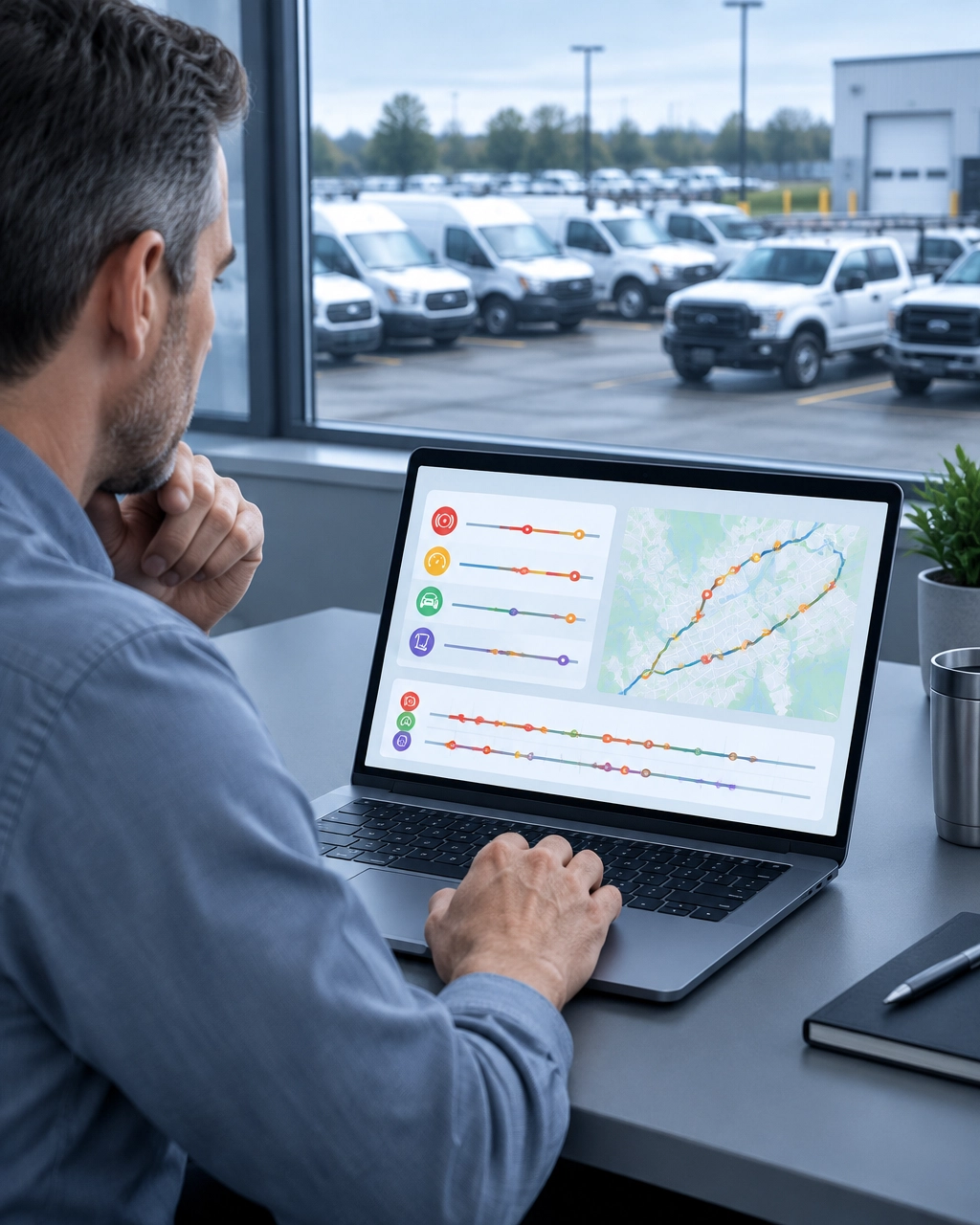
Building a Closed-Loop Fleet Safety Program: From AI Telematics Triggers to Positive Coaching
Title tag: Closed-Loop Fleet Safety Program: AI Coaching Guide
Meta description: Learn how AI telematics triggers, video review, coaching, and scorecards create a repeatable fleet safety program.
A dash camera that records but never changes behavior is only part of a safety strategy. Small and mid-size fleets need a repeatable process that identifies risk, supports a private coaching conversation, and measures what happens next.
That process is a closed-loop safety program. It connects AI telematics triggers, video review, driver coaching, scorecards, and follow-up actions in one continuous cycle.
The goal is not to punish drivers. The goal is to fix risky behavior before it becomes a collision, claim, compliance issue, or reason for a good employee to leave.
What a closed-loop fleet safety program does
A closed-loop fleet safety program turns vehicle and video data into a documented management process:
- Detect a risky behavior through AI video or telematics.
- Review the event with enough context to understand what happened.
- Coach the driver privately and constructively.
- Document the conversation and agreed improvement.
- Measure future behavior through telematics driver scorecards.
- Recognize progress and adjust the program as patterns change.
This approach is different from sending managers a list of alerts. An alert creates awareness. A closed loop creates action and follow-through.
Safety managers can use a Tracking Management Suite to view fleet activity, run driver scorecard reports, and receive notifications for events such as speeding, idling, unauthorized movement, and G-sensor activity.
The result is a safety process that moves from event detection to measurable improvement.
Start with meaningful AI telematics triggers
Triggers are the front door of the program. If a fleet configures too many alerts, managers quickly become overwhelmed. If the thresholds are too broad, drivers may lose confidence in the system.
The strongest programs prioritize behaviors that are both measurable and coachable.
Harsh braking
A harsh-braking alert identifies a sudden deceleration event. The event deserves context because the driver may have responded appropriately to a pedestrian, stopped vehicle, road hazard, or another motorist.
The coaching question should not be, “Why did you brake so hard?” It should be, “What did you see, and what could have created more space before the event?”
Hard cornering
Hard cornering can indicate excessive speed, poor route awareness, or a necessary maneuver around an unexpected hazard. Reviewing the road-facing video helps the manager separate a preventable pattern from a single defensive action.
Following distance
Following-distance events are highly coachable. Managers can review whether the driver had enough time and space to respond to traffic conditions, then reinforce a specific following-distance expectation.
Distraction
AI-enhanced cameras can help identify behaviors such as phone use, looking away from the road, or other forms of in-cab distraction. These events require a particularly respectful approach because the purpose is to correct the behavior without creating a culture of surveillance or embarrassment.
Speeding
Speeding events should be evaluated against the posted limit, route type, traffic conditions, and frequency. A repeated pattern in a work zone or residential area may deserve more attention than an isolated threshold event.
Fatigue and drowsiness indicators
Where supported by the camera system, fatigue-related alerts can identify signs such as prolonged eye closure or reduced attention. These events should trigger a safety check rather than an automatic disciplinary response. The manager should confirm whether scheduling, sleep, health, or route demands may be contributing factors.
A practical trigger policy uses tiers:
- Low-level or isolated event: In-cab alert or brief reminder.
- Repeated behavior: Private coaching assignment and follow-up review.
- Severe event: Immediate manager review and documented intervention.
- Pattern across multiple drivers: Fleet-wide training, route changes, or policy clarification.
This keeps the program focused on risk instead of treating every alert as a violation.

Review video efficiently before speaking with a driver
Managers should not spend hours searching through continuous footage. AI telematics should narrow the review to relevant events, while the manager verifies the context.
A consistent review process can take only a few minutes:
- Open the event summary. Note the vehicle, driver, time, location, speed, and trigger type.
- Watch the event clip. Review the seconds before, during, and after the alert.
- Check surrounding conditions. Look for traffic, weather, road design, pedestrians, work zones, or another vehicle’s actions.
- Compare similar events. Determine whether the alert is isolated or part of a recurring pattern.
- Choose the coaching objective. Define the one behavior the driver needs to improve.
- Save documentation when appropriate. Download the clip if it supports coaching, a claim, training, or an incident record.
Instant video access is important in this workflow. Managers should be able to control their footage directly rather than waiting for a vendor to retrieve each clip. That immediate access helps the team review events while details are fresh and keeps routine coaching from becoming an administrative burden.
Safety Track’s $99.95 per vehicle, per month unlimited video plan includes unlimited viewing and unlimited downloads. Unlimited viewing is what makes routine coaching affordable because managers can review context, compare events, and revisit footage without treating every review as an additional purchase.
For more complex operations, Safety Track also supports open API connections that can help integrate telematics and video data with dispatch, maintenance, safety, and risk-management applications.
Make every coaching conversation private and constructive
The conversation determines whether drivers view the program as a safety resource or a punishment system.
A productive fleet driver safety coaching program follows four principles:
- Private: Discuss individual events away from coworkers and customers.
- Constructive: Focus on the behavior and the next action.
- Consistent: Apply the same process across drivers and vehicle types.
- Specific: Use a short video example instead of vague criticism.
A simple coaching structure works well:
1. Begin with the facts
“An event was recorded on Tuesday at 2:15 p.m. on Main Street. The vehicle was traveling 42 mph in a 30 mph zone.”
Avoid opening with accusations or conclusions.
2. Ask for the driver’s perspective
“What was happening on the road at that moment?”
The driver may provide context that is not obvious from the first review. Listening also gives the manager a chance to identify route, scheduling, vehicle, or training issues.
3. Identify the behavior to change
“Going forward, the expectation is to reduce speed before entering this type of zone and maintain the posted limit.”
The conversation should address one or two clear actions. Too many corrections at once make improvement harder to measure.
4. Agree on the follow-up
“We will review the next two weeks of speed events and discuss the trend during the next check-in.”
The manager should record the event, the driver’s explanation, the coaching point, and the follow-up date.
Coaching should recognize good judgment as well. A driver who responds appropriately to a hazard, maintains a safe following distance, or shows improvement should receive positive feedback. This makes the program more balanced and helps drivers understand that cameras are not used only to find fault.

Use telematics driver scorecards to measure progress
A scorecard should guide a conversation, not define a driver’s value.
Effective telematics driver scorecards separate behaviors into categories such as:
- Speed management
- Harsh braking
- Acceleration
- Cornering
- Following distance
- Distraction
- Seat belt use
- Collision warnings
- Vehicle care and maintenance
Managers should review trends instead of relying on one composite number. A driver may have a strong overall score but need targeted support with following distance. Another driver may have few harsh events but a recurring speeding pattern in specific areas.
Scorecards should also account for exposure. A driver covering 2,000 miles will naturally generate more opportunities for events than a driver covering 500 miles. Managers should compare rates, patterns, and severity where the system allows it, rather than relying only on raw event counts.
The most useful scorecards answer three questions:
- What behavior needs attention?
- Has the behavior improved after coaching?
- What support or training should happen next?
Use constructive gamification to reinforce safe behavior
Gamification can encourage engagement when it recognizes progress instead of publicly shaming low performers.
Useful approaches include:
- Recognizing the most improved driver each month
- Celebrating teams with consistent seat belt compliance
- Highlighting smooth driving and strong hazard awareness
- Offering private badges or milestones
- Comparing departments or routes instead of exposing individual rankings
- Including driver feedback when an event is disputed
Avoid public “worst driver” lists. They can damage trust and create pressure to hide mistakes rather than report them.
A positive scorecard program gives drivers a clear path to improvement. It also gives managers a way to recognize safe performance that might otherwise go unnoticed.

Connect safety coaching to CSA performance
A closed-loop program does not guarantee a specific CSA outcome. It does create a more organized way to address behaviors that can contribute to safety violations and crash risk.
Managers can align internal coaching categories with relevant areas of fleet compliance, including:
- Unsafe driving behaviors
- Hours-of-service concerns
- Vehicle maintenance
- Crash-related events
- Seat belt compliance
- Inspection and documentation practices
The program should track both leading and lagging indicators.
Leading indicators include:
- Coaching completion
- Driver feedback
- Speeding trends
- Harsh-event rates
- Following-distance performance
- Training completion
Lagging indicators include:
- Preventable collisions
- Claims
- Inspection violations
- Vehicle downtime
- Compliance trends
Reviewing both types of data helps managers identify problems earlier. If speeding events decline after targeted coaching, the fleet has a measurable behavior improvement even before a larger compliance trend becomes visible.
Fleet leaders should review CSA information through official FMCSA resources, including the Safety Measurement System, and work with qualified compliance professionals when interpreting regulatory obligations.
Build driver retention into the safety program
Driver retention improves when expectations are clear and management practices are fair. A camera program should protect drivers as well as the company.
That requires:
- Explaining what the cameras detect and why
- Establishing reasonable privacy and access policies
- Giving drivers an opportunity to provide context
- Correcting behavior consistently across the fleet
- Avoiding automatic punishment for every alert
- Recognizing improvement
- Reviewing camera accuracy and disputed events
A driver who understands the process is more likely to view coaching as professional feedback. A driver who believes every event could result in public criticism or immediate discipline is less likely to trust the program.
The purpose of a closed-loop safety program is not to create more penalties. It is to create better decisions, clearer expectations, and stronger communication between managers and drivers.
Start with one repeatable safety loop
Small and mid-size fleets do not need to launch every feature at once. They can begin with three or four high-value triggers, a consistent video review process, and a short private coaching format.
A practical starting cycle looks like this:
- Configure alerts for speeding, harsh braking, distraction, and following distance.
- Review flagged video with GPS and event context.
- Hold a private coaching conversation.
- Document the agreed behavior change.
- Review the driver’s scorecard after two to four weeks.
- Recognize improvement or provide additional support.
- Adjust thresholds and training based on fleet-wide patterns.
This is how cameras become part of a working safety system instead of another source of unused data.
Safety Track’s AI-enhanced camera and fleet management solutions give managers access to video, GPS tracking, alerts, reporting, and custom integrations. With immediate control over footage and an unlimited video plan that includes unlimited viewing and downloads, fleet teams can make routine coaching practical and consistent.
Contact Safety Track to discuss a custom-tailored closed-loop fleet safety program.

Tyler Schneider is the IT Director at Safety Track, overseeing the company’s technological infrastructure and innovations. With a strong background in information technology and systems management, Tyler ensures that Safety Track stays at the forefront of tech solutions in fleet management. His strategic expertise supports the seamless integration of technology across the company’s operations.