
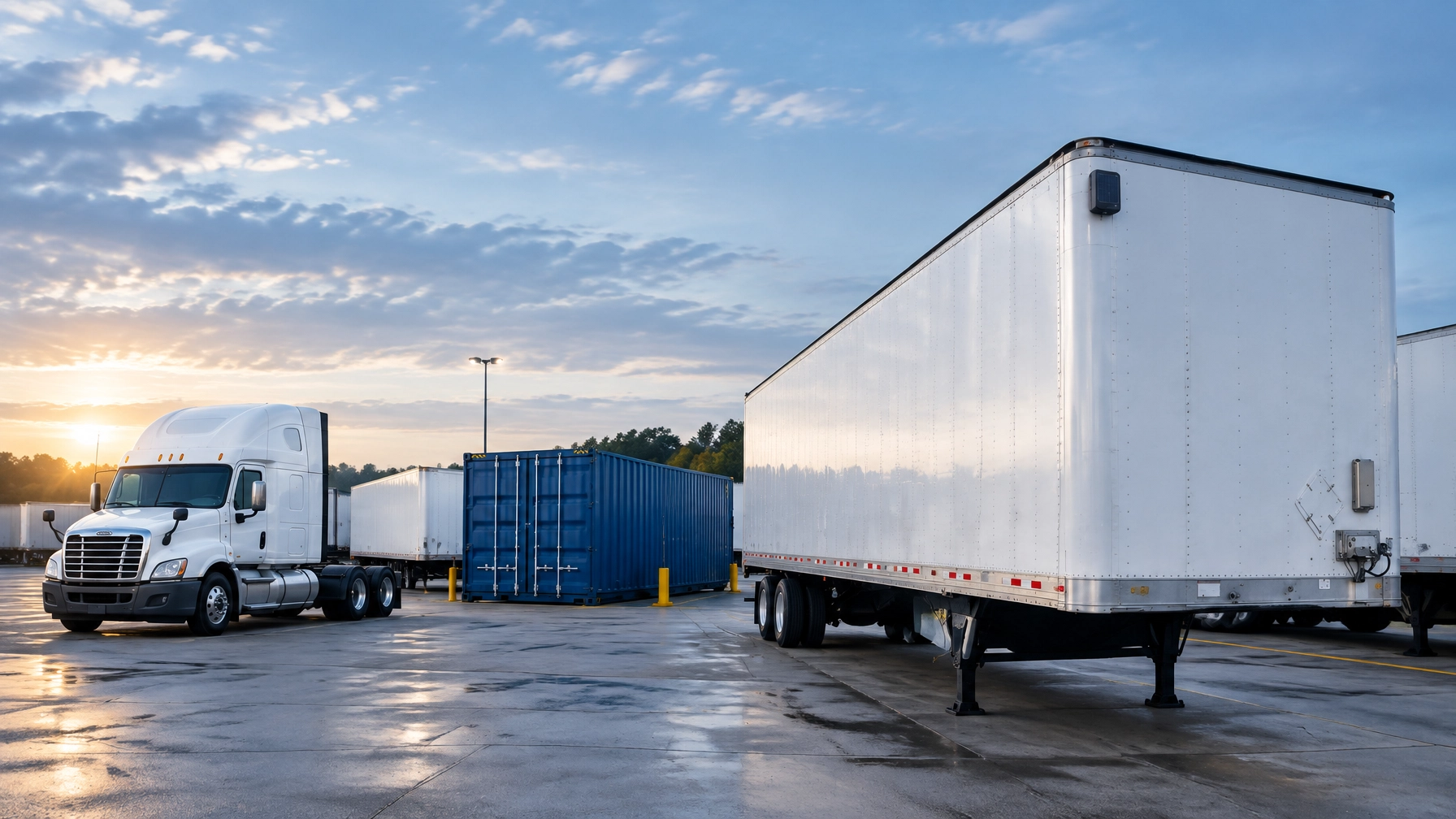
Unpowered Asset & Trailer Tracking: Solar GPS vs. Long-Life Battery Units for Cargo Protection
Trailers, containers, generators, and other unpowered assets create a visibility gap for fleet managers. They may be essential to daily operations, but they do not always have a dependable power source. Once they leave a tractor, job site, or active route, they can disappear from the fleet manager’s view.
That gap creates operational and security risks. A trailer may sit at the wrong yard for days. A container may be moved without authorization. Cargo may be exposed to tampering before anyone knows the asset has left its approved location.
Unpowered trailer GPS asset tracking closes that gap. The right tracker provides location visibility, movement alerts, geofencing, and a foundation for faster theft detection and recovery. The key decision is choosing the power approach that fits the asset’s environment: solar harvesting or a long-life battery.
Why Unpowered Assets Need Dedicated Tracking
Powered trucks can typically support hardwired GPS devices and continuous telematics data. Unpowered trailers and containers require a different approach.
These assets may spend time:
- Parked in a storage yard
- Detached from a tractor between trips
- Staged at a construction site
- Loaded at a warehouse or distribution center
- Stored inside a building with limited sunlight
- Moved between customers, subcontractors, or job sites
Manual inventory checks do not provide enough control. A spreadsheet may show where an asset should be, but GPS tracking shows where it is now.
A platform such as Safety Track’s Tracking Management Suite gives fleet managers a centralized view of vehicles and equipment. Managers can locate assets, create geofences, run reports, and receive text or email alerts when unexpected movement occurs.
The result is practical visibility across trailers, containers, and other non-powered equipment.
Solar GPS vs. Long-Life Battery Trackers
Solar and battery-powered units both support unpowered asset tracking. They solve the same visibility problem but perform differently in different environments.

Solar-powered fleet asset trackers
A solar powered fleet asset tracker uses daylight to recharge an internal battery. It is best suited to assets stored outdoors where the solar surface has regular exposure.
Solar tracking works well for:
- Outdoor trailer yards
- Construction equipment staging areas
- Intermodal containers
- Open storage lots
- Utility and rental equipment
- Assets that remain parked for long periods
Solar does not mean the unit operates without limits. The tracker still depends on panel exposure, battery capacity, cellular coverage, and reporting frequency. Dirt, snow, shade, roof orientation, seasonal daylight, and prolonged cloud cover can reduce energy collection.
The main advantage is reduced maintenance. When the panel receives sufficient daylight, it helps keep the internal battery charged while the asset remains in service.
Safety Track’s ST-1050 Solar is described as a weatherproof device that can ping on demand or at intervals of 10 minutes, 30 minutes, 12 hours, or 24 hours. Those reporting options allow fleet managers to balance tracking detail and energy use based on the asset’s risk profile.
Long-life battery tracking units
Long-life battery units are better suited to assets stored indoors, under cover, or in yards with limited sunlight. They use a high-capacity battery and conserve energy through configurable reporting intervals and sleep modes.
Battery-powered tracking works well for:
- Indoor trailers
- Covered storage areas
- Warehouse equipment
- Containers stacked beneath other equipment
- Assets that move between indoor and outdoor locations
- Fleets that need simple, low-maintenance installation
A battery tracker should not be selected based only on a headline battery-life estimate. Real-world performance depends on how often the unit reports, how frequently the asset moves, cellular signal strength, temperature, sensor activity, and battery age.
Safety Track’s ST-1300 is listed as a weatherproof device with longer battery life and configurable reporting intervals. Fleet managers should review expected update frequency and operating conditions with the provider before choosing a deployment plan.
Quick comparison
| Consideration | Solar GPS tracker | Long-life battery tracker |
|---|---|---|
| Best environment | Outdoor yards and open job sites | Indoor, covered, or low-light locations |
| Primary energy source | Daylight plus internal battery | Internal battery |
| Maintenance | Low when solar exposure is reliable | Periodic battery planning required |
| Reporting flexibility | Supports frequent or scheduled updates | Frequent updates consume more battery |
| Main limitation | Shade, snow, dirt, and limited daylight | Battery depletion over time |
| Ideal use case | Outdoor trailers and containers | Indoor trailers and mixed-storage assets |
The right choice depends on where the asset spends most of its time, not simply where it operates during a delivery.
What Shortens Tracker Battery Life?
Fleet managers should set realistic expectations for any battery-powered device. Battery life is not a fixed number because operating conditions change.
The following factors can shorten battery life:
- Frequent location updates
A tracker that reports every few minutes uses more energy than one that reports every 12 or 24 hours. - Constant movement
Moving assets may trigger more GPS fixes, cellular transmissions, and event notifications. - Weak cellular coverage
The device may use additional energy when it repeatedly attempts to connect and transmit data. - Extreme temperatures
Very cold or hot conditions can reduce battery efficiency and affect battery performance over time. - Frequent tamper or door events
Repeated door openings, vibration events, or unauthorized movement alerts increase activity. - Battery age
Rechargeable batteries gradually lose capacity. A deployment plan should include inspection and replacement expectations.
Solar trackers also require planning. A solar panel covered by dirt, snow, equipment, or dense vegetation cannot collect energy effectively. Managers should include the tracker in regular asset inspections, especially in winter or after long periods of bad weather.
A reliable deployment begins with the desired alert speed. A high-risk cargo trailer may need more frequent updates than a low-use storage container.
Build Alerts Around Real Security Events
GPS location alone is useful, but event-based alerts make tracking actionable. The platform should tell managers when an asset’s movement or condition differs from the expected plan.
Geofencing for yards and job sites
Geofencing creates a virtual boundary around a yard, warehouse, customer location, or construction site. Safety Track’s TMS supports custom round, polygon, and route geofences, with notifications when an asset crosses a boundary.
Fleet managers can create alerts for:
- A trailer leaving a secure yard after hours
- A container entering an unauthorized location
- Equipment arriving at the wrong job site
- An asset remaining outside a designated area
- A trailer returning to the wrong facility
Geofencing turns a map into an active monitoring tool. It also supports better yard inventory management because managers can see which assets are inside each location without relying on phone calls or manual counts.
Disconnected trailer alerts
A trailer leaving without its expected tractor is a meaningful security event. It may indicate an unauthorized hookup, an unplanned dispatch change, or potential theft.
Disconnected trailer alerts can be configured around the relationship between the trailer tracker, external power, tractor connection, movement, and geofence status. Depending on the hardware and deployment, the system may identify:
- Loss of external power
- Trailer movement after separation
- Movement outside approved hours
- A trailer leaving a yard without an expected tractor
- A tractor-trailer connection that does not match the dispatch plan
Fleet managers should confirm how the selected hardware detects disconnection. Some deployments rely on power-state changes, while others combine GPS movement, geofence rules, and tractor or trailer data.
The objective is straightforward: alert the team when a trailer moves without the expected operational context.
Optical door-open sensors
Location data cannot confirm whether cargo doors opened. An optical door-open sensor or another compatible door sensor adds that missing layer.
A door sensor can support alerts when:
- A trailer door opens outside a delivery window
- A container opens inside a restricted area
- Cargo access occurs after business hours
- A door opens while the asset is moving
- A trailer is tampered with before dispatch
Not every GPS tracker includes an optical sensor. Fleet managers should ask whether the device supports external sensor inputs, what wiring or wireless options are available, and whether door events appear in the same dashboard as location and geofence alerts.
Door monitoring is especially valuable for high-value cargo, temperature-sensitive shipments, and trailers that remain unattended between appointments.

Yard Inventory Management Without Manual Searches
A yard can become difficult to manage as the number of trailers, containers, and equipment units grows. Assets may be present but incorrectly recorded. Others may be assigned to a job but remain at a previous facility.
Yard inventory management improves when every unpowered asset has a clear status:
- At the assigned yard
- At a customer or job site
- In transit
- Outside an approved geofence
- Stationary for longer than expected
- Connected to a tractor
- Disconnected and moving
- Experiencing a door or tamper event
This visibility helps managers answer basic operational questions quickly:
- Which trailers are available?
- Which assets are at the wrong location?
- Which containers have not moved recently?
- Which units left the yard overnight?
- Which trailers need to be dispatched to the next job?
The Tracking Management Suite provides real-time location, reporting, geofencing, and SMS or email alerts in one system. That single view helps small fleets reduce administrative work while giving larger logistics and construction operations better control across multiple locations.
Tracking Supports Recovery: It Does Not Prevent Theft Alone
No GPS tracker physically prevents theft on its own. A tracker cannot replace secure yards, access controls, locks, driver procedures, or cargo-handling standards.
Its value is detection and recovery speed.
A layered cargo protection program should include:
- GPS tracking on trailers and unpowered assets
- Geofences around yards and job sites
- Disconnected trailer alerts
- Movement alerts outside approved hours
- Door-open or optical sensor events
- Visible asset identification and documentation
- A defined response process for suspicious activity
- Contact information for law enforcement and recovery partners
When an alert fires, the fleet team needs to know who reviews it, who contacts the driver or site manager, and when law enforcement should receive the asset’s location history.
Fast response matters because cargo theft and trailer tampering become more costly as time passes.
How to Choose the Right Deployment
Fleet managers should evaluate the complete operating environment before selecting a tracker.
Ask these questions:
- Where is the asset stored most often?
Outdoor storage supports solar. Indoor or covered storage favors long-life battery hardware. - How often is location data needed?
Frequent updates provide more detail but increase energy consumption. - What should trigger an alert?
Movement, geofence exits, disconnection, door openings, tampering, or extended dwell time may all require different rules. - How will the team respond?
Alerts should reach the people responsible for dispatch, security, or asset recovery. - Does the platform support mixed fleets?
A growing operation may need to track powered trucks, trailers, containers, and heavy equipment in one system. - Can the system connect with existing software?
Safety Track’s Open API integration supports the use of telematics and video data in custom dispatch, maintenance, safety, and risk-management applications.
A custom deployment is more effective than applying the same hardware and alert rules to every asset.
Make Unpowered Assets Visible Again
Solar GPS and long-life battery units both provide a practical answer to the visibility gap surrounding trailers and unpowered equipment. Solar is a strong fit for outdoor assets with reliable daylight exposure. Long-life battery tracking is better for indoor, covered, or low-light storage environments.
The most effective program combines the right power source with geofencing, disconnected trailer alerts, door monitoring, and yard inventory management. It gives fleet managers a current view of where assets are and a faster way to act when something changes.
Safety Track provides customizable GPS tracking solutions for vehicles, trailers, heavy equipment, and other fleet assets. Review the available asset-tracking options or contact Safety Track to discuss a deployment built around the fleet’s storage conditions, reporting needs, and cargo-protection priorities.

Tyler Schneider is the IT Director at Safety Track, overseeing the company’s technological infrastructure and innovations. With a strong background in information technology and systems management, Tyler ensures that Safety Track stays at the forefront of tech solutions in fleet management. His strategic expertise supports the seamless integration of technology across the company’s operations.