
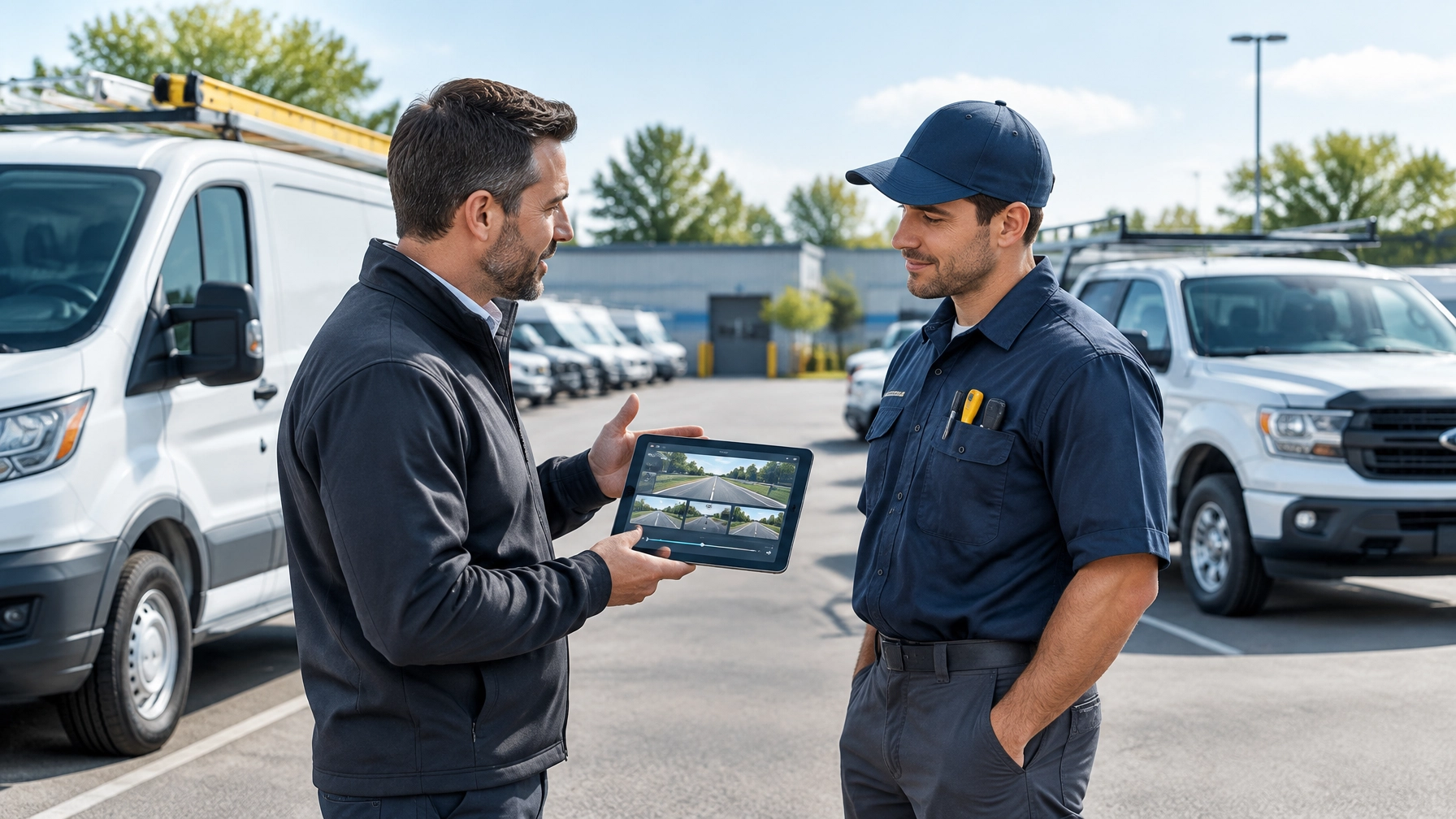
The Two-Minute Coaching Conversation: Turning One Clip Into Better Driving
A flagged dash-camera clip creates an opportunity. It shows a specific moment, gives the fleet manager something concrete to discuss, and helps the driver connect a decision with its potential risk.
The challenge is what happens next. A long lecture can put the driver on the defensive. A vague reminder such as “be more careful” does not provide a useful next step. Ignoring the clip allows the same behavior to continue.
For small businesses operating HVAC vans, plumbing trucks, electrical service vehicles, lawn-care vehicles, delivery vans, and property-maintenance fleets, the solution can be simple: one clip, one focused conversation, and one specific agreement.
A two-minute coaching conversation keeps the discussion timely and practical. It also makes driver feedback easier to repeat across a busy operation.
Start With a Conversation, Not an Accusation
The opening determines how the driver receives the rest of the discussion. Managers should begin with the shared goal of safe, professional driving rather than an accusation.
A useful opening has three parts:
- Thank the driver for taking a moment.
- State that the purpose is to understand what happened.
- Explain that the conversation will focus on one behavior and one improvement.
A manager might say:
“Thanks for taking two minutes. I want to look at one short clip from yesterday’s route. The goal is to understand what happened and agree on one way to handle a similar situation more safely next time.”
This approach lowers tension without minimizing the event. It tells the driver that the manager is addressing a behavior, not attacking the driver’s character.
The manager should avoid opening with statements such as “You always do this” or “This was careless.” Those phrases turn a review into a personal judgment before the driver has had a chance to explain the situation.
The objective is accountability with context. A calm opening makes that possible.
Let the Driver Narrate the Clip First
After opening the conversation, play the clip without immediately explaining what the manager sees. Ask the driver to narrate the situation.
Useful questions include:
- “What do you see happening here?”
- “What were you watching at this point?”
- “What was traffic doing around you?”
- “What made this situation difficult?”
- “What would you do differently if the same situation happened again?”
The driver may identify details that are not obvious from a short clip. Traffic may have changed suddenly. A vehicle may have entered the lane. A delivery location may have created a visibility problem. The driver may also recognize the unsafe behavior before the manager names it.
Listening first improves the quality of the review. It helps the manager distinguish between an isolated event, a reasonable response to an unusual hazard, and a repeatable behavior that needs correction.
Safety Track’s AI fleet dash cameras and fleet safety and compliance tools can help managers identify events for review. The technology starts the process. The conversation turns the footage into a practical lesson.

Keep the Conversation to Two Minutes
The time limit matters because the purpose is focused coaching, not a full training session.
A two-minute conversation encourages the manager to:
- Review one clip
- Address one primary behavior
- Ask one or two questions
- Agree on one next step
- Document the discussion briefly
Long meetings can make drivers feel that every flagged event will become a disciplinary hearing. A short conversation keeps feedback close to the behavior and makes regular coaching more realistic.
A practical structure looks like this:
First 20 seconds: Open
Thank the driver and explain the purpose.
Next 40 seconds: Watch and listen
Play the clip. Ask the driver to describe what happened.
Next 40 seconds: Identify the behavior
Describe the observable action and explain the risk.
Final 20 seconds: Agree and close
Set one specific expectation and confirm when the manager will follow up.
The manager can schedule a longer discussion when the clip reveals a serious incident, repeated behavior, suspected impairment, or a training need that cannot be handled in two minutes. The two-minute format is for routine coaching moments, not every possible safety issue.
Focus on the Behavior, Not the Person
Effective feedback describes what happened without labeling the driver.
Instead of saying, “You are an aggressive driver,” a manager can say:
“The following distance closed as traffic slowed, leaving less time to react.”
Instead of saying, “You were careless while backing,” the manager can say:
“The vehicle moved while the area behind it was not fully visible.”
Behavior-based language is more precise. It gives the driver something that can be changed and measured.
Managers should also connect the behavior to the risk:
- Short following distance reduces available reaction time.
- Distracted driving reduces awareness of changing hazards.
- Fast turns can affect vehicle control and cargo stability.
- Backing with limited visibility increases the risk of striking a person, vehicle, or fixed object.
The conversation should remain factual and proportional. A single clip does not define a driver’s overall performance. It does provide a useful moment to reinforce the company’s operating standard.
Example Script: Following-Distance Clip
A manager reviewing a following-distance event might say:
“Let’s look at this section. What do you see happening between your van and the vehicle ahead?”
After the driver responds, the manager can continue:
“Right. The gap becomes short as traffic slows. The concern is not your character or effort. It is the amount of space available if the vehicle ahead brakes suddenly. What could you do earlier in this situation?”
The driver might suggest easing off the accelerator sooner. The manager can then establish one agreement:
“Good. For the next two weeks, let’s focus on creating a consistent following gap whenever traffic and road conditions allow. If traffic compresses, ease off earlier instead of matching the vehicle ahead closely. I’ll review a few upcoming trips and we’ll check in briefly.”
The manager should use the company’s defined following-distance standard, including any requirements that apply to the fleet’s vehicle types and operating conditions. The key is to make the expectation specific enough for both people to recognize improvement.

Example Script: Backing Incident
Backing events require a calm, direct review because visibility can change quickly around service locations, customer properties, and crowded parking areas.
A manager might say:
“Before we look at the clip, what was limiting your view behind the vehicle at this location?”
After listening:
“The vehicle began moving while the rear area was not fully clear. The safer step is to stop, scan the area, and get out and look when visibility is limited. Use a spotter when one is available and establish clear communication before moving.”
The manager can close with one agreement:
“For the next several routes, the agreement is stop, scan, and get out and look before backing whenever the path is not completely visible. If the area remains unclear, use a spotter or reposition the vehicle. I’ll follow up after reviewing the next few backing events.”
The conversation should not assume that every backing incident has the same cause. The manager should consider the location, vehicle configuration, lighting, pedestrians, parked vehicles, and available space. The objective is to reinforce a repeatable decision process.

End With One Specific Agreement
A coaching conversation should end with a clear statement of what happens next.
Good agreements are:
- Specific: “Create more space before traffic slows.”
- Observable: “Stop and check the area before backing.”
- Practical: “Use a spotter when one is available.”
- Time-based: “Review the next two weeks of trips.”
- Shared: “The manager will follow up, and the driver will apply the agreed behavior.”
Avoid ending with “Just be safer.” That phrase expresses a goal but does not describe an action.
The manager can ask the driver to repeat the agreement in their own words:
“Before we wrap up, what is the one step you are taking from this review?”
This confirms understanding and gives the driver ownership of the next action.
Document the Conversation Briefly
Documentation does not need to become an administrative project. A short note is enough for routine coaching.
The manager can record:
- Date of the conversation
- Vehicle and driver
- Event type
- Behavior discussed
- Driver’s explanation, if relevant
- Agreed action
- Follow-up date
For example:
“Reviewed following-distance clip with Unit 04 driver on October 2. Driver identified that the gap closed as traffic slowed. Agreed to ease off earlier and maintain the fleet’s following-distance standard when conditions allow. Review upcoming trips in two weeks.”
The note creates continuity. It helps managers recognize improvement, identify repeated patterns, and apply expectations consistently across the fleet.
Companies should maintain access controls and follow applicable privacy, employment, insurance, and evidence-retention requirements when storing or sharing video.
Follow Up and Share Good Clips
Follow-up is what turns a conversation into a change in behavior. A manager does not need to review every second of every route. The manager should check the relevant event type or a representative sample of later trips.
If the driver improves, acknowledge it:
“I reviewed the recent trips and saw more space before traffic compressed. That is the adjustment we discussed. Keep using that approach.”
Recognition matters. Drivers respond better when video is used to reinforce good judgment, not only to identify mistakes.
Managers can share clips showing:
- Smooth braking
- Early hazard recognition
- Careful backing
- Proper following distance
- Good use of mirrors and signals
- Calm responses to unexpected traffic
This creates a more balanced safety culture. Drivers learn that the camera system documents professional decisions as well as risky ones.
Unlimited Video Makes Routine Coaching Possible
Consistent coaching requires practical access to footage. Managers should not have to ration reviews because each clip creates an additional charge or wait for a vendor to retrieve footage that the business needs immediately.
Safety Track’s $99.95 per vehicle, per month unlimited video plan includes unlimited viewing and unlimited downloads. Authorized managers can access footage directly, review the surrounding context, and download clips for coaching, training, claims, or internal records.
That direct access supports a routine process:
- Open the flagged event.
- Review enough context to understand it.
- Hold a two-minute conversation.
- Record the agreement.
- Follow up on the next trips.
The value is not simply having more footage. The value is being able to use the footage consistently without waiting for vendor retrieval or deciding whether another review is worth an extra fee. Managers can also use instant video access to respond quickly when an incident or customer question requires evidence.
Consistency Beats Intensity
One dramatic safety meeting rarely changes driving behavior for the long term. Consistent, specific conversations have a stronger effect.
A small fleet manager can begin with one flagged clip each week. The manager can keep the discussion respectful, focus on one behavior, document the agreement, and recognize improvement at the next review.
That process works for HVAC fleets, plumbing companies, electrical contractors, local delivery businesses, lawn-care operators, and property-maintenance teams. It gives drivers clear expectations while giving managers a repeatable way to improve safety.
A video alert identifies the moment. A two-minute conversation creates understanding. Follow-up turns the agreement into a habit.
Contact Safety Track to discuss a custom fleet video and telematics solution for a small business fleet.
Frequently Asked Questions
How long should a routine driver coaching conversation last?
A routine conversation can be completed in about two minutes when it focuses on one clip and one behavior. Serious incidents or repeated problems may require a longer review or additional training.
Should a manager let the driver speak first?
Yes. Asking the driver to explain what they saw and what influenced the decision provides context and encourages a two-way conversation. The manager can then address the observable behavior and establish the safer next step.
Should fleet managers share positive driving clips?
Yes. Sharing examples of good hazard response, safe following distance, and careful backing helps drivers understand that video is used for recognition as well as correction.

Tyler Schneider is the IT Director at Safety Track, overseeing the company’s technological infrastructure and innovations. With a strong background in information technology and systems management, Tyler ensures that Safety Track stays at the forefront of tech solutions in fleet management. His strategic expertise supports the seamless integration of technology across the company’s operations.