
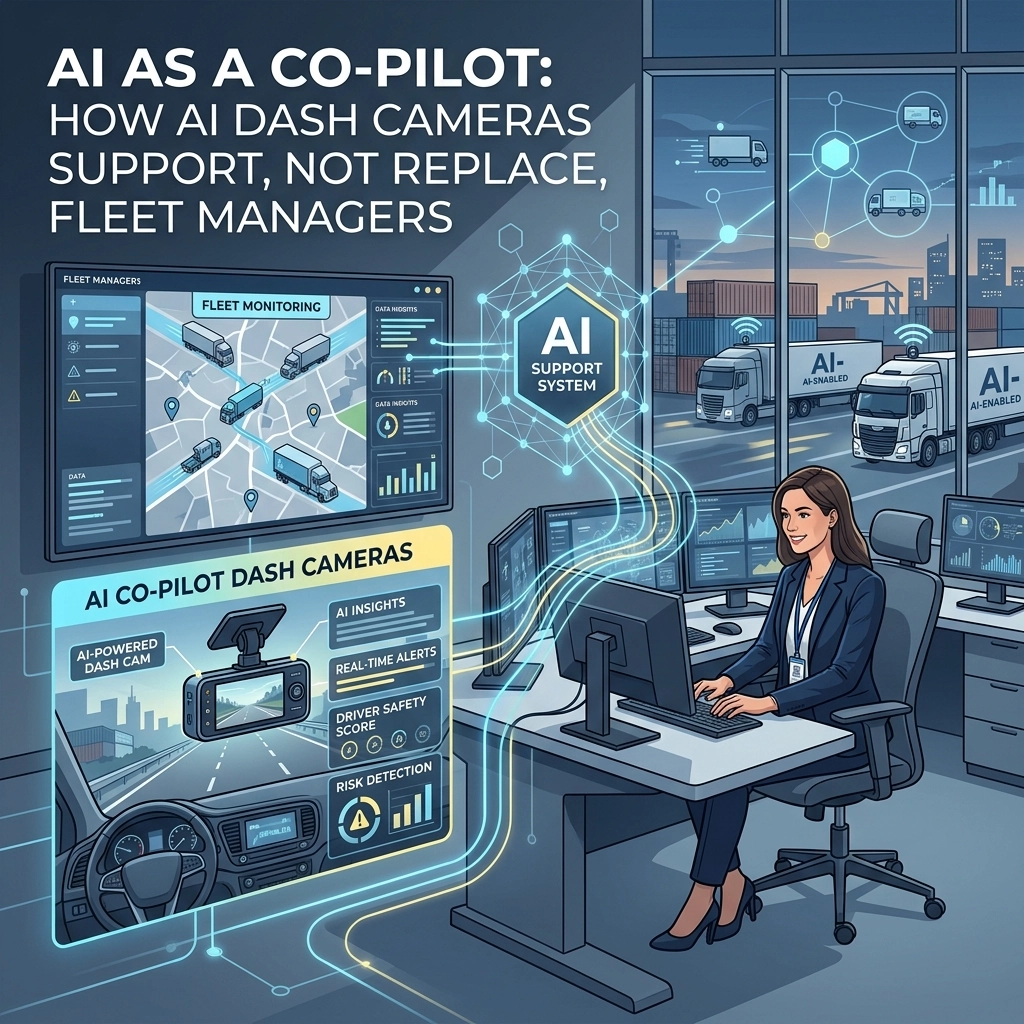
AI Dash Cameras: Co-Pilot for Safer, More Efficient Fleet Management
The logistics and transportation industry is currently undergoing a massive technological shift. For decades, fleet management relied on a mixture of gut instinct, paper logs, and basic GPS data. However, as the complexity of modern supply chains increases and safety regulations become more stringent, the role of the fleet manager has expanded beyond what a single human can reasonably oversee. Enter Artificial Intelligence.
There is a common misconception that the introduction of AI signifies the eventual replacement of human oversight. In reality, AI dash cameras for fleets are designed to function as a “co-pilot.” Much like an aircraft’s co-pilot monitors complex systems and alerts the captain to anomalies, AI-driven technology supports fleet managers by acting as an extra set of eyes and an analytical powerhouse. This technology doesn’t replace the manager’s expertise; it amplifies it, allowing them to focus on high-level strategy rather than getting lost in a sea of raw data.
The Evolution from Passive Recording to Active Intelligence
In the early days of fleet safety, dash cameras were passive tools. They recorded footage onto an SD card that was only checked after an accident occurred. This “forensic” approach was useful for insurance claims but did nothing to prevent the incident in the first place. Modern AI fleet safety cameras have changed the paradigm from reactive to proactive.
Today’s video telematics solutions use “edge computing,” meaning the AI software lives directly on the camera hardware. These devices can identify specific behaviors: such as distracted driving, tailgating, or fatigue: in real-time. Instead of a manager having to watch hours of video to find one instance of a driver using their phone, the AI identifies the event immediately.
This transition from passive recording to active intelligence is what defines the “co-pilot” relationship. The AI handles the monotonous task of monitoring every second of every trip, while the fleet manager retains the authority to decide how to act on that information. This partnership ensures that no critical safety event goes unnoticed, regardless of how many vehicles are in the fleet.

Managing by Exception: Filtering the Noise
One of the greatest challenges for a modern fleet manager is “data fatigue.” When a fleet grows to dozens or hundreds of vehicles, the amount of data generated by traditional GPS and video systems becomes overwhelming. Without AI, a manager might receive hundreds of alerts for “harsh braking,” many of which might be justified (such as avoiding a child running into the street).
AI dash cameras for fleets solve this problem through a process called “automated triage.” The AI evaluates the context of an event before alerting the manager. It asks: Was the driver distracted when the brake was applied? Was the following distance too short? If the AI determines the event was a legitimate safety risk, it flags it for review. If it was a safe, defensive maneuver, it may simply log the data without requiring immediate human intervention.
This allows managers to practice “Management by Exception.” Instead of reviewing the behavior of every driver, they can focus their limited time on the top 5% of risky events that actually require their expertise. By filtering out the noise, AI empowers managers to be more effective and less reactive. To understand how these tools fit into a broader operational strategy, you can explore how AI fleet optimization tools transform your operations.
The Human Element: AI as a Tool for Targeted Coaching
Technology can identify a mistake, but it cannot mentor a driver. This is where the human fleet manager remains irreplaceable. A camera can beep when a driver is distracted, but it cannot sit down with that driver to understand why they are distracted or help them develop better habits through professional development.
Video telematics solutions provide the objective evidence needed for productive coaching sessions. Without video, coaching often turns into a “he-said, she-said” argument. A driver might insist they weren’t speeding, or that the other vehicle cut them off. AI-enhanced footage provides a clear, unbiased account of the facts.
When a manager uses this data, they aren’t just “policing” their drivers; they are acting as a mentor. They can show the driver exactly what the AI saw, discuss the risks involved, and provide effective driver training programs to correct the behavior. This targeted approach is far more successful than generic safety meetings because it addresses the specific needs of each individual.
Furthermore, having this data allows managers to recognize good performance. AI can identify when a driver successfully avoids an accident through defensive driving, allowing the manager to provide positive reinforcement. This builds a culture of safety and mutual respect that no automated system could ever achieve on its own.

Protecting Your Greatest Asset: Driver Exoneration
A major point of friction when introducing fleet safety cameras is the fear among drivers that they are being “spied on.” However, when framed as a co-pilot, the narrative shifts from surveillance to protection. In the event of an accident involving a commercial vehicle, the professional driver is often blamed by default.
AI cameras act as the driver’s most reliable witness. Because these systems capture the moments leading up to an incident, they can provide proof that a driver was following all safety protocols. For instance, if a passenger vehicle cuts off a semi-truck and slams on the brakes, the AI footage can instantly prove the truck driver was not at fault.
This leads to faster insurance settlements and protects the company from the rising costs of “nuclear” litigation. By exonerating drivers, fleet managers prove that the technology is there to support them, not to catch them doing something wrong. For a deeper look at the financial benefits of this protection, see why fleet camera systems deliver significant cost savings.
Operational Synergy: Beyond Safety
While safety is the primary driver for adopting AI dash cameras for fleets, the co-pilot relationship extends into operational efficiency. When integrated with a full telematics suite, these cameras provide a holistic view of the fleet’s health and performance.
For example, AI can help identify patterns that lead to excessive fuel consumption or vehicle wear and tear. If the system detects frequent harsh braking or rapid acceleration, it’s not just a safety concern: it’s a maintenance concern. Managers can use these insights to adjust maintenance schedules or optimize routes.
During challenging seasons, such as the unpredictable weather of spring, having real-time video intelligence is invaluable. Managers can see the road conditions their drivers are facing and provide real-time guidance on whether to continue a route or seek shelter. This level of support is discussed in our guide on navigating unpredictable spring weather with video telematics.

Balancing Technology and Privacy
One of the most important roles of a fleet manager is navigating the ethical landscape of workplace technology. As AI becomes more prevalent, managers must act as the bridge between the company’s need for data and the driver’s right to privacy.
The “co-pilot” philosophy emphasizes transparency. Managers who successfully implement AI fleet safety cameras are those who communicate openly about what the cameras do and, more importantly, what they don’t do. Most AI systems are designed to only record and upload footage when a safety event is triggered. They aren’t meant to watch a driver eat their lunch or listen to their private conversations.
Managers must take the lead in establishing clear policies regarding data usage. By balancing monitoring with privacy rights, they maintain the trust of their workforce while still reaping the benefits of the technology. You can learn more about finding this balance in our article on fleet monitoring vs. employee privacy rights.
Data-Driven Decision Making vs. Traditional Intuition
Experience is a fleet manager’s most valuable asset. Years of managing drivers and schedules create an intuition that technology cannot replicate. However, intuition can be clouded by bias or incomplete information.
AI provides the “hard data” that validates a manager’s intuition. Instead of “thinking” a certain route is dangerous or “feeling” like a driver is becoming less attentive, the manager has the numbers to back it up. This transition to data-driven safety training over tradition allows for more confident decision-making at the executive level.
When it comes time to choose a system that fits this managerial style, the process can be complex. Choosing the right “co-pilot” requires looking at how the hardware integrates with your existing workflows. For guidance on this, refer to our post on how to choose the best fleet camera system.
The ROI of an Empowered Manager
Ultimately, the value of AI dash cameras for fleets is measured by the return on investment (ROI). But that ROI isn’t just about lower insurance premiums: it’s about the increased productivity of the fleet manager.
When a manager is no longer bogged down by administrative tasks and manual video review, they can focus on high-value activities like:
- Developing long-term safety strategies.
- Improving driver retention through better communication and recognition.
- Optimizing asset utilization and reducing downtime.
- Integrating new technologies like GPS trailer tracking.
By acting as a force multiplier, AI allows a single manager to handle a larger fleet more effectively than they ever could before. This scalability is essential for companies looking to grow in a competitive market.
Future Insights: The Roadmap Ahead
As we look toward the future, the integration between human managers and AI will only deepen. We are already seeing the emergence of predictive analytics, where AI can forecast the likelihood of an accident occurring before it ever happens, based on a combination of driver history, weather, and traffic patterns.
However, even in a future with predictive modeling and autonomous features, the human element will remain the “Captain” of the ship. AI will provide the insights, but the manager will provide the context, the empathy, and the strategic direction. The goal is a seamless partnership where technology handles the data and humans handle the people. For more on where this technology is heading, check out our future insights into safety tracking technology.

Conclusion: Embracing the Co-Pilot
The fear that AI will replace fleet managers is based on a misunderstanding of what fleet management actually is. It is not just about moving boxes or watching dots on a map; it is about leadership, risk management, and human psychology. AI has no “leadership” capabilities: it only has “processing” capabilities.
By embracing AI dash cameras for fleets as a co-pilot, managers can reclaim their time and focus on the parts of their job that truly matter. At Safety Track, we specialize in providing the tools that make this partnership possible. Our video telematics solutions are designed to give you the visibility you need without the headache of data overload.
The future of fleet management isn’t a choice between humans and machines. It’s about humans with machines, working together to create a safer, more efficient, and more profitable industry. If you’re ready to see how an AI co-pilot can support your team, explore our AI fleet dash cameras today.
Ready to enhance your fleet’s safety?
Contact Safety Track today to learn more about our custom solutions tailored to your unique operational needs. Whether you’re looking for real-time monitoring or long-term safety analytics, we have the expertise to help you stay ahead of the curve.

Tyler Schneider is the IT Director at Safety Track, overseeing the company’s technological infrastructure and innovations. With a strong background in information technology and systems management, Tyler ensures that Safety Track stays at the forefront of tech solutions in fleet management. His strategic expertise supports the seamless integration of technology across the company’s operations.