
Blind Spot Detection & MDVR Radar Fusion: Eliminating Pedestrian Hazards in Municipal Fleets
Municipal refuse trucks operate where visibility is limited and people are close. Residential streets, narrow alleys, parked vehicles, bike lanes, and frequent stops create a demanding environment for drivers and pedestrians.
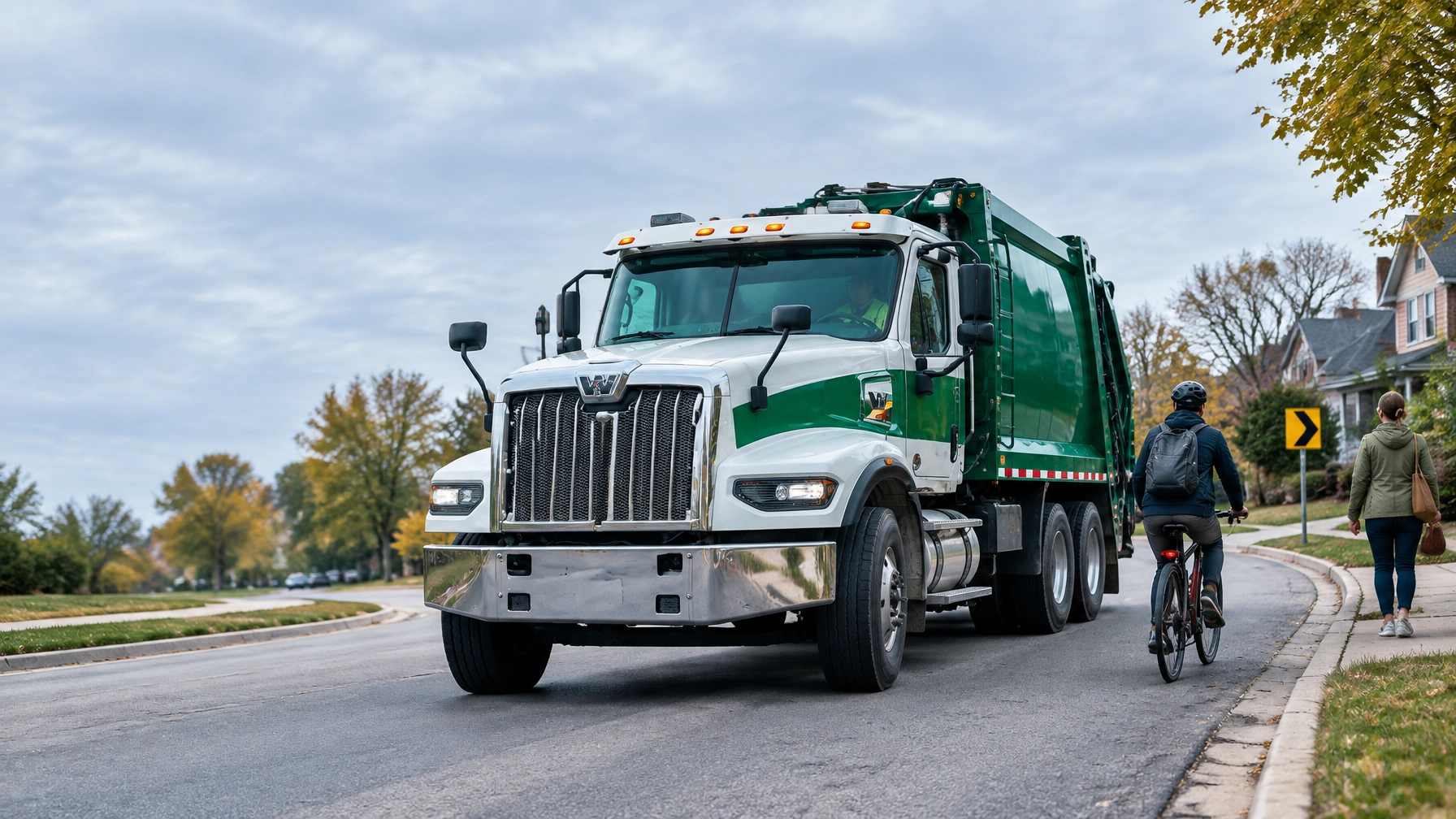
The most recurring risk is the low-speed right turn. A driver may check mirrors and still lose sight of a cyclist or pedestrian near the passenger side. A truck’s size, cab height, body length, and turning path can create a blind zone that changes as the vehicle moves.
Blind spot detection MDVR fleets address this risk by combining multiple camera views, mobile digital video recording, GPS data, and sensor alerts. When millimeter-wave radar is fused with camera feeds, the system can identify both the location and type of road user entering a danger zone.
The result is more than a recording system. It becomes an active safety layer that supports driver awareness, fleet oversight, and public trust.
Why right-hand turns create a recurring municipal fleet hazard
Right-hand turns place the passenger side of a truck closest to the curb. That is also where pedestrians may be crossing and cyclists may be traveling beside traffic.
The risk increases when:
- The truck is moving through a residential intersection
- A cyclist approaches from behind while the truck is stopped
- Parked cars block the driver’s view of the sidewalk
- A refuse truck pulls away from a collection stop
- The vehicle turns through a narrow alley or tight corner
- Multiple pedestrians are near a bus stop, driveway, or crosswalk
Low speed does not eliminate risk. It gives the driver more time to react, but the truck’s turning path can still move across a person’s path quickly. A driver may also focus on the front corner while the rear wheels track closer to the curb.
This creates a practical need for fleet side turn assist. The system should warn the driver when a pedestrian or cyclist enters the monitored passenger-side zone before the vehicle completes the turn.
The objective is not to replace driver judgment. It is to provide another layer of information when mirrors and direct sightlines are not enough.
What radar-camera fusion adds to blind spot detection
Cameras and radar solve different parts of the detection problem.
Cameras provide visual context. AI-enabled video can help classify whether an object is a pedestrian, cyclist, vehicle, or another obstacle. Camera feeds also give fleet managers visual evidence for reviewing an event later.
Millimeter-wave radar provides distance and movement data. It can measure the relative position of an object and continue detecting movement in conditions that challenge cameras, including darkness, glare, rain, and visual clutter.
Radar-camera fusion combines these inputs in the MDVR or connected safety controller. The system can compare:
- Where an object is located
- How quickly it is moving
- Whether it is entering a defined blind zone
- Whether the truck is turning or traveling straight
- Whether the vehicle’s speed and direction create a meaningful risk
This combination helps reduce unnecessary warnings while improving detection of vulnerable road users. The camera helps identify the object. Radar helps confirm its position and movement.
A complete system can also synchronize alerts with GPS, turn-signal status, vehicle speed, and recorded video. Fleet managers receive a more useful event record instead of an isolated alarm.

Vulnerable road user detection focuses on people, not just objects
Vulnerable road user detection refers to technology designed to recognize people who have little physical protection in a traffic interaction. In municipal fleet operations, that typically includes:
- Pedestrians
- Cyclists
- People using mobility devices
- Children near residential streets
- Roadside workers
- Individuals walking near parked vehicles or collection points
A general proximity sensor may detect an object. A VRU-focused system provides more useful context by distinguishing a person or cyclist from a fixed object such as a mailbox, sign, or parked vehicle.
That distinction matters for driver coaching. A warning that identifies a person entering the passenger-side danger zone gives the driver a clear reason to slow, stop, or reassess the turn.
Municipal fleets should also configure detection zones around the actual vehicle. A rear-loader, side-loader, street sweeper, and utility truck do not have identical dimensions or blind spots. Sensor placement and alert boundaries should reflect the body style, wheelbase, mirror position, and route environment.
What the driver hears and sees during a side-turn alert
A warning system must be understandable under pressure. Drivers should not have to interpret a complicated screen while maneuvering a large vehicle.
A practical deployment typically includes:
- A passenger-side visual indicator
- A small in-cab display or warning panel
- An audible tone when a VRU enters the blind zone
- A more urgent tone when time-to-collision decreases
- A camera view showing the relevant side of the truck
- Alerts that become active or more sensitive when the turn signal is engaged
For example, a driver begins a slow right turn on a residential street. The passenger-side radar detects movement near the curb. The camera identifies a cyclist. The in-cab system produces an audible alert and displays the passenger-side video feed.
The driver can then stop the turn, allow the cyclist to pass, and continue only when the path is clear.
The system should support driver confidence rather than create constant distraction. Alert thresholds need to be tuned for municipal routes, operating speeds, vehicle dimensions, and common pedestrian locations. Drivers also need training on what each tone means and what action is expected.
Which municipal vehicles should receive radar-plus-camera coverage?
Not every vehicle requires the same configuration. A fleet assessment helps managers prioritize the vehicles and routes with the greatest exposure.
Radar-plus-camera systems are especially appropriate for:
- Rear-load and side-load refuse trucks
These vehicles are large, make frequent curbside stops, and operate around pedestrians and cyclists. - Street sweepers and municipal service trucks
These vehicles often travel slowly through neighborhoods while working close to curbs and parked vehicles. - Utility and public works trucks
Crews may stop near intersections, construction areas, and narrow alleys where people move around the vehicle. - Vehicles assigned to dense urban routes
High pedestrian and cyclist activity increases the value of passenger-side monitoring and turn alerts. - Trucks with long bodies or limited rear visibility
Additional side and rear cameras can improve coverage around the entire vehicle.
A deployment may use passenger-side radar and camera coverage as the first phase. Fleets can then add driver-facing cameras, rear cameras, 360-degree views, GPS tracking, and additional sensors based on route data and event history.
This phased approach helps municipalities control budget while addressing the most important risk first.
How fleet managers review events after an alert
The value of a blind spot system continues after the truck completes the turn. Each relevant event should produce a synchronized record that may include:
- Forward-facing video
- Passenger-side video
- Rear or body-mounted camera footage
- Radar detection information
- Vehicle location
- Speed and heading
- Turn-signal status
- Alert time and duration
Fleet managers can review the event to determine whether the alert was appropriate, how the driver responded, and whether the route or intersection requires additional attention.
A manager may discover that alerts occur repeatedly near the same school, apartment complex, alley, or collection point. That information can support route planning, signage requests, driver coaching, or changes to collection procedures.
Video review should be constructive. The goal is to identify patterns and improve decisions, not to treat every alert as a disciplinary event. Clear event footage can help managers recognize good defensive driving as well as opportunities for improvement.
Safety Track’s fleet camera solutions and AI fleet dash cameras support video-based monitoring, driver accountability, and incident review. A custom fleet deployment can also connect camera coverage with GPS tracking and real-time monitoring requirements.

Instant video access strengthens incident response
When a pedestrian or cyclist reports a close call, fleet managers need facts quickly. Waiting for a vendor to retrieve footage delays the review and can leave the municipality responding to incomplete information.
Instant access gives authorized users direct control over available footage. Managers can review the event, compare camera angles, download the relevant clip, and share it with the appropriate internal or external party without waiting for vendor retrieval.
Safety Track’s $99.95 per vehicle, per month unlimited video plan includes:
- Unlimited video viewing
- Unlimited video downloads
- Faster event investigation
- More flexibility for driver coaching
- Predictable monthly video costs
Unlimited access also allows managers to review the full context before and after an alert. That is important when a short event clip does not explain how the pedestrian, cyclist, driver, and truck moved in relation to one another.
For municipalities, this supports accurate communication, better documentation, and more consistent safety reviews.
The human and financial stakes
A serious pedestrian or cyclist incident affects more than a claim file. It can affect a driver’s confidence, a municipality’s relationship with residents, and public perception of the entire service.
The financial consequences may include:
- Liability claims
- Vehicle downtime
- Legal and administrative costs
- Higher insurance expenses
- Route disruption
- Additional training requirements
- Damage to public trust
A radar-camera deployment cannot eliminate every hazard. It can provide earlier awareness, clearer evidence, and a repeatable process for improving operations.
That combination matters. Drivers receive practical assistance at the moment a blind zone becomes relevant. Fleet managers receive data for coaching and route analysis. Residents receive a municipal service fleet that is taking pedestrian and cyclist safety seriously.
A practical deployment checklist
Before selecting a blind spot detection system, municipal fleet managers should confirm that the solution can:
- Detect pedestrians and cyclists near the passenger side
- Support low-speed right-turn alerts
- Combine millimeter-wave radar with camera feeds
- Record synchronized event video
- Cover the vehicle’s actual body dimensions
- Provide clear visual and audible in-cab alerts
- Work in low light and changing weather conditions
- Connect events to GPS and vehicle data
- Allow managers to review and download footage immediately
- Support driver coaching and trend analysis
- Scale across refuse, utility, and public works vehicles
- Be tailored to the fleet’s routes and operating procedures
The best system is not simply the one with the longest feature list. It is the one drivers can understand, managers can use, and the municipality can deploy consistently.
Contact Safety Track to discuss a custom fleet camera and monitoring deployment.
Safer turns start with better visibility
Right-hand turns will remain a recurring challenge for municipal and refuse fleets because trucks operate close to pedestrians and cyclists in places where visibility changes quickly.
Blind spot detection MDVR fleets give drivers another source of awareness. With vulnerable road user detection, fleet side turn assist, millimeter-wave radar, and camera feeds working together, the system can identify hazards earlier and guide a safer response.
For fleet managers, the benefits extend beyond the cab. Immediate video access supports faster event review, better coaching, clearer incident documentation, and stronger public accountability.
A tailored radar-camera deployment helps municipalities put visibility where it matters most: beside the truck, near the curb, and at the moment a low-speed turn begins.
Frequently Asked Questions
What is radar-camera fusion in a municipal fleet?
Radar-camera fusion combines millimeter-wave radar data with AI camera feeds. Radar measures object position and movement, while cameras help classify pedestrians, cyclists, vehicles, and other objects.
Why are right-hand turns a major risk for refuse trucks?
Right-hand turns place the truck’s passenger side near the curb, where cyclists and pedestrians may be traveling or crossing. The truck’s size and turning path can create blind zones that are difficult to monitor using mirrors alone.
What is fleet side turn assist?
Fleet side turn assist uses sensors and cameras to monitor the side of a commercial vehicle during a turn. When a pedestrian or cyclist enters a defined danger zone, the system provides an audible and visual in-cab warning.
What does vulnerable road user detection identify?
Vulnerable road user detection can identify pedestrians, cyclists, and other people who face increased risk during interactions with large commercial vehicles.
Does Safety Track offer unlimited video access?
Safety Track’s $99.95 per vehicle, per month unlimited video plan includes unlimited viewing and unlimited downloads. Authorized fleet users can access footage directly instead of waiting for vendor retrieval.

Tyler Schneider is the IT Director at Safety Track, overseeing the company’s technological infrastructure and innovations. With a strong background in information technology and systems management, Tyler ensures that Safety Track stays at the forefront of tech solutions in fleet management. His strategic expertise supports the seamless integration of technology across the company’s operations.