
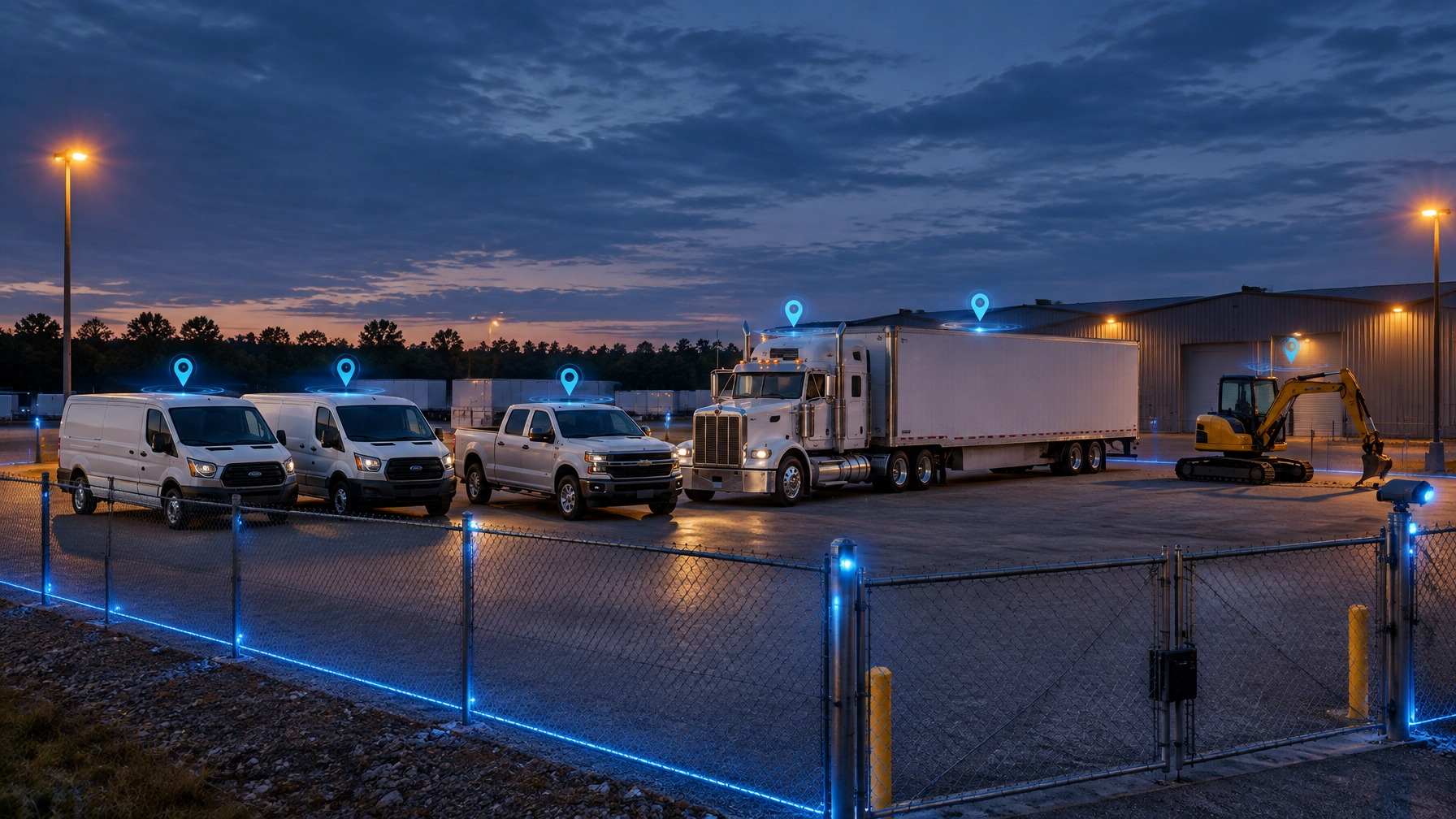
Commercial Fleet Theft Prevention: Layering Geofencing, Starter Interrupt, and Covert GPS
Theft creates more than a replacement expense. A stolen work truck, trailer, or excavator can interrupt scheduled jobs, delay customers, increase insurance pressure, and leave a small business without the equipment it needs to operate.
A single security device rarely provides complete protection. A visible GPS tracker can be found and disconnected. A geofence can identify unauthorized movement but cannot physically prevent it. An engine immobilizer can restrict vehicle use but cannot locate a trailer or non-powered machine.
A stronger strategy layers three controls:
- Covert GPS hardware with battery backup for location visibility
- Polygon geofence breach alerts for immediate detection
- Remote starter interrupt or engine immobilization for controlled response and recovery
These tools complement each other. Together, they help fleet managers detect suspicious movement, confirm what happened, coordinate with law enforcement, and protect operations during the first critical minutes of a theft event.
Why a Single Theft Prevention Layer Is Easy to Defeat
Commercial vehicles and equipment face different security risks. A service van may be targeted for its tools. A trailer may be moved without authorization and left at another location. Construction equipment may be loaded onto another vehicle and removed from an overnight jobsite.
Each asset also has different power and connectivity requirements. A hardwired tracker may work well on a powered truck but may not be appropriate for an unpowered trailer. A camera can provide valuable evidence but may not continue recording if its power source is disconnected.
A single layer leaves a gap:
- GPS alone provides location data, but a thief may search for and disable the device.
- Geofencing alone sends an alert, but managers still need a way to locate and respond to the asset.
- Starter interrupt alone can restrict a vehicle’s next start, but it does not provide location visibility or protect unpowered equipment.
- Cameras alone can capture evidence, but footage does not replace real-time asset tracking.
Layered fleet vehicle theft prevention combines detection, visibility, and controlled intervention.

Layer One: Covert GPS Trackers With Battery Backup
A covert GPS tracker adds a second source of location information that is harder to identify and remove. Fleet managers can deploy this type of hardware on vehicles, trailers, containers, and high-value equipment in a concealed, protected location.
The tracker should be selected according to the asset. A powered truck may use a hardwired device. An unpowered trailer or machine may require a weather-resistant unit with a long-life battery or solar-assisted power. Safety Track offers asset tracking devices designed for different deployment needs, including the ST-1050 Solar, ST-1300, and ST-1200 Hardwired.
The goal is not to promise that a tracker cannot be found. The goal is to maintain a location signal if a primary telematics device is damaged, unplugged, or removed.
A fleet vehicle theft prevention GPS deployment should include:
- Primary tracking on the vehicle or equipment
- A covert secondary tracker on high-value or high-risk assets
- Battery status monitoring where available
- Tamper or power-loss alerts where supported
- Accurate asset records, including VIN, equipment number, trailer number, and description
- A tested process for sharing current location information with law enforcement
For trailers and non-powered equipment, the tracker must also be installed where it can withstand vibration, dust, weather, and normal maintenance activity. A concealed device that loses power or cellular connectivity is not a dependable backup.
Layer Two: Polygon Geofence Breach Alerts
Geofencing turns location data into an operational security rule. A fleet manager draws a virtual boundary around an approved area, such as a yard, depot, construction site, customer property, or storage lot.
Safety Track’s Tracking Management Suite supports custom round, polygon, and route geofences. The system can send text or email notifications when an asset crosses a boundary.
Polygon geofences are especially useful for commercial theft prevention because they can follow the actual shape of a property. A simple circle may include roads, neighboring lots, or public areas that are not part of the secured site. A polygon can be drawn around the yard, equipment entrance, loading area, or jobsite perimeter.
Fleet managers should configure rules for:
- After-hours movement: An excavator leaves a jobsite overnight.
- Unauthorized yard exit: A truck crosses the depot boundary outside approved operating hours.
- Trailer movement: A trailer departs a staging area without a dispatch assignment.
- Route deviation: A vehicle leaves an approved route or operating region.
- Unexpected engine activity: A parked vehicle starts or moves during a restricted time window.
- Extended unauthorized stops: A stolen asset pauses at a location that does not match the work order.
Geofence breach alerts are only effective when the notification reaches the right person. Small and mid-size fleets should route high-priority alerts to an on-call manager, operations lead, or security contact. A low-priority email that no one monitors overnight does not provide meaningful protection.
The first week after deployment should include alert testing. Managers should confirm that boundaries are accurate, operating hours reflect real schedules, and authorized movements do not create unnecessary false alarms.

Layer Three: Remote Starter Interrupt and Engine Immobilization
A remote starter interrupt or engine immobilization system provides a controlled way to restrict vehicle use. Depending on the equipment and installation, the system may prevent the next engine start or support a remote shutoff function.
These terms should not be treated as interchangeable. A starter interrupt generally prevents a vehicle from starting. An engine immobilization system may use a control module to restrict operation. Remote shutoff capabilities vary by vehicle, equipment type, installation, and configuration.
Safety must govern every immobilization decision. A fleet should never abruptly disable a moving vehicle in traffic or create a hazardous condition. A practical policy typically requires:
- Verification that the movement is unauthorized
- Confirmation of the vehicle’s current status and location
- Approval from an authorized manager
- Coordination with law enforcement when appropriate
- Use only when the vehicle is stopped or when the system is specifically designed and approved for the situation
- Clear documentation of who issued the command and why
For a stolen truck, the immobilizer is most useful as a controlled recovery tool. GPS identifies where the vehicle is. A geofence alert explains when it left an approved area. The starter interrupt can help prevent the vehicle from being restarted after it stops, subject to system capabilities and law enforcement direction.
This layer does not replace physical security. Fencing, lighting, wheel locks, access controls, and secure parking remain important, especially for construction sites and overnight yards.
A Rapid Recovery Protocol for the First Ten Minutes
Technology only improves security when employees know what to do. A written theft response protocol should identify primary and backup contacts before an incident occurs.
Minutes 0–2: Receive and verify the alert
The on-call manager receives a geofence breach, movement, tamper, or power-loss alert. The manager should immediately check:
- Asset name and identification number
- Last known location and current location
- Direction of travel, if available
- Authorized dispatches or after-hours work orders
- Whether a driver, technician, or subcontractor is scheduled to move the asset
- Whether additional alerts show tampering, door activity, or power interruption
Verification should be quick, not an excuse to delay escalation. If no authorized explanation exists, the event should be treated as suspicious.
Minutes 2–5: Escalate and preserve information
The fleet manager contacts the designated security lead, owner, or operations executive. The team should preserve the alert history and record the time of the first unauthorized movement.
Managers should gather:
- Vehicle or equipment description
- License plate, VIN, or serial number
- Trailer number and cargo description
- Current GPS location and heading
- Last approved location
- Time of geofence breach
- Recent photos and identifying marks
- Any available video footage
Safety Track’s real-time tracking tools help managers maintain current location visibility. If cameras are installed, live video or recorded footage can help verify whether the movement involved an employee, a tow vehicle, or unauthorized access.
Minutes 5–10: Contact law enforcement and coordinate containment
The fleet’s designated contact should report the theft to the appropriate local law enforcement agency. The report should include the asset’s identification details, exact current location, direction of travel, and the time the theft was detected.
Managers should provide live location information through the method requested by law enforcement. They should avoid independent pursuit or confrontation. Employees should not approach suspected thieves or attempt a roadside recovery.
If the vehicle has a remote starter interrupt or engine immobilization system, an authorized manager should review whether it is safe and appropriate to use. The action should follow company policy, system instructions, applicable law, and law enforcement guidance.
The objective is not to guarantee recovery. The objective is to reduce the time between unauthorized movement, verified detection, accurate reporting, and coordinated response.
Protecting Trailers, Heavy Equipment, and Overnight Yards
Construction and equipment-heavy operations need asset-specific security rules.
For heavy equipment, managers can create jobsite geofences and configure alerts for movement during nonworking hours. A solar or long-life battery GPS tracker can maintain visibility when the equipment is not connected to vehicle power. Physical barriers, lighting, locked access points, and equipment staging plans add important deterrence.
For trailers, a dedicated asset tracker can identify unauthorized movement even when the trailer is disconnected from a tractor. Managers should also consider door sensors or other accessories when cargo access is a significant risk. The Safety Track theft protection solution outlines how GPS tracking, alerts, cameras, and remote shutoff accessories can work together.
Overnight yard procedures should include:
- A final asset location check before closing
- Confirmation that all vehicles and trailers are inside approved geofences
- Locked gates and controlled key access
- Adequate lighting and visible cameras
- An on-call alert recipient
- A monthly test of alerts and response procedures
For visual verification and incident documentation, Safety Track’s video options can complement GPS tracking. The unlimited video plan costs $99.95 per vehicle, per month and includes unlimited viewing and unlimited downloads. Video does not replace GPS tracking, but it can help managers verify events and provide evidence without waiting for a vendor to retrieve footage.
Build a Security Program That Matches the Fleet
Commercial fleet theft prevention works best when it matches the assets, operating hours, and risk profile of the business. A small HVAC fleet may need vehicle tracking, after-hours yard geofences, and starter interrupt protection. A construction company may need covert GPS hardware on excavators, trailer tracking, jobsite boundaries, and a more detailed recovery protocol.
The most effective program combines:
- Covert GPS hardware for backup location visibility
- Geofence breach alerts for early detection
- Remote starter disable or engine immobilization for controlled vehicle response
- Cameras and live video for verification and evidence
- Secure yards and jobsites to deter unauthorized access
- Written procedures that guide the first ten minutes
Safety Track provides custom fleet management solutions for vehicles, trailers, and equipment. Explore the Tracking Management Suite, review asset tracking options, or contact Safety Track to discuss a deployment designed around the operation.

Tyler Schneider is the IT Director at Safety Track, overseeing the company’s technological infrastructure and innovations. With a strong background in information technology and systems management, Tyler ensures that Safety Track stays at the forefront of tech solutions in fleet management. His strategic expertise supports the seamless integration of technology across the company’s operations.