
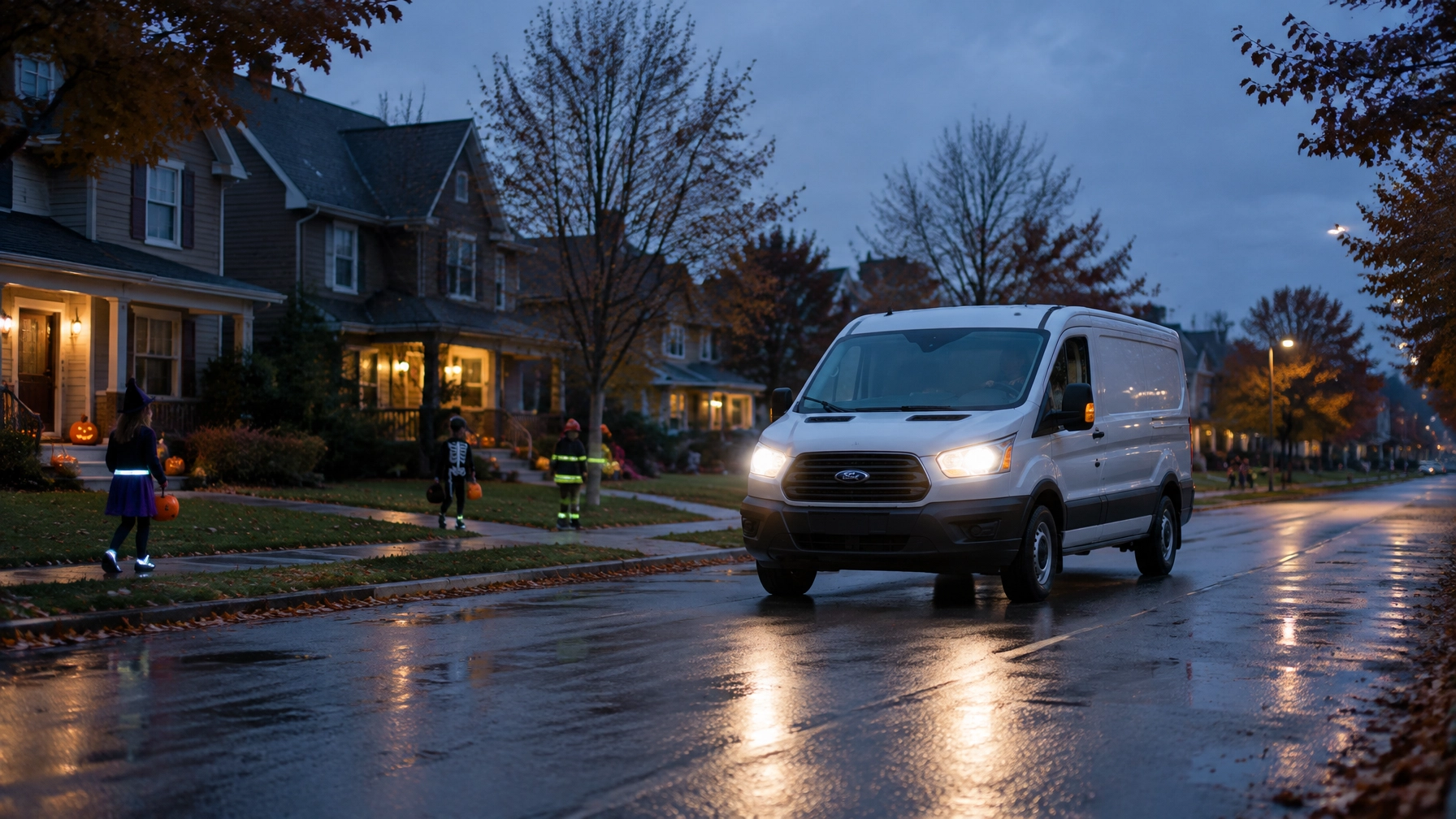
Halloween Is the One Night Your Drivers Should Slow Down
Halloween creates a unique pedestrian risk for small business fleets. Children in dark costumes move through residential streets, adults gather near driveways, and parked cars can block a driver’s view. Dusk arrives earlier in the fall, while service drivers may already be finishing a long day of calls and deliveries.
Research published in JAMA Pediatrics found that pedestrian fatality risk was 43% higher on Halloween evenings than on comparable evenings. For children ages 4 to 8, the risk was approximately 10 times higher. The study identified the highest risk around 6 p.m., when dusk, residential traffic, and trick-or-treating overlap.
For HVAC, plumbing, electrical, lawn care, property maintenance, and local delivery companies, Halloween requires more than a general safety reminder. Owners and fleet managers should adjust routes, reinforce low-speed driving, and make sure drivers have the tools to respond when something unexpected happens.
Why Halloween Requires a Different Fleet Safety Plan
Halloween changes the normal driving environment. Children may cross between parked vehicles, step into the street from a driveway, or move quickly from one home to another. Costumes and masks can reduce visibility for pedestrians, while decorations and low lighting create additional visual distractions.
The risk is especially high for service fleets because vans and light trucks often travel directly into residential neighborhoods. A driver may need to stop at several homes, enter narrow driveways, or navigate streets where children are walking outside.
Several conditions make Halloween evening different:
- Trick-or-treaters may cross outside marked crosswalks.
- Children may be difficult to see between parked cars.
- Masks and costumes can limit a child’s peripheral vision.
- Drivers may encounter more vehicles stopped along the curb.
- Dusk and darkness reduce reaction time.
- Drivers may be fatigued after a full schedule of service calls.
- Decorations, porch lights, and crowds can create visual clutter.
The correct response is straightforward: reduce speed, increase following distance, scan continuously, and give pedestrians more time and space.
Adjust Route Timing Before October 31
The safest Halloween route is often the route that avoids the busiest trick-or-treating hours. Fleet managers should review the service schedule before the holiday and identify calls that can be moved earlier in the day.
The highest-risk period generally falls between approximately 5 p.m. and 9 p.m. A small business can reduce exposure during that window by:
- Scheduling residential calls earlier.
- Completing routes near schools and family neighborhoods before dusk.
- Moving nonurgent appointments to another day.
- Grouping nearby jobs to reduce repeated neighborhood travel.
- Avoiding unnecessary repositioning after the final service call.
- Allowing extra time between appointments.
A tightly packed schedule creates pressure to hurry. That pressure can lead to speeding, rushed turns, and distracted navigation. Adding realistic travel time helps drivers maintain a safe pace without worrying about being late to the next job.
GPS tracking can also help managers review route timing and identify neighborhoods where vehicles are likely to encounter heavier pedestrian activity. Safety Track’s GPS fleet tracking and AI monitoring solutions give businesses greater visibility into vehicle location, driving activity, and route conditions.

Set a Lower-Speed Standard for Residential Streets
The posted speed limit is not always the appropriate speed for Halloween evening. Drivers should slow down further when children, parked vehicles, or limited visibility make the road more difficult to read.
Fleet managers should coach drivers to:
- Drive below the posted limit when conditions require it.
- Cover the brake when passing parked vehicles.
- Stop fully before entering or exiting driveways.
- Check both sides of the street before turning.
- Avoid passing a vehicle stopped near a crosswalk or group of children.
- Leave additional space behind other vehicles.
- Expect pedestrians to appear from between parked cars.
- Use headlights early and keep windshields clean.
A driver should never assume that a child will use a crosswalk or follow a predictable path. The safest approach is to treat every residential street as a low-speed, child-dense environment.
Backing deserves special attention. A small child can disappear from a driver’s view behind a van or light truck. Drivers should walk around the vehicle when practical, check mirrors and camera views, and back slowly. If visibility is limited, the driver should stop and request assistance rather than continue guessing.
Coach Drivers on Pedestrian Awareness
A short pre-shift safety meeting can make Halloween expectations clear. The conversation does not need to be complicated. It should focus on the behaviors most likely to prevent an incident.
Managers should remind drivers to scan in layers:
- Look ahead for children near the curb, driveways, and parked cars.
- Check both sides before turns and while passing stopped vehicles.
- Watch vehicle movement for open doors, sudden stops, and cars pulling away from the curb.
- Recheck blind areas before moving through an intersection or driveway.
- Expect movement whenever people are gathered near the roadway.
Drivers should also eliminate distractions. Phone use, route adjustments, eating, and other in-cab tasks should stop while the vehicle is moving. Navigation should be set before departure, and any necessary changes should be made after pulling over safely.
Managers can use a brief coaching message such as:
“On Halloween, slow down before the danger becomes visible. Look between parked cars, cover the brake near driveways, and assume a child may enter the roadway.”
This keeps the message practical and easy to remember.
Account for Driver Fatigue at the End of the Day
Halloween safety is not only about pedestrians. It is also about the condition of the driver.
Service technicians and delivery drivers may spend the entire day moving between jobs. Fatigue can reduce scanning effectiveness, delay braking, and make it harder to recognize hazards in low light. A driver who is tired may also feel more pressure to finish the last appointment quickly.
Fleet managers should review the final assignments of the day and avoid placing the most demanding residential routes at the end of an extended shift. Managers should also encourage drivers to report fatigue before it affects performance.
Warning signs include:
- Frequent yawning
- Difficulty maintaining attention
- Missing turns or route instructions
- Delayed reactions
- Drifting within the lane
- Irritability or reduced awareness
- Trouble recalling the last few miles
A fatigued driver should take a break, notify a manager, or stop operating the vehicle when necessary. A delayed service call is manageable. A pedestrian collision is not.
Use AI Dash Cameras for Real-Time Awareness and Evidence
AI dash cameras add another layer of protection during high-risk driving periods. A properly configured system can identify safety events, record the surrounding footage, and help managers review what occurred.
For Halloween routes, useful capabilities include:
- Pedestrian detection alerts
- Forward collision and near-miss detection
- Hard-braking event detection
- Driver distraction and fatigue alerts
- Night and low-light video quality
- GPS-linked event information
- Event-triggered video clips
- Driver-facing and road-facing views
An in-cab alert can give a driver an additional prompt to slow down or pay attention. It does not replace active driving awareness, but it supports the driver when conditions change quickly.
The video also helps managers understand the full context of an event. A hard-braking alert could involve a child entering the road, another vehicle stopping suddenly, or a driver following too closely. Reviewing the footage before and after the alert provides a more accurate picture than relying on an event label alone.

Safety Track’s fleet dash camera systems are designed to connect video with broader fleet management data. This gives small businesses a practical way to monitor driver behavior, investigate incidents, and provide focused coaching.
Instant Video Access Matters After an Incident
When a pedestrian-related event occurs, time and accuracy matter. A fleet owner may need to understand what happened, notify an insurer, respond to a customer, or protect a driver from an inaccurate allegation.
Waiting for a vendor to retrieve footage slows down that process. Small businesses need immediate control of their own video. Authorized users should be able to select the vehicle, locate the relevant time, review the footage, and download the necessary clip without submitting a retrieval request.

Safety Track’s unlimited video plan is $99.95 per vehicle, per month. It includes unlimited video viewing and unlimited downloads. That gives small fleets the flexibility to review the full context of a Halloween event, preserve footage for a claim, and use clips for driver coaching without per-clip or per-download charges.
Managers should preserve the original footage, document who accessed it, and share it only with authorized parties. Businesses should also follow their insurance, privacy, and evidence-retention policies.
A Practical Halloween Fleet Checklist
Before vehicles leave the yard, fleet managers should confirm:
- Residential routes have been reviewed and adjusted.
- High-pedestrian areas are scheduled earlier when possible.
- Drivers understand the lower-speed expectation.
- Headlights, mirrors, windshields, and wipers are clean.
- Dash cameras are operating and properly positioned.
- Drivers know how to respond to fatigue.
- Navigation is set before vehicles move.
- Drivers understand safe backing procedures.
- Managers know how to access event-triggered video.
- Contact information for incident reporting is available.
Drivers should remember one central rule: slow down before a pedestrian becomes visible. Extra time and distance give the driver more options when a child, vehicle, or unexpected hazard enters the roadway.
Safer Halloween Routes Start With Preparation
Halloween presents a concentrated pedestrian risk for small business fleets. Residential streets become busier, visibility declines, and children behave in ways that drivers cannot always predict.
Fleet owners can reduce that risk by adjusting routes, setting lower-speed expectations, coaching drivers on pedestrian awareness, managing fatigue, and using AI dash cameras for alerts and video evidence. Instant access to footage also gives businesses control when an incident requires immediate review.
A few schedule changes and a focused safety briefing can protect drivers, pedestrians, customers, and the company’s reputation. Contact Safety Track to learn how a custom-tailored GPS tracking and AI video solution can support a small service fleet.
Sources
- Pedestrian Fatalities Associated With Halloween in the United States
- U.S. Department of Transportation Halloween Safety Advisory

Tyler Schneider is the IT Director at Safety Track, overseeing the company’s technological infrastructure and innovations. With a strong background in information technology and systems management, Tyler ensures that Safety Track stays at the forefront of tech solutions in fleet management. His strategic expertise supports the seamless integration of technology across the company’s operations.