
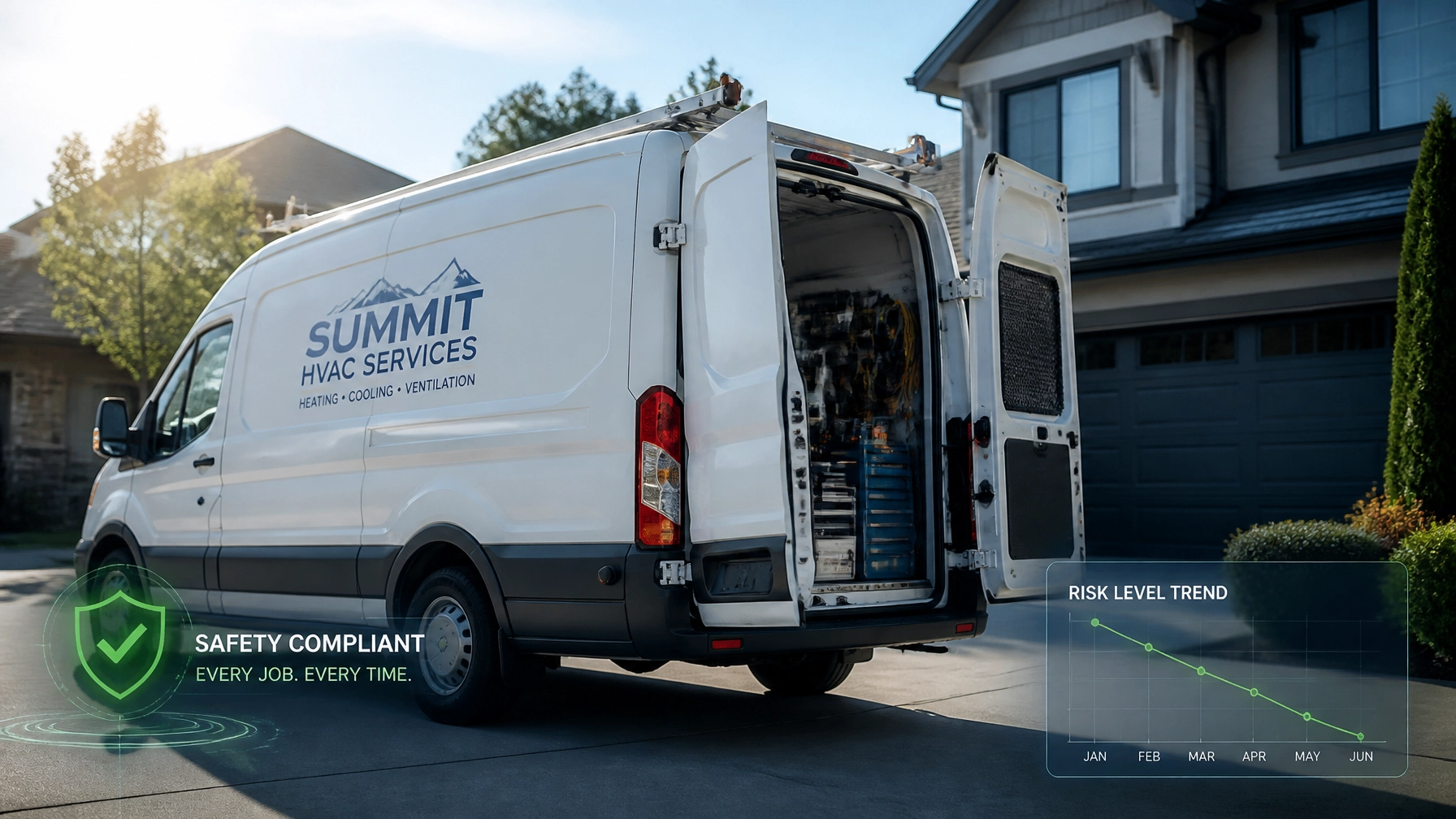
HVAC Fleet Survival Guide: How to Lower Your Insurance Premiums in 2026 with AI Safety Data
For HVAC business owners, the road has become increasingly expensive. In 2026, the cost of keeping a fleet on the street is no longer just about fuel and technician wages. Commercial auto insurance has climbed to the top of the expense report, with premiums for service fleets now averaging between $150 and $250 per vehicle every month. For a growing company with ten vans, that is a $30,000 annual bill before a single wrench is turned.
The landscape of insurance underwriting has shifted. Traditional insurers no longer rely solely on historical claims data or the “zip code” of your business. They want real-time proof that your drivers are safe. This shift has created a divide in the industry: companies that embrace AI safety data are seeing significant cost reductions, while those sticking to traditional methods are being pushed into high-risk pricing tiers.
This guide outlines how HVAC fleet managers can leverage modern technology to reclaim control over their insurance costs and protect their bottom line.
The New Era of Underwriting: Data Over Assumptions
Insurance carriers in 2026 have moved away from broad rate trends. They now split fleets into narrow risk categories based on measurable safety behaviors. If you cannot provide data-backed proof of your fleet’s performance, underwriters often default to the highest risk category.
Underwriters are looking for more than just a clean driving record. They want to see proactive risk management. This includes monitoring for high-risk behaviors such as harsh braking, rapid acceleration, and distracted driving. For HVAC fleets, which often operate in dense residential areas and busy commercial zones, these metrics are critical.
By implementing video telematics solutions, companies can move from being a “number on a spreadsheet” to a “preferred risk.” When you can show an insurer that your fleet has reduced harsh braking events by 40% over six months, you aren’t just talking about safety: you are providing the currency they use to lower your rates.

AI Safety Data: The Proof Insurers Demand
Artificial Intelligence has transformed the standard dash camera into a powerful safety consultant. Modern fleet safety cameras do more than just record video; they analyze every second of the journey.
These systems use AI to identify patterns that lead to accidents before they happen. For example, the technology can detect if a technician is checking a phone or if they are consistently following other vehicles too closely. This “AI safety data” serves two purposes: it allows for immediate driver coaching and provides a transparent record for insurance providers.
When it comes time for policy renewal, having a documented history of safety improvements is your strongest negotiation tool. Insurers are increasingly offering “premium credits” for fleets that use AI-enhanced monitoring. In many cases, having this technology is becoming a requirement for securing competitive terms at all.

Protecting Your Business from the “Deep Pockets” Narrative
One of the greatest threats to an HVAC business is the false claim. Because your vans are branded and your business is perceived to have insurance coverage, you are often a target for staged accidents or exaggerated injury claims. Without visual evidence, these situations often turn into a “he said, she said” battle that the commercial vehicle usually loses.
A high-quality commercial dash cam system changes the dynamic of an accident investigation. Instead of months of litigation and rising premiums, you can provide immediate video evidence that exonerates your driver.
At Safety Track, we have seen video evidence reduce insurance costs by up to 25% specifically because it eliminates the payout for false claims. Faster settlements mean less time spent in legal battles and a cleaner loss history, which is the single most important factor in long-term premium stability.
Actionable Steps to Lower Your 2026 Premiums
If you are facing a renewal or looking to cut operational costs, follow these steps to position your HVAC fleet as a low-risk partner for insurers.
1. Modernize Your Hardware
The old “set it and forget it” dash cams are no longer enough. You need systems that provide real-time monitoring and AI analysis. Ensure your cameras are dual-facing to capture both the road ahead and driver behavior. This provides the comprehensive data set that underwriters now expect.
2. Formalize Your Driver Safety Program
Technology is most effective when it is part of a larger safety culture. Use the data from your telematics to create a formal scoring system for your technicians. Document your coaching sessions and reward drivers who maintain high safety scores. Showing an insurer a written, enforced safety policy backed by data is a powerful way to secure better rates.

3. Share the Right Data with Your Broker
Do not wait for your broker to ask for safety data. Be proactive. Provide quarterly reports showing your fleet’s safety trends. Highlight reductions in speeding, idle time, and harsh maneuvers. When your broker has these metrics, they can shop your policy to carriers that specifically reward tech-forward fleets.
4. Optimize Maintenance Records
Vehicle health is a direct component of safety. Faulty brakes or worn tires increase accident risk. Integrate your maintenance tracking with your safety data to show that your vehicles are in top condition. This holistic view of fleet management demonstrates to insurers that you are managing risk from every possible angle.
The ROI of Safety: Beyond the Premium
While lower insurance costs are a primary goal, the benefits of AI safety data extend into every part of your HVAC operation. Reducing accidents by up to 40% doesn’t just save on premiums; it keeps your vans on the road and your technicians on the job.
Furthermore, behavior monitoring consistently leads to significant fuel savings: up to 30% in many cases. By reducing aggressive driving and optimizing routes through better telematics, you are cutting two of your largest overhead costs simultaneously.

Conclusion: Taking the Lead in 2026
The era of “blind” fleet management is over. In 2026, the success of an HVAC business depends on its ability to turn safety into a measurable asset. High insurance premiums are not an inevitability; they are a challenge that can be solved with the right technology and data.
By investing in AI-enhanced safety systems, you protect your drivers, your reputation, and your profits. At Safety Track, we specialize in custom-tailored solutions that help fleets like yours navigate these rising costs.
Don’t let rising premiums dictate the future of your business. Take control of your data, prove your safety, and watch your operational costs drop.

Tyler Schneider is the IT Director at Safety Track, overseeing the company’s technological infrastructure and innovations. With a strong background in information technology and systems management, Tyler ensures that Safety Track stays at the forefront of tech solutions in fleet management. His strategic expertise supports the seamless integration of technology across the company’s operations.