
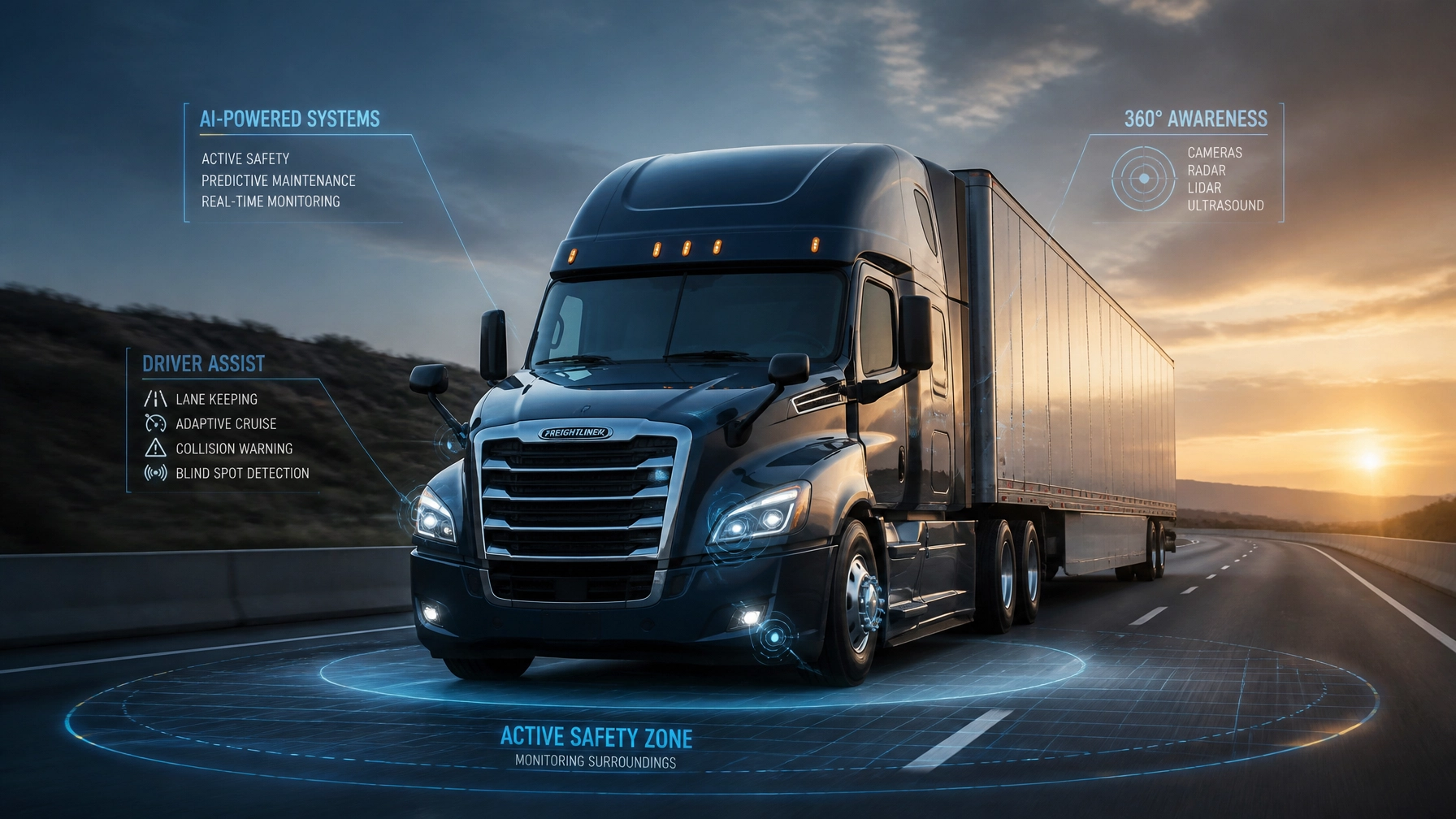
Eliminating Distracted Driving: AI Dash Cameras for Fleet Safety
June marks the beginning of National Safety Month, a critical period for fleet managers to evaluate their safety protocols and risk mitigation strategies. In the logistics and transportation industry, safety is not merely a compliance requirement; it is the foundation of operational success and financial stability. Among the various risks faced by commercial fleets, one remains more persistent and dangerous than almost any other: distracted driving.
According to the latest data from 2024, more than 3,200 people are killed annually in crashes involving distracted drivers in the United States. Furthermore, over 315,000 injuries are reported each year due to a lack of attention on the road. For fleet managers operating heavy-duty US-model trucks like Kenworth, Peterbilt, and Freightliner, these statistics represent more than just numbers: they represent massive liability, rising insurance premiums, and potential loss of life.
Modern problems require modern solutions. This National Safety Month, the industry is shifting its focus toward AI dash cameras for fleets as the primary defense against distraction. By utilizing computer vision and real-time behavior analysis, these systems are no longer passive observers but active participants in driver safety.
The Crisis of Distraction in Modern Logistics
Distracted driving is often reduced to the image of a driver texting, but for a professional operator, it is far more complex. It encompasses cognitive distraction, visual distraction, and manual distraction. A driver might be focused on a dispatch tablet, eating while behind the wheel, or even smoking: all behaviors that take eyes off the road or hands off the wheel for crucial seconds.
The risk factors are staggering. Research indicates that a driver texting is 23 times more likely to be involved in a safety event. Even dialing a hand-held phone increases the risk of a crash by 12 times. In a 40-ton commercial vehicle traveling at highway speeds, a three-second glance at a notification means the truck has traveled the length of a football field without a pilot’s guidance.
Fleet managers are facing a landscape where “nuclear verdicts” and surging insurance rates are the norm. To combat this, the integration of fleet safety cameras has moved from a “nice-to-have” feature to a business-critical asset. These AI-enhanced systems provide the visibility needed to identify risky patterns before they result in a collision.
Beyond the Mirror: How AI Dash Cameras See Risk

Traditional dash cameras provided video evidence after the fact. While useful for insurance claims, they did nothing to prevent the accident from occurring in the first place. AI-enhanced dash cameras represent a generational leap in technology. These devices use internal and external sensors to monitor both the road and the driver simultaneously.
The core of this technology is “Computer Vision.” The camera is equipped with a processor capable of identifying human behavior in real-time. It doesn’t just record video; it understands what it is seeing. For example, the system can distinguish between a driver checking their side mirror and a driver looking down at a mobile device.
Driver-Facing Intelligence
The driver-facing lens focuses on specific “points of interest” on the driver’s face and body. It monitors eye movement, head position, and hand placement. If the AI detects that the eyes have been diverted from the road for a duration exceeding a set safety threshold, it triggers an immediate response.
Road-Facing Awareness
Simultaneously, the road-facing lens monitors the truck’s environment. It tracks lane markings, following distances, and traffic signals. When the AI combines these two streams of data: seeing, for instance, that a driver is looking down while the truck is rapidly approaching the vehicle ahead: it can prioritize the urgency of the alert.
The “Cell Phone Problem” and Real-Time Intervention
The most common distraction in 2026 remains the mobile device. Despite strict federal regulations and company policies, the temptation of connectivity is high. AI dash cameras are specifically programmed to detect the distinct silhouette of a smartphone.
When a driver picks up a phone, the AI identifies the object and the associated behavior (hand-to-ear or eyes-to-lap). Rather than simply recording the event for later review, the system provides an immediate in-cab audio alert. This “voice of God” reminder: often a simple voice prompt or a distinct beep: acts as a pattern interrupt. It forces the driver’s attention back to the task of driving.
For fleet managers, this real-time intervention is the key to achieving Safety Track’s claim of up to 40% fewer accidents. By stopping the behavior in the second it starts, the technology prevents the collision entirely. The event is then uploaded to a secure cloud dashboard where managers can see a short clip of the incident, allowing for objective coaching sessions later.
Smoking, Eating, and Cognitive Distraction
While cell phones get the most attention, other “minor” distractions contribute significantly to fleet risk. Smoking while driving, for example, is not just a health issue; it is a distraction that involves manual movement and cognitive diversion. AI dash cameras can be configured to detect smoking and notify management, which is particularly important for fleets transporting flammable or high-value assets.
Similarly, eating and drinking are manual distractions that can lead to delayed reaction times. If a driver is struggling with a food item while trying to navigate a congested urban intersection, their ability to perform an emergency maneuver is compromised.
Drowsiness and Fatigue Detection
Fatigue is a form of distraction where the mind is no longer present. AI cameras monitor for “micro-sleeps” and frequent yawning. By identifying the early signs of exhaustion, the system can suggest a break before a fatigue-related incident occurs. This proactive approach is a hallmark of complete fleet management solutions.
The Financial Impact: Insurance, Claims, and Exoneration

Beyond the human element, there is a clear financial mandate for AI dash cameras. The cost of a single commercial truck accident can exceed hundreds of thousands of dollars in property damage, medical bills, and legal fees.
Insurance Savings
Insurance providers are increasingly offering discounts to fleets that implement AI-monitored safety systems. These systems provide a “verifiable safety record.” When a company can prove they have reduced distraction events by 30% or 50% through AI coaching, they become a much lower risk for the insurer. Many Safety Track clients see up to 25% lower insurance costs because they have the video evidence to back up their safety claims.
Exoneration and False Claims
In a collision involving a passenger vehicle and a commercial truck, the truck driver is often blamed by default. Without video evidence, it becomes a “he-said, she-said” situation that usually ends in a settlement from the trucking company. AI dash cameras provide the “silent witness” needed to prove that the driver was attentive, had their hands on the wheel, and was following all safety protocols at the time of the incident. This ability to exonerate drivers protects the company’s bottom line and the driver’s professional reputation.
Building a Driver-First Safety Culture
A common concern among fleet owners is driver pushback. No one likes the idea of being “watched.” However, the most successful safety programs frame AI dash cameras not as “Big Brother,” but as a “Digital Co-Pilot.”
Transparency is Key
During National Safety Month, it is an excellent time to re-introduce these systems to your team. Explain that the goal is not to catch them doing something wrong, but to protect them from the mistakes of others and to help them return home safely every night.
Positive Reinforcement
Modern fleet management platforms allow for the creation of driver scorecards. Instead of only focusing on the “red flags,” managers can use the data to reward the top 10% of safest drivers. Recognizing those who consistently maintain zero distraction events fosters a culture of pride and accountability.
Future-Proofing with Safety Track

At Safety Track, we understand that one size does not fit all. A construction fleet using heavy-duty Peterbilt trucks on-site has different needs than a logistics company running long-haul Freightliners across state lines. Our solutions are custom-tailored to your specific operations.
Our AI Enhanced Security systems ensure that security is always in sight. Whether you are looking to reduce fuel costs through better behavior monitoring or aiming to eliminate distracted driving entirely, our integrated platform provides the visibility you need.
Comprehensive Visibility
- GPS Tracking: Monitor vehicle location and load safety at all times.
- Dash Cameras: AI-enhanced monitoring for both inside and outside the vehicle.
- Asset Tracking: Keep an eye on non-powered assets and trailers.
- Maintenance Tracking: Improve performance through automated diagnostic alerts.
Conclusion: Taking Action This National Safety Month
National Safety Month serves as a reminder that safety is a continuous journey. Distracted driving is a preventable crisis, and the technology to eliminate it is available today. By investing in AI dash cameras, fleet managers are doing more than just buying hardware; they are investing in the longevity of their business and the lives of their drivers.
Eliminating distraction leads to fewer accidents, lower insurance premiums, and a more efficient fleet. As we move through June, consider how a custom-tailored AI solution could transform your safety record.
Ready to protect your fleet?
Contact Safety Track today for a custom-tailored fleet management solution that puts safety first.

Tyler Schneider is the IT Director at Safety Track, overseeing the company’s technological infrastructure and innovations. With a strong background in information technology and systems management, Tyler ensures that Safety Track stays at the forefront of tech solutions in fleet management. His strategic expertise supports the seamless integration of technology across the company’s operations.