
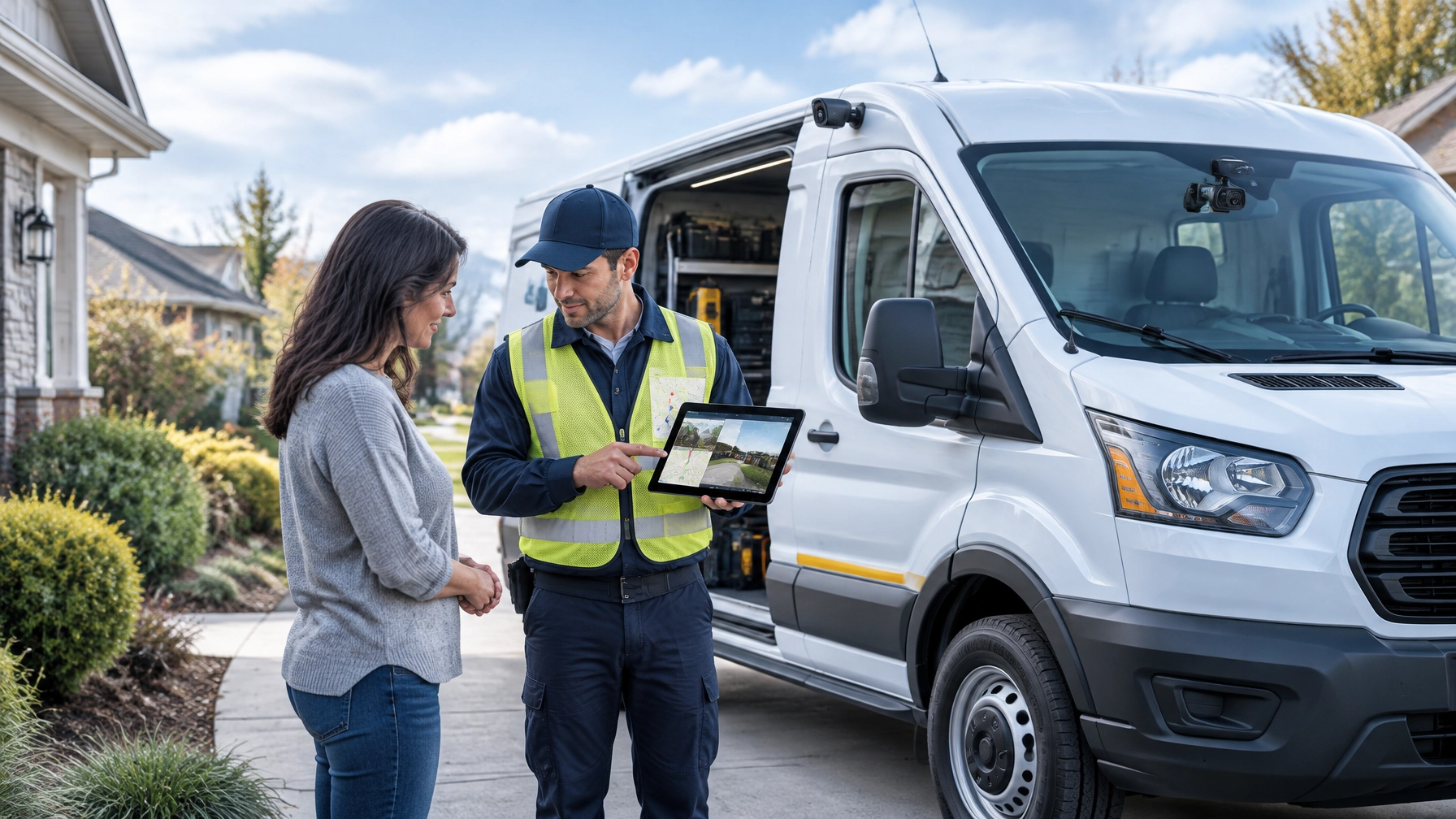
Prove It: Defending Your Team When a Customer Disputes the Job
A customer dispute can cost a small service business more than the original job. A refund can reduce the value of the visit. A chargeback can create administrative work. A negative review can influence future customers. A disagreement that remains unresolved can damage a relationship that took years to build.
For HVAC, plumbing, electrical, lawn care, delivery, and property maintenance businesses, the most common disputes are not major crashes. They are questions about what happened at a customer location:
- Did the technician arrive within the scheduled window?
- Did the vehicle cause damage on the property?
- Was the job actually completed?
- What was said at the door?
- Did the customer receive the service that was promised?
GPS tracking and AI-enhanced dash cameras give fleet managers a clearer record. Location data helps establish where a vehicle was and when it arrived. Video helps show the surrounding circumstances. Together, they help managers move from conflicting accounts to documented facts.
The goal is not to win an argument with a customer. The goal is to determine what happened, protect the team when the work was done correctly, and correct the process when the customer was right.
Customer disputes are easier to resolve with facts
Small businesses often rely on dispatch records, technician notes, invoices, and memory when a complaint arrives. Those records remain important, but they may not answer every question.
A GPS and video system adds operational detail. Depending on the vehicle and camera configuration, managers can review:
- Vehicle arrival and departure times
- The route leading to the customer location
- Time spent at the property
- Vehicle positioning during arrival and departure
- Events recorded around the job
- Relevant forward-facing, rear-facing, or interior footage
Safety Track’s GPS tracking solutions and fleet camera systems help businesses connect vehicle activity with video evidence. This gives managers a practical way to investigate service questions without relying on assumptions.
The result is a faster response and a more consistent customer experience.
Four common service disputes video and location data can clarify
1. A customer disputes the arrival window
A customer may say the technician arrived late, missed the appointment, or never reached the property. The technician may remember arriving on time. Dispatch records may show a scheduled window but not the actual stop.
GPS location history can help establish when the service vehicle reached the address and when it left. A manager can compare that information with the work order, dispatch notes, and customer communication.
A short video clip can add context by showing the vehicle approaching or leaving the location. It can also help confirm whether the vehicle stopped at the correct property or remained nearby during the appointment.
The response should remain factual:
“The vehicle arrived at 10:07 a.m. and departed at 11:02 a.m. The scheduled service window was 10:00 to 12:00. Here is the relevant visit record for your review.”
That approach avoids blame and gives the customer a clear explanation.
2. A customer claims the vehicle caused property damage
Driveways, lawns, gates, curbs, exterior walls, and landscaping can become part of a service dispute. A customer may report that a van damaged the property while backing in, parking, or leaving.
Video does not automatically prove every property condition. However, it can help managers evaluate the claim more carefully. Footage may show:
- The vehicle’s approach and parking position
- Whether the van made contact with an object
- The direction and speed of a maneuver
- Whether another vehicle or person was present
- Conditions visible before departure
Location and timestamp data help narrow the investigation to the correct visit. Forward-facing and rear-facing cameras can provide additional context when the vehicle was moving near a driveway, gate, or other property feature.
If the footage shows that the vehicle made contact, the business can respond responsibly and begin its claims process. If the footage shows no contact, the manager can explain that finding without dismissing the customer’s concern.
The objective is a fair review, not an automatic defense of the driver.

3. A customer claims the job was never finished
A completed job can be disputed when the customer does not see the final result, misunderstands the scope of work, or believes a technician left before completing the agreed service.
GPS data can confirm that the vehicle reached the location and remained there for a reasonable period. Video can help establish the arrival and departure context. The business can then compare those records with:
- The original work order
- Technician notes
- Parts or materials used
- Customer signatures or digital confirmations
- Before-and-after photos
- Invoices and payment records
Vehicle video usually cannot show every task performed inside a home or commercial building. It should not be presented as proof of work that the camera could not observe. Instead, it becomes one part of a complete service record.
For example, the business may be able to show that the technician arrived, remained on site for the documented service period, and left at the recorded time. Technician notes and customer signoff can address the specific work completed.
This combination provides a stronger and more credible response than relying on a vehicle location alone.
4. The customer and technician disagree about what was said
Conversations at a doorway can create confusion about pricing, additional work, access, safety concerns, or the customer’s expectations. A customer may remember one agreement while the technician remembers another.
Exterior vehicle video may show when the technician arrived and left, but it may not capture the conversation at the door. Interior or audio recording depends on the system configuration and applicable privacy requirements. Businesses should never assume that a camera recorded a conversation or use audio without reviewing relevant laws and policies.
When video cannot establish the exact words exchanged, managers should compare:
- The approved estimate
- The work order
- Technician notes
- Text messages or emails
- Customer approvals
- Time-stamped photos
- Payment and invoice records
The manager should ask both sides for a factual account. If the customer was given unclear information, the business can correct its process. If the technician followed the approved scope, the records can support that conclusion.
Clear documentation protects both the customer and the employee.
A five-step workflow for resolving a dispute
A repeatable process keeps a complaint from becoming an emotional debate.
1. Record the specific allegation
Write down the customer’s concern using neutral language. Note the address, date, approximate time, vehicle, technician, and disputed issue.
Avoid summarizing the complaint as “customer is wrong.” Record what the customer says happened.
2. Confirm arrival and departure times
Use GPS trip history, geofence information, dispatch records, and work-order timestamps to identify the service visit. Confirm that the selected vehicle and time period are correct before reviewing footage.
This step often resolves basic arrival-window questions without requiring a lengthy investigation.
3. Pull the relevant clip
Review footage before and after the relevant event. A few seconds may not provide enough context to understand a backing maneuver, arrival, departure, or interaction near the vehicle.
Safety Track’s AI fleet safety cameras can support incident review and driver accountability. Authorized users should be able to access available footage directly instead of waiting for a vendor to retrieve it.
4. Share only what answers the question
Send the customer the relevant evidence by a secure link or another appropriate sharing method. Do not send unrelated footage from the entire route.
Include a short factual explanation:
- Vehicle and date
- Arrival and departure time
- Location
- What the clip shows
- Any limitations of the footage
The exchange should be calm and professional. Video is most effective when it supports a clear explanation rather than an accusation.
5. Use the result internally
If the evidence supports the technician, document the resolution and retain the relevant records according to company policy. If the customer was correct, address the issue directly and use the incident to improve training, dispatch communication, property-condition documentation, or customer approvals.
Video should support accountability in both directions.
Immediate access makes same-day resolution possible
A dispute loses momentum when a business has to wait days for footage. The customer may post a review, begin a chargeback, or contact an insurer before the manager has the information needed to respond.
Self-serve access changes that process. With Safety Track, authorized fleet users can control their available footage directly. They can search for the vehicle and time period, review the clip, download the evidence, and share the relevant video without submitting a vendor retrieval request.
That immediate control matters for small businesses. The owner or operations manager may be handling dispatch, customer service, billing, and fleet safety at the same time. A direct video workflow removes an unnecessary delay.
Safety Track’s $99.95 per vehicle, per month unlimited video plan includes:
- Unlimited video viewing
- Unlimited video downloads
This allows managers to review the full context of a service visit, download clips for customer communication, and preserve evidence for internal records without paying per clip.
Learn more about managing fleet video directly or why instant video access matters.

Protect the customer relationship while protecting the team
A customer dispute is an opportunity to demonstrate professionalism. The business should acknowledge the concern, review the facts, and explain the result clearly.
A useful response has three parts:
- Recognize the concern: “We understand why this was frustrating.”
- Explain the evidence: “Our vehicle records show the van arrived at 2:14 p.m. and left at 3:01 p.m.”
- State the next step: “We are reviewing the technician notes and will follow up today.”
This approach avoids unnecessary defensiveness. It also shows employees that the company will evaluate complaints fairly instead of automatically accepting or rejecting one side.
When the team did the job well, video and location data help prove it. When a process failed, those same records help the business improve.
Build a stronger record for every service call
Fleet video is not just an accident-investigation tool. For small service businesses, it can support customer service, billing accuracy, employee protection, and proof of service.
A practical record combines:
- GPS arrival and departure data
- Relevant dash camera footage
- Work orders
- Technician notes
- Customer approvals
- Site photographs
- Invoices and payment records
Together, these records help managers resolve disagreements in minutes instead of allowing them to become refunds, chargebacks, bad reviews, or lost repeat business.
At Safety Track, the goal is straightforward: give small fleet operators more visibility and control over what happens on the road and at the job site. Contact Safety Track to discuss a custom video and GPS tracking solution for a service fleet.

Frequently asked questions
Can GPS tracking prove that a technician completed the work?
GPS tracking can help confirm that a vehicle reached a location, when it arrived, and when it departed. It does not prove every task performed inside a property. Managers should combine location records with work orders, technician notes, photos, and customer approvals.
Can dash camera footage settle a disagreement about a conversation?
It depends on the camera configuration and applicable privacy requirements. Vehicle video may show the timing and context of an interaction, but it may not capture conversations at a customer’s door. Businesses should use written records and approvals when video cannot establish the exact words exchanged.
How quickly can a business access fleet video?
With self-serve access, authorized users can review available footage directly instead of waiting for a vendor to retrieve it. Availability depends on the vehicle, system configuration, connectivity, and footage retention settings.
What does Safety Track’s unlimited video plan include?
The plan costs $99.95 per vehicle, per month and includes unlimited video viewing and unlimited video downloads.

Tyler Schneider is the IT Director at Safety Track, overseeing the company’s technological infrastructure and innovations. With a strong background in information technology and systems management, Tyler ensures that Safety Track stays at the forefront of tech solutions in fleet management. His strategic expertise supports the seamless integration of technology across the company’s operations.