
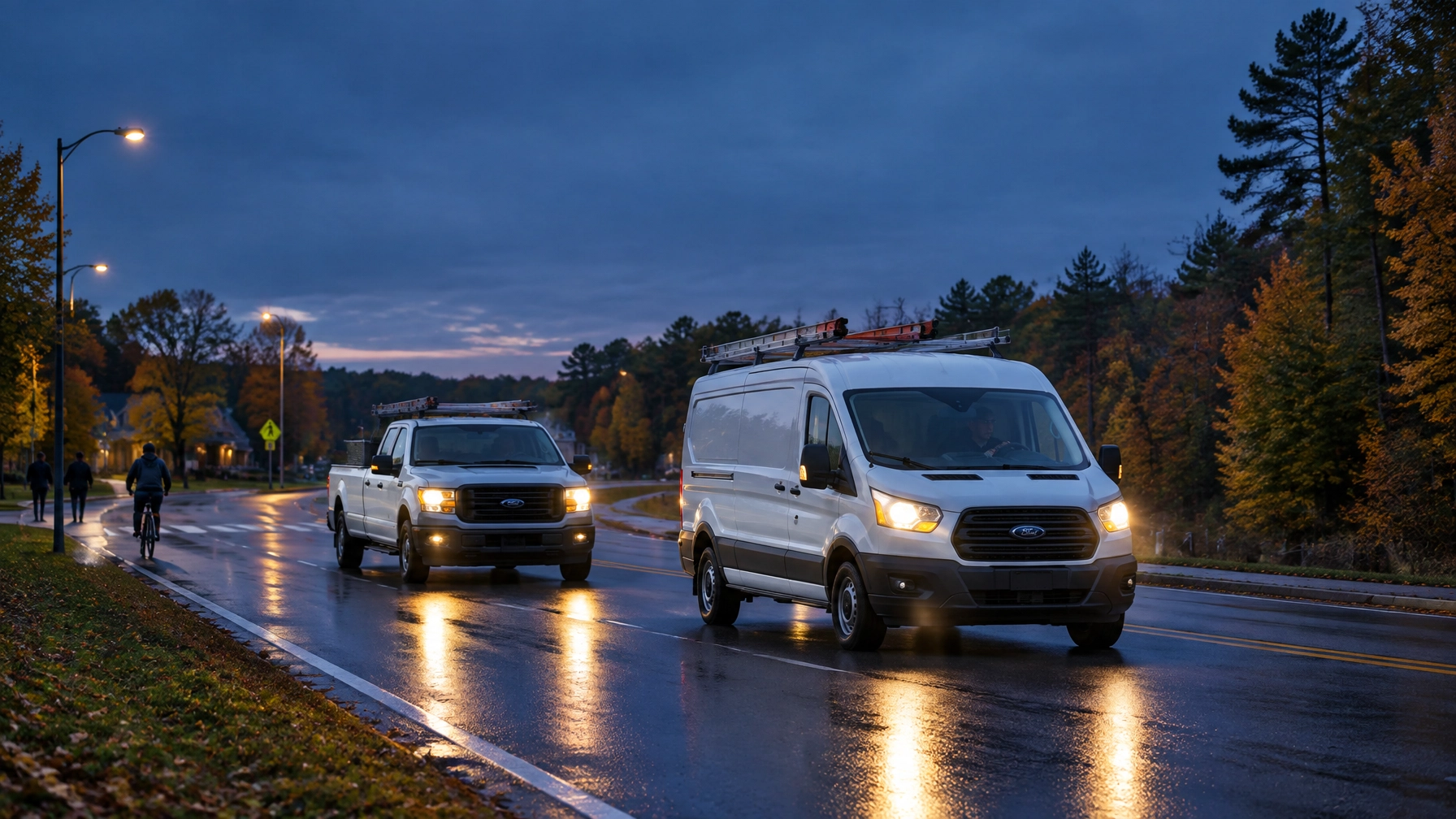
The 4:45 PM Problem: Why Fall’s Early Darkness Is Your Fleet’s Riskiest Hour
For a small HVAC, plumbing, delivery, lawn care, or property maintenance business, the last route of the day often looks routine. A technician finishes a job, a delivery driver heads back to the shop, or a maintenance crew starts the final return trip.
Then the clock reaches 4:45 PM.
In late September and October, that same route can move from daylight into dusk within minutes. After the clocks shift to standard time in early November, quitting time can arrive in full darkness. Pedestrians and cyclists become harder to see. Deer move near roadways. Drivers are managing the final miles of a long workday.
That combination makes the last run of the day one of the most important seasonal safety concerns for small fleets.
Fleet managers can reduce the risk by preparing vehicles, adjusting routes, coaching drivers, and using AI-enhanced dash cameras to create better visibility when an incident occurs.
Why the Last Run of the Day Changes in Fall
Fall creates a visibility problem before many businesses change their schedules.
A service van that leaves a job at 4:00 PM may travel through bright daylight in September. By October, the same departure can happen during low light. After the time change, the driver may complete the final miles in darkness.
The difference matters because other road users are less visible in low-light conditions. According to NHTSA pedestrian safety data, most pedestrian fatalities occur in darkness. NHTSA also advises drivers to use additional caution around crosswalks, neighborhoods, bus stops, schools, and poorly lit roads.
Small business fleets often operate exactly in these areas. HVAC and plumbing vans travel through residential neighborhoods. Delivery vehicles stop near apartment buildings and storefronts. Property maintenance trucks use suburban and rural roads where lighting may be limited.
The final route of the day deserves a seasonal safety plan rather than an assumption that familiar roads are low risk.
Four Risks That Converge Around 4:45 PM
1. Reduced visibility for everyone
Dark clothing, unlit bicycles, glare from oncoming headlights, rain, and dirty windshields can make pedestrians and cyclists difficult to detect.
Drivers should scan beyond the lane directly ahead. They should check sidewalks, shoulders, driveways, crosswalks, and parked vehicles before turning or moving through an intersection.
Lower speeds also provide more time to react. A driver who cannot see beyond the distance illuminated by the headlights is traveling too fast for the conditions.
2. Deer movement after sunset
Fall is also deer season on the road. Deer activity increases during autumn, with collisions frequently concentrated around dawn, dusk, and the evening hours. State Farm’s animal collision guidance identifies fall as a high-risk period for animal-related crashes.
This matters for service fleets that travel between suburban developments, wooded areas, farms, and rural job sites.
Drivers should:
- Scan both shoulders, not just the travel lane.
- Reduce speed near wooded areas, fields, and posted deer crossings.
- Watch for eye shine or sudden movement near the road.
- Expect additional deer if one animal appears.
- Brake firmly and stay in the lane instead of swerving.
Route planning can help, too. If a particular road has limited lighting and frequent deer activity, dispatchers can consider earlier departures, alternate routes, or additional time for the return trip.
3. Fatigue at the end of a long workday
A technician may have completed several jobs before beginning the final drive. A delivery driver may have made dozens of stops. A property maintenance employee may be physically tired after working outdoors.
Fatigue affects reaction time, attention, and decision-making. Darkness makes the problem worse because drivers must work harder to interpret limited visual information.
The FMCSA’s driver fatigue guidance emphasizes adequate sleep and stopping to rest when a driver becomes drowsy. While every small fleet may not operate commercial motor vehicles subject to the same requirements, the safety principle applies broadly: no employee should be expected to continue driving when fatigue affects safe operation.
Warning signs include:
- Frequent yawning or blinking
- Difficulty remembering the last few miles
- Drifting within the lane
- Missing turns or traffic signals
- Delayed reactions
- Irritability or reduced concentration
Managers should make it clear that a driver can report fatigue without pressure to continue. A safe return plan is more valuable than an on-time arrival.
4. A narrow margin for distraction
A phone notification, dispatch message, navigation adjustment, or conversation can take a driver’s attention away from the road at the exact moment visibility is lowest.
Darkness reduces the amount of information available to the driver. A brief glance away can mean missing a pedestrian, cyclist, stopped vehicle, or animal near the shoulder.
Small fleet owners should reinforce a simple rule: configure navigation before moving, silence nonessential alerts, and pull over safely when an operational issue requires attention.

Prepare Vans and Light Trucks Before the Season
A fall safety program begins with the vehicle.
Fleet managers should add an early-darkness inspection to the normal maintenance routine. The check does not need to be complicated, but it should be consistent across every van and light truck.
Inspect:
- Headlights, including low and high beams
- Brake lights, taillights, and turn signals
- Marker lights and hazard lights
- Windshield condition and wiper performance
- Washer fluid levels
- Mirrors and camera lenses
- Tire condition and pressure
- Reflective markings and warning equipment
Clean light lenses can improve output. Clean windshields and mirrors reduce glare. Properly aimed headlights help drivers see the roadway without creating unnecessary glare for other motorists.
Wipers deserve particular attention in fall. Rain, road spray, and early darkness can quickly turn a manageable drive into a low-visibility situation. A vehicle with streaking wipers or weak washer spray is not ready for the evening route.
Owners should also check the interior. A bright dashboard or phone screen can reduce a driver’s ability to see into dark areas outside the vehicle. Screen brightness should remain low enough to avoid glare without making navigation difficult to read.
Adjust Route Timing and Driver Expectations
A schedule designed for summer daylight may not work in November.
Business owners can review recurring service calls and identify routes that become riskier after sunset. Rural roads, wooded corridors, school zones, busy shopping areas, and neighborhoods without sidewalks deserve special attention.
Practical adjustments include:
- Scheduling longer or more complex routes earlier in the day.
- Building additional time into evening appointments.
- Avoiding unrealistic promises about final arrival times.
- Giving drivers permission to slow down in low-light areas.
- Identifying safe locations for breaks or temporary stops.
- Reviewing routes with frequent deer or pedestrian activity.
This is also a useful time for a short seasonal toolbox talk. The discussion can focus on headlight use, scanning for pedestrians, deer response, fatigue warning signs, and the company’s process for reporting a safety concern.
Coaching is more effective when it reflects the actual work. A plumbing company should discuss dark residential streets and driveway backing. A delivery business should address apartment complexes, loading zones, and pedestrians near entrances. A landscaping company should focus on equipment visibility and returning vehicles after sunset.

How AI Dash Cameras Support Safer Fall Driving
An AI dash camera does not replace alert driving, proper maintenance, or good scheduling. It gives fleet managers another layer of visibility and accountability.
Modern camera systems can help in four important ways.
Better video in low-light conditions
Night and low-light video quality matters when a collision, near miss, or customer dispute occurs after sunset. Clear forward-facing footage can show roadway conditions, traffic movement, headlights, pedestrians, and the actions of other vehicles.
A driver-facing view can provide additional context about attention and fatigue indicators, depending on the camera configuration and company policy.
Fatigue and distraction alerts
AI-enhanced systems can identify signs of driver distraction or drowsiness and provide alerts while the vehicle is operating. An in-cab warning gives the driver an opportunity to refocus before a risky behavior becomes an incident.
Managers can use these alerts for coaching rather than relying only on crash reports. A short conversation after a pattern of phone distraction, lane departure, or fatigue indicators can correct behavior earlier.
Event-triggered clips
Hard braking, sudden swerving, collision detection, and other safety events can trigger relevant video clips. This reduces the need to search manually through hours of routine footage.
Event-triggered clips are especially useful during the evening return window. A manager can quickly review what happened before and after a hard brake caused by a pedestrian, deer, stopped vehicle, or roadway obstruction.
Video should always be reviewed with context. An alert identifies an event. The footage helps explain it.
Instant access when something happens
Small businesses cannot afford to wait days for a vendor to retrieve video. An owner may need footage immediately after a collision, customer complaint, or allegation involving a driver.
With Safety Track’s fleet camera systems, authorized users can access available footage directly. They can select the vehicle, find the time of the event, review the surrounding clip, and download the video without waiting for vendor retrieval.
That immediate control is a major advantage during the high-risk evening period. It helps managers respond while details are still fresh, support insurance claims, and protect drivers from inaccurate allegations.

Include Video Access in the Q4 Fleet Budget
Q4 planning is the right time to review seasonal fleet risks and technology costs together.
Small business owners should evaluate more than the camera hardware. They should consider whether the plan supports frequent viewing, downloads, driver coaching, and incident response without unpredictable fees.
Safety Track’s unlimited video plan costs $99.95 per vehicle, per month. It includes:
- Unlimited video viewing
- Unlimited video downloads
- Direct access to available footage
- Support for claims and incident reviews
- Video-based driver coaching
- Predictable monthly budgeting
Unlimited access matters because one evening event may require more than one review. A manager may need to watch the clip, check the moments before the event, download a copy for an insurer, and save another copy for internal documentation.
A per-clip or per-download model can discourage that process. A predictable plan encourages managers to use video when it provides value.
Fleet owners can also review Safety Track’s guide to managing their own video and its overview of unlimited video pricing for small fleets.
Build the Fall Evening Checklist
Before the seasonal time change, fleet managers should confirm that each driver understands the expectations:
- Inspect headlights, wipers, mirrors, and tires before leaving.
- Turn headlights on early and keep them clean.
- Reduce speed when visibility drops.
- Scan for pedestrians, cyclists, deer, and stopped vehicles.
- Avoid phone use and unnecessary screen interaction.
- Report fatigue before it affects driving.
- Pull over safely when a break is needed.
- Report incidents promptly so footage can be reviewed.
- Use AI alerts and video clips for constructive coaching.
- Confirm that authorized managers know how to access footage immediately.
The goal is not to make every driver anxious about the last route. It is to make the company prepared for predictable seasonal changes.
Make the 4:45 PM Route Safer
Fall darkness changes the risk profile of a normal service call. Reduced visibility, pedestrians in dark clothing, cyclists, deer, fatigue, and distraction can all converge during the final miles of the workday.
Small fleets can respond with practical steps:
- Maintain lighting and wipers.
- Adjust route timing.
- Coach drivers on low-light conditions.
- Set clear fatigue expectations.
- Use AI dash cameras for alerts and event-triggered video.
- Keep immediate control of footage when something happens.
A seasonal safety review now can protect drivers, reduce claims delays, and support better Q4 budget decisions. Contact Safety Track to discuss a custom-tailored GPS tracking and AI video solution for a small business fleet.

Tyler Schneider is the IT Director at Safety Track, overseeing the company’s technological infrastructure and innovations. With a strong background in information technology and systems management, Tyler ensures that Safety Track stays at the forefront of tech solutions in fleet management. His strategic expertise supports the seamless integration of technology across the company’s operations.