
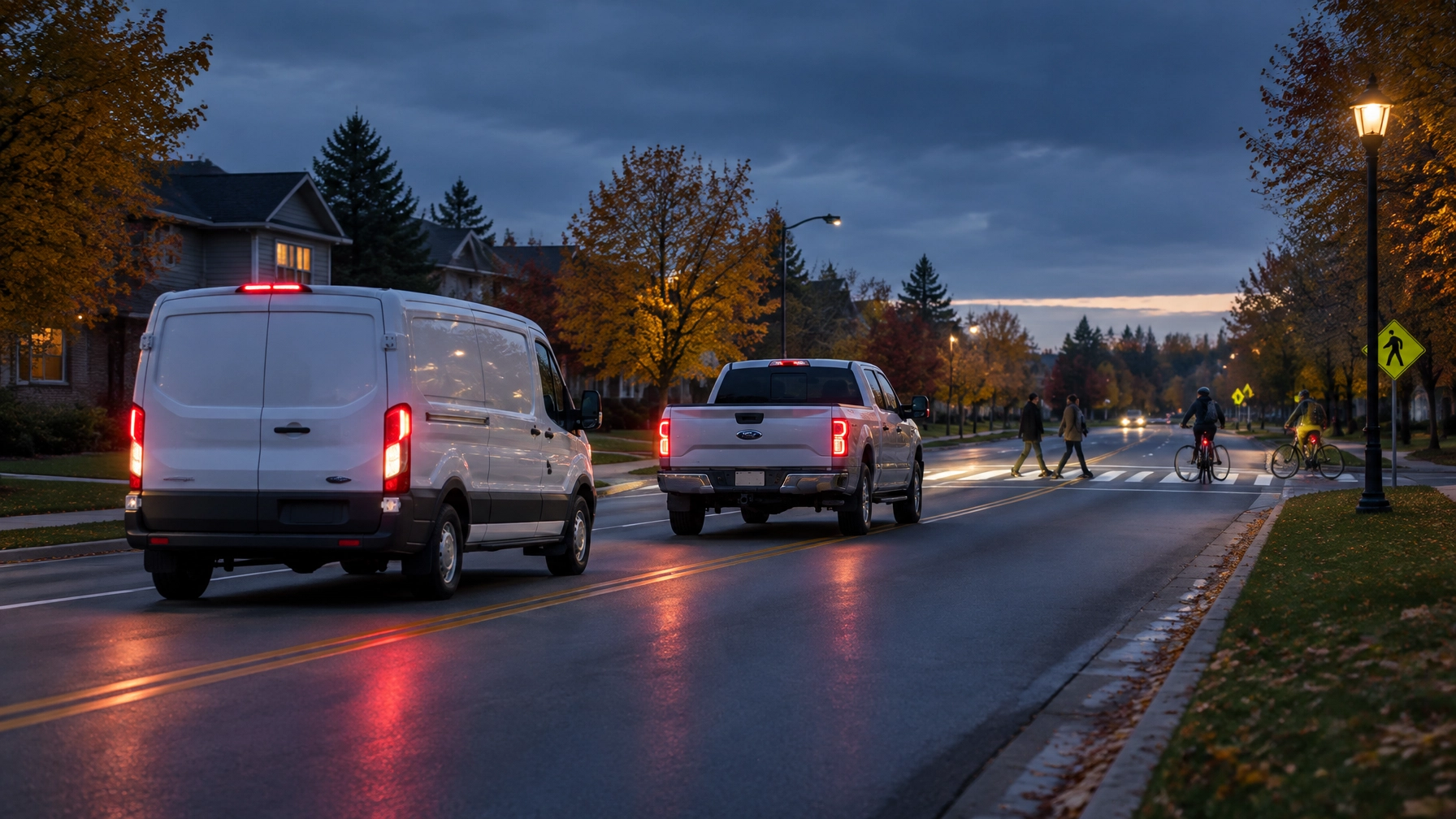
The Week After the Clock Change: Five Dark Days That Catch Drivers Out
The first workweek after the clocks change can create a difficult combination for small business fleets. On November 1, 2026, clocks move back one hour across most of the United States. Morning routes become brighter, but afternoon routes become darker much earlier.
That shift affects more than the clock on the wall. Quitting time now arrives in full darkness. Drivers’ internal schedules may still feel out of sync. Pedestrians, cyclists, school activities, deer, and residential traffic all become harder to see during the evening rush.
For small fleets operating US-model vans and light trucks, the first five workdays after the change should be treated as a focused safety period. A few practical changes can improve visibility, reduce fatigue-related risk, and give managers better control when an incident occurs.
Why the First Workweek Deserves Extra Attention
The fall clock change provides an extra hour overnight, but that does not guarantee that every driver immediately feels rested. The body’s circadian rhythm still has to adjust to a new pattern of light and darkness. The Sleep Foundation explains that the end of daylight saving time can continue to affect sleep schedules, habits, and daylight exposure for a week or longer.
The operational challenge is simple:
- Morning commutes are brighter.
- Afternoon commutes become darker.
- Drivers may feel tired at familiar times.
- Residential routes have more low-light activity.
- Deer are more active around dawn and dusk.
- A familiar route can suddenly look different.
These conditions do not mean drivers are unprepared or careless. They mean fleet managers should adjust expectations and provide a clear briefing before the change.
NHTSA identifies late afternoon as one of the periods when drowsy-driving crashes occur more frequently because of natural changes in the body’s internal clock. That matters for service businesses, delivery fleets, contractors, and other small companies whose vehicles are often returning from jobs during the new darkness.
1. Adjust Route Timing Before the Darkness Sets In
The best first step is reviewing the schedule. Fleet managers should identify which routes place drivers on unfamiliar, rural, wooded, or pedestrian-heavy roads during the darkest part of the evening.
The longest drives should not automatically be scheduled at the end of the day during the first week. When possible, dispatchers can:
- Schedule distant jobs earlier in the day.
- Complete rural or wooded routes before sunset.
- Group nearby afternoon stops together.
- Avoid sending drivers across unfamiliar residential areas after dark.
- Build short breaks into longer routes.
- Allow additional time for low-light traffic conditions.
A route that was easy to complete in daylight may require more attention after the clock change. Drivers may encounter school activities, pedestrians walking home, cyclists without visible lighting, and vehicles entering residential streets during the evening rush.
GPS tracking helps managers see where vehicles are operating and how long routes are taking. That information supports practical schedule changes instead of relying only on assumptions. Safety Track’s fleet tracking systems provide visibility into vehicle locations and route activity so managers can make informed decisions.
Route changes do not need to be permanent. The goal is to give drivers and dispatchers a safer transition while daylight patterns, traffic behavior, and driver routines settle into the new schedule.

2. Brief Drivers Before November 1
A short safety briefing can prevent the clock change from becoming an afterthought. Managers should discuss the change during the final meeting or dispatch call before the first post-change workweek.
The briefing should cover:
- The date and time of the clock change.
- The earlier evening sunset.
- Route changes for the first five workdays.
- Proper headlight and taillight use.
- Deer and wildlife awareness.
- Pedestrian and cyclist visibility.
- Fatigue warning signs.
- The procedure for reporting a concern or near miss.
Drivers should understand that reporting fatigue is a safety action, not a performance failure. A driver who notices heavy eyelids, repeated yawning, difficulty focusing, drifting thoughts, missed turns, or lane-position changes needs to notify the appropriate manager and stop in a safe location when necessary.
The National Highway Traffic Safety Administration recommends getting adequate sleep and recognizing that caffeine alone is not a dependable solution for serious fatigue. If a driver becomes sleepy, the correct response is to pull over safely. NHTSA also notes that a short nap may provide temporary alertness when combined with appropriate precautions.
Managers should reinforce the same message consistently: no delivery, appointment, or service call is more important than a driver reaching the destination safely.
3. Inspect Lights, Wipers, and Reflective Markings
Darkness exposes vehicle-maintenance problems that may be less noticeable during daylight. A small fleet should complete a focused visibility inspection before the clock change.
Check every van and light truck for:
- Working headlights on both low and high beams.
- Clean, visible taillights and brake lights.
- Turn signals and hazard lights.
- Windshield wiper condition.
- Adequate washer fluid.
- Clean windshields, mirrors, and camera lenses.
- Properly placed reflective markings.
- Loose, damaged, or faded reflective tape.
- Exterior lighting blocked by equipment or cargo.
A dirty windshield can scatter light and increase glare from oncoming traffic. Worn wipers can leave streaks that make pedestrians, cyclists, animals, and road hazards more difficult to identify.
Fleet managers should also remind drivers to use headlights when visibility is reduced and to avoid relying on daytime running lights as a substitute for full vehicle lighting. The vehicle should be visible from the front, rear, and sides.
A basic inspection takes little time, but it helps ensure that a service van or light truck is easier for other road users to see during the first dark commutes.
4. Watch for Deer, Pedestrians, and Cyclists
The fall clock change shifts more vehicle travel into periods when deer are active. Deer often move around dawn and dusk, and they may appear suddenly from wooded shoulders, fields, and drainage areas.
Drivers should:
- Reduce speed on wooded or rural roads.
- Scan both shoulders, not only the lane ahead.
- Watch for additional deer after seeing one.
- Avoid swerving sharply if a collision becomes unavoidable.
- Use high beams only when conditions and traffic allow.
- Leave more following distance on dark routes.
Urban and suburban routes require a different kind of attention. Pedestrians may be walking home in low light. Cyclists may be harder to see near driveways, intersections, and parked vehicles. School activities and after-school programs can also place more people near residential roads during the new evening darkness.
Drivers should approach crosswalks, bus stops, school zones, bike lanes, and driveways with extra caution. Scanning farther ahead gives the driver more time to identify movement and respond smoothly.
Visibility is a shared responsibility, but commercial drivers have an important role because their vehicles spend more time on the road and often operate in neighborhoods where people are not expecting heavy traffic.
5. Use AI Dash Cameras to Support Safer Decisions
An AI-enhanced dash camera gives small fleet owners another layer of visibility during the five dark days. The technology does not replace driver judgment, route planning, or maintenance. It helps managers identify events and review what happened.
Depending on system configuration, AI dash cameras can support:
- Low-light roadway video.
- Fatigue alerts.
- Distracted-driving alerts.
- Forward-collision or unsafe-driving notifications.
- Driver coaching.
- Incident investigation.
- Video evidence for insurance and customer disputes.
Low-light video quality matters because the most important moments may occur after sunset. A clear recording can help managers understand roadway conditions, traffic movement, driver actions, and the behavior of other road users.
Alerts can also direct attention to potential fatigue or distraction patterns. Managers should use those alerts as coaching inputs, not as a substitute for a complete review. A focused conversation supported by relevant footage is more useful than a general reminder to “be careful.”
Safety Track’s AI-powered dash cameras and fleet safety and compliance solutions are designed to help managers monitor driving behavior and review incidents with greater context.

Instant Video Access Matters When an Incident Happens
A dark commute can lead to questions after a hard brake, near miss, customer complaint, or collision. Fleet managers need to know what happened while the details are still current.
With Safety Track’s instant video access, authorized fleet users can access available footage directly rather than waiting for a vendor to retrieve it. Managers can review the relevant time period, compare footage with GPS information, and download the clips needed for claims, coaching, or internal records.
The instant-access video approach gives a small business direct control over its footage. That control is especially important when a manager needs more than one clip or camera angle to understand an event.
Safety Track also offers an unlimited video plan for $99.95 per vehicle, per month. The plan includes unlimited viewing and unlimited downloads. Small fleets can review footage thoroughly, preserve evidence, and support driver coaching without counting each viewing session or download.
A Five-Day Plan for Small Fleet Owners
The first workweek after the clock change is a practical opportunity to reinforce safety habits. Before November 1, fleet managers should:
- Review routes that will run in early darkness.
- Move the longest drives earlier when possible.
- Brief drivers on fatigue and visibility risks.
- Inspect headlights, taillights, wipers, mirrors, and reflective markings.
- Remind drivers to watch for deer, pedestrians, and cyclists.
- Monitor fatigue and distraction alerts.
- Review relevant video promptly after a near miss or incident.
- Encourage drivers to report fatigue before it affects performance.
The clock change is predictable. That gives small businesses time to prepare. By adjusting schedules, checking equipment, communicating expectations, and using AI dash camera visibility, fleet managers can make the first dark workweek more controlled and safer for everyone on the road.
At Safety Track, fleet owners can combine GPS tracking, AI-enhanced camera systems, real-time monitoring, and direct video access in a solution tailored to their operation. Contact Safety Track to discuss a fleet safety program for the darker months ahead.
Frequently Asked Questions
When does the time change occur in 2026?
In most areas of the United States, clocks move back one hour on Sunday, November 1, 2026. The first full workweek afterward runs from November 2 through November 6.
Why can the week after the fall clock change affect fleet safety?
Even though the fall change provides an extra hour overnight, drivers may still need time to adjust to the new schedule of light and darkness. Evening routes become darker earlier, which can increase visibility challenges and expose fatigue during the late afternoon.
What should small fleets inspect before the clock change?
Fleet managers should inspect headlights, taillights, brake lights, turn signals, windshield wipers, washer fluid, mirrors, windshield cleanliness, and reflective markings on every vehicle.
How much does Safety Track’s unlimited video plan cost?
Safety Track’s unlimited video plan costs $99.95 per vehicle, per month and includes unlimited viewing and unlimited downloads.
How can AI dash cameras help during dark routes?
AI dash cameras can provide low-light video, fatigue and distraction alerts, and footage for incident review. With instant access, authorized fleet users can review and download available footage without waiting for vendor retrieval.

Tyler Schneider is the IT Director at Safety Track, overseeing the company’s technological infrastructure and innovations. With a strong background in information technology and systems management, Tyler ensures that Safety Track stays at the forefront of tech solutions in fleet management. His strategic expertise supports the seamless integration of technology across the company’s operations.