
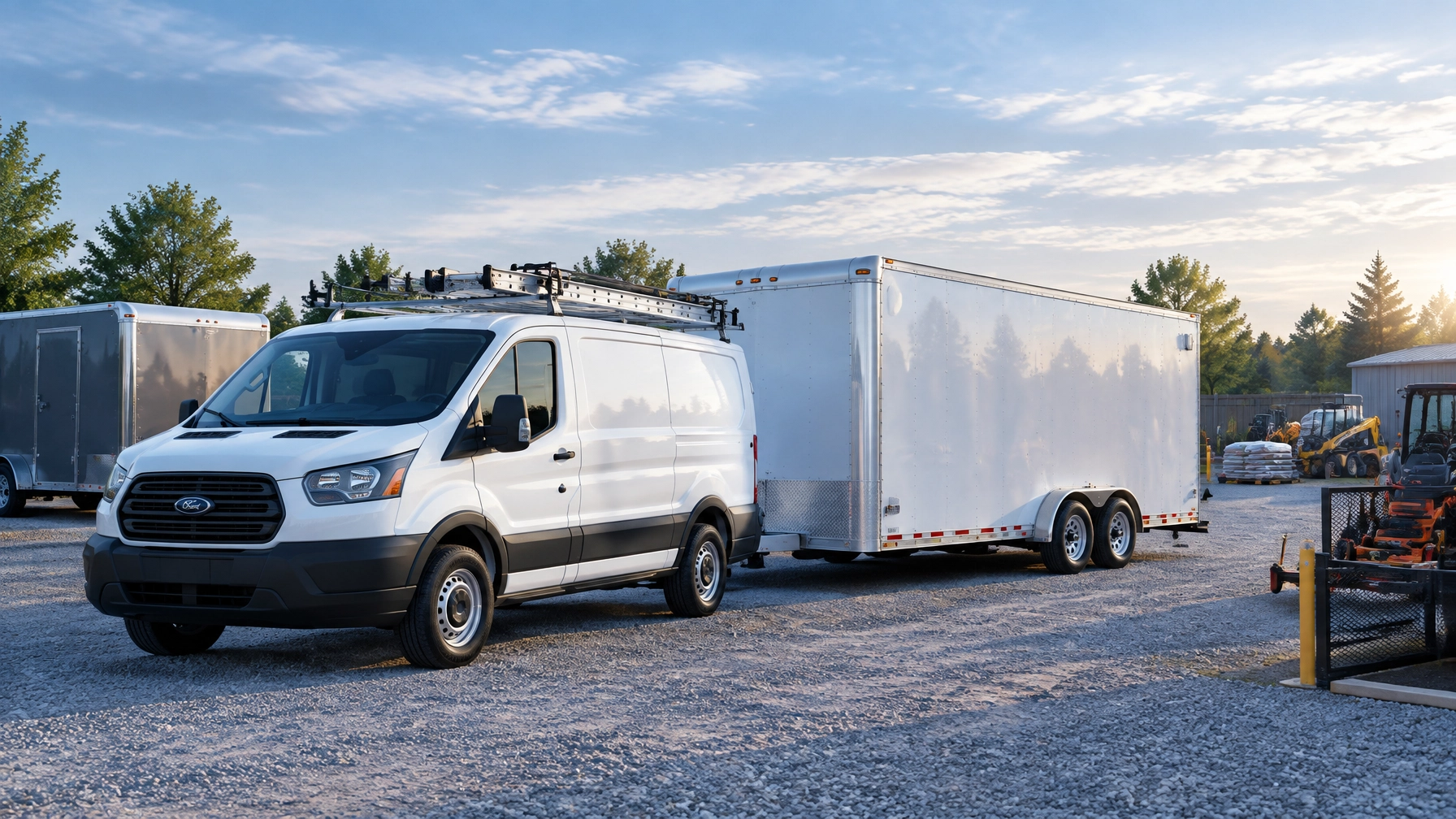
Where’s the Trailer? Asset Tracking for Businesses With Unpowered Equipment
A business owner may know where every work truck is and still have no idea where the trailer went.
That gap creates daily problems for contractors, landscapers, construction companies, equipment rental businesses, and other small fleets. A truck can be visible on a fleet map while its trailer, mower, lift, generator, or job-site equipment sits at the wrong location. Finding it often means calling drivers, checking old work orders, or driving to multiple sites.
GPS asset tracking closes that visibility gap. It gives managers a practical way to locate trailers and other non-powered assets, monitor movement, and respond quickly when equipment leaves an approved area.
Why Trucks Are Visible While Trailers Disappear
Most fleet tracking systems connect directly to a vehicle’s electrical system. That works well for vans, pickups, and trucks. Unpowered equipment creates a different challenge because it does not have an ignition or battery system that can continuously power a standard vehicle tracker.
Trailers and equipment can also move independently of the vehicle that originally transported them. A trailer may be dropped at a job site, loaned to another crew, or left in a customer’s yard. A mower may be unloaded and moved separately. A generator may be stored behind a building or transferred between sites without anyone updating the office.
This creates several operational questions:
- Where is the trailer right now?
- Which job site has the generator?
- Was the mower returned to the yard?
- How long has the lift been sitting unused?
- Did equipment leave the property after business hours?
- Is a missing asset misplaced, rented out, or stolen?
GPS asset tracking places trailers and non-powered equipment on the same visibility system as fleet vehicles. A quick glance can replace the phone call asking, “Where’s the trailer?”

How GPS Asset Tracking Works for Non-Powered Assets
A GPS asset tracker is mounted directly to the trailer or equipment. The device communicates its location through cellular networks and sends updates to fleet management software. Depending on the hardware and configuration, the system can provide current location, movement history, dwell time, and alerts.
The most useful setup combines:
- GPS location data to show where an asset is located
- Movement detection to identify unexpected activity
- Geofencing to define approved yards and job sites
- After-hours alerts to flag movement during restricted periods
- Historical reporting to show where an asset has been
- A shared dashboard to view vehicles and equipment together
Businesses can use GPS asset tracking for enclosed trailers, flatbeds, landscaping equipment, generators, lifts, containers, and other mobile assets. Smaller tools may require a different type of tag or beacon, so the right hardware depends on the asset’s size, value, location, and movement pattern.
Safety Track offers GPS tracking solutions as part of a broader fleet management approach. A custom solution helps a small business start with the equipment that creates the most operational risk instead of tracking every item immediately.
Solar or Long-Life Battery? Choose Based on the Asset
Unpowered asset trackers generally use solar power, long-life batteries, or a combination of power options. The correct choice depends on where an asset spends its time and how often it needs to report its location.
Solar-powered trackers
Solar trackers work well for trailers and equipment that remain outdoors with consistent exposure to daylight. The solar panel helps recharge the device and can reduce the need for routine battery replacement.
Solar is often a good fit for:
- Outdoor utility trailers
- Open flatbeds
- Storage containers
- Equipment that moves frequently between outdoor sites
- Assets that need regular location updates
Solar performance depends on the environment. A trailer stored under a roof, inside a warehouse, or beneath heavy tree cover will not receive the same charging opportunity as an asset parked in an open yard. Dirt, weather, and extended periods without sunlight also affect performance.
Long-life battery trackers
Battery-powered trackers are practical for enclosed trailers, equipment stored indoors, or assets that sit stationary for long periods. They do not require wiring or dependable sunlight, which simplifies installation.
Battery tracking is often a better fit for:
- Enclosed trailers
- Generators and compact lifts
- Equipment stored inside buildings
- Assets that move infrequently
- Equipment that needs a discreet, wire-free installation
Battery life depends on reporting frequency, temperature, cellular coverage, motion, and the device itself. Manufacturers may advertise multi-year life under specific conditions, but businesses should treat those figures as planning estimates rather than guarantees. More frequent location updates and recovery mode can use more power.
A practical evaluation should ask how long the tracker lasts under the business’s actual reporting schedule. The goal is not simply the longest advertised battery life. The goal is dependable visibility with manageable maintenance.
For additional buyer considerations, Teletrac Navman’s trailer tracking guide explains how power source, update frequency, durability, and installation affect tracker selection.
Use Geofencing to Monitor Yards and Job Sites
A geofence is a virtual boundary placed around a physical location. Small businesses can create geofences around a home yard, storage lot, customer property, construction site, or equipment staging area.
Once a geofence is active, managers can receive an alert when an asset enters or exits the defined area. Geofences can also be paired with time rules. For example, a trailer may be allowed to leave a yard between 6:00 a.m. and 7:00 p.m. but trigger an alert if it moves at midnight.
Useful geofence rules include:
- Alert when a trailer leaves the main yard
- Alert when a generator leaves a job site
- Alert when equipment enters an unauthorized location
- Alert when an asset moves during non-working hours
- Alert when a trailer remains at a site longer than expected
Geofencing does not eliminate the need for an equipment check-out process. It adds a reliable layer of visibility when schedules change or communication breaks down.

Tracking Helps Detect Theft. It Does Not Prevent It
Asset tracking is an important security tool, but it is not a physical theft-prevention device.
A tracker does not stop someone from hitching a trailer, moving a generator, or loading equipment onto another vehicle. It helps the business detect unauthorized movement sooner and provides location information that can support a faster response and recovery effort.
Managers should combine tracking with basic physical controls:
- Lock trailers and hitch couplers
- Use wheel locks where appropriate
- Park high-value assets in visible, well-lit areas
- Secure equipment to fixed structures when practical
- Maintain an asset inventory with photos and serial numbers
- Limit access to keys, gates, and storage areas
- Review after-hours movement alerts promptly
Safety Track’s guidance on real-time alerts and theft response reinforces the value of immediate notification. The faster a business knows an asset has moved, the faster it can verify the situation and take action.
What Should a Small Business Track First?
A business does not need to tag every tool on the first day. A phased rollout keeps the project manageable and shows value quickly.
Start with assets that meet one or more of these conditions:
- They move frequently between job sites.
These assets create the most location confusion. - They are expensive to replace.
A tracker can support faster detection when the cost of loss is high. - They are difficult to identify from a distance.
Similar-looking trailers and equipment are easy to misplace. - They are shared by multiple crews.
Shared equipment needs stronger accountability. - They sit outside overnight.
Outdoor equipment has greater exposure to unauthorized movement. - They cause scheduling problems when unavailable.
A missing trailer can delay an entire crew, not just one task.
Assign each tracked asset a clear name, such as “Enclosed Trailer 2” or “North Yard Generator.” Record its serial number, photos, purchase information, and primary use. Then create geofences for the yard and regular job sites.

Make Asset Location Part of the Daily Workflow
GPS asset tracking delivers the most value when managers use it as part of normal operations. A morning map check can confirm that the right equipment is at the right job site. An end-of-day review can show which trailers returned to the yard.
Managers can also use historical location data to improve utilization. If one trailer is rarely used while another is constantly in demand, the business may be able to rebalance equipment or delay a purchase. Location history can also help verify site visits, investigate delays, and support internal accountability.
Asset tracking works alongside vehicle tracking, maintenance records, and driver safety tools. For businesses adding cameras, immediate video access provides another layer of control. With Safety Track, customers can access and download their footage directly instead of waiting for a vendor to retrieve it. The $99.95 unlimited video plan is $99.95 per vehicle, per month and includes unlimited viewing and unlimited downloads.
Video is not a replacement for trailer tracking. It serves a different purpose. GPS asset tracking answers where the equipment is. Video helps show what happened around a vehicle or incident.
Improve Visibility Before the Next Trailer Goes Missing
Unpowered equipment should not disappear from the management process simply because it does not have an ignition. GPS asset tracking gives small businesses a practical way to monitor trailers, generators, mowers, lifts, and other mobile equipment.
The strongest implementation starts small:
- Track the most valuable and mobile assets first
- Match solar or battery hardware to the operating environment
- Set geofences around yards and job sites
- Configure movement and after-hours alerts
- Review battery status and reporting frequency
- Combine tracking with physical security
- Use location history to improve utilization
A quick glance at a fleet dashboard is more efficient than a chain of phone calls. With the right asset tracking plan, managers gain control over equipment location, reduce avoidable delays, and respond faster when something moves without authorization.
Contact Safety Track to discuss a fleet management solution tailored to the vehicles and unpowered assets that keep the business moving.

Tyler Schneider is the IT Director at Safety Track, overseeing the company’s technological infrastructure and innovations. With a strong background in information technology and systems management, Tyler ensures that Safety Track stays at the forefront of tech solutions in fleet management. His strategic expertise supports the seamless integration of technology across the company’s operations.